AI · alternatives · 2026

24 alternatives to Agent Rigor
Stop AI doom-loops. Add discipline to coding agents.
Below are 24 products that do a similar job, ranked by how close each is in meaning and then by launch-day votes. Prices are shown for the 1 we have checked on their own sites, 1 of them free or with a free tier.
- 1

- 2
 Zencoder ▲766
Hi HN, I’m Andrew, Founder of Zencoder. While building our IDE extensions and cloud agents, we ran into the same issue many of you likely face when using coding agents in complex repos: agents getting stuck in loops, apologizing, and wasting time. We tried to manage this with scripts, but juggling terminal windows and copy-paste prompting was painful. So we built Zenflow, a free desktop tool to orchestrate AI coding workflows. It handles the things we were missing in standard chat interfaces: Cross-Model Verification: You can have Codex review Claude’s code, or run them in parallel to see…
2025 · zencoder.ai · its alternatives →
- 3

- 4
 Prime Agent▲164
A coding agent that can refine its own harness
Aug 2026 · primeintellect.ai · its alternatives →
- 5

Single-agent LLMs suck at long-running complex tasks. We’ve open-sourced a multi-agent orchestrator that we’ve been using to handle long-running LLM tasks. We found that single LLM agents tend to stall, loop, or generate non-compiling code, so we built a harness for agents to coordinate over shared context while work is in progress. How it works: 1. Orchestrator agent that manages task decomposition 2. Sub-agents for parallel work 3. Subscriptions to task state and progress 4. Real-time sharing of intermediate discoveries between agents We tested this on a Putnam-level math problem, but the…
Feb 2026 · github.com · its alternatives →
- 6

Run and supervise teams of coding agents from planning to merge. Any harness (Claude code, codex, +25 more). Desktop, web, mobile, and cloud agents. - Untrivial-ai/agent-orchestrator
Aug 2026 · aoagents.dev · its alternatives →
- 7

- 8

- 9Brick Coder AI▲109
Build powerful agents in seconds with AI CANVA GENERATOR
2025 · brickcoder.vercel.app · its alternatives →
- 10
 HAR▲110
Open Source harness for multi-agent coding workflows
Aug 2026 · github.com · its alternatives →
- 11

Contribute to fulcrumresearch/quibbler development by creating an account on GitHub.
Oct 2025 · github.com · its alternatives →
- 12

When we asked developers from large engineering teams, almost everyone is using Claude Code, Cursor, or Copilot. But adoption is still inconsistent. Some of us would have 15 agents running in Claude Code at the same time; some would still refuse to use any of them and write code manually. There's a fragmented AI development problem: - Five developers building similar features, and all of them start from scratch - No way to share "here's how we prompt AI to follow our architecture" - No trail of how the AI changes were generated - People leave the company, so does the their knowledge Aviator…
2025 · aviator.co · its alternatives →
- 13

- 14AO
I have spent a long time working in an XP/TDD style, so when AI coding tools became useful enough for real work, I adopted them quickly. The first bottleneck I hit was not code generation, it was verification: AI could write code and tests quickly, but I was still the person reviewing implementations, clicking through flows, checking logs, inspecting database state, and deciding whether the result was actually correct. That pushed me to move validation further left. Before implementation, AI had to produce test plans. After implementation, it had to execute those plans too: drive the…
Mar 2026 · its alternatives →
- 15
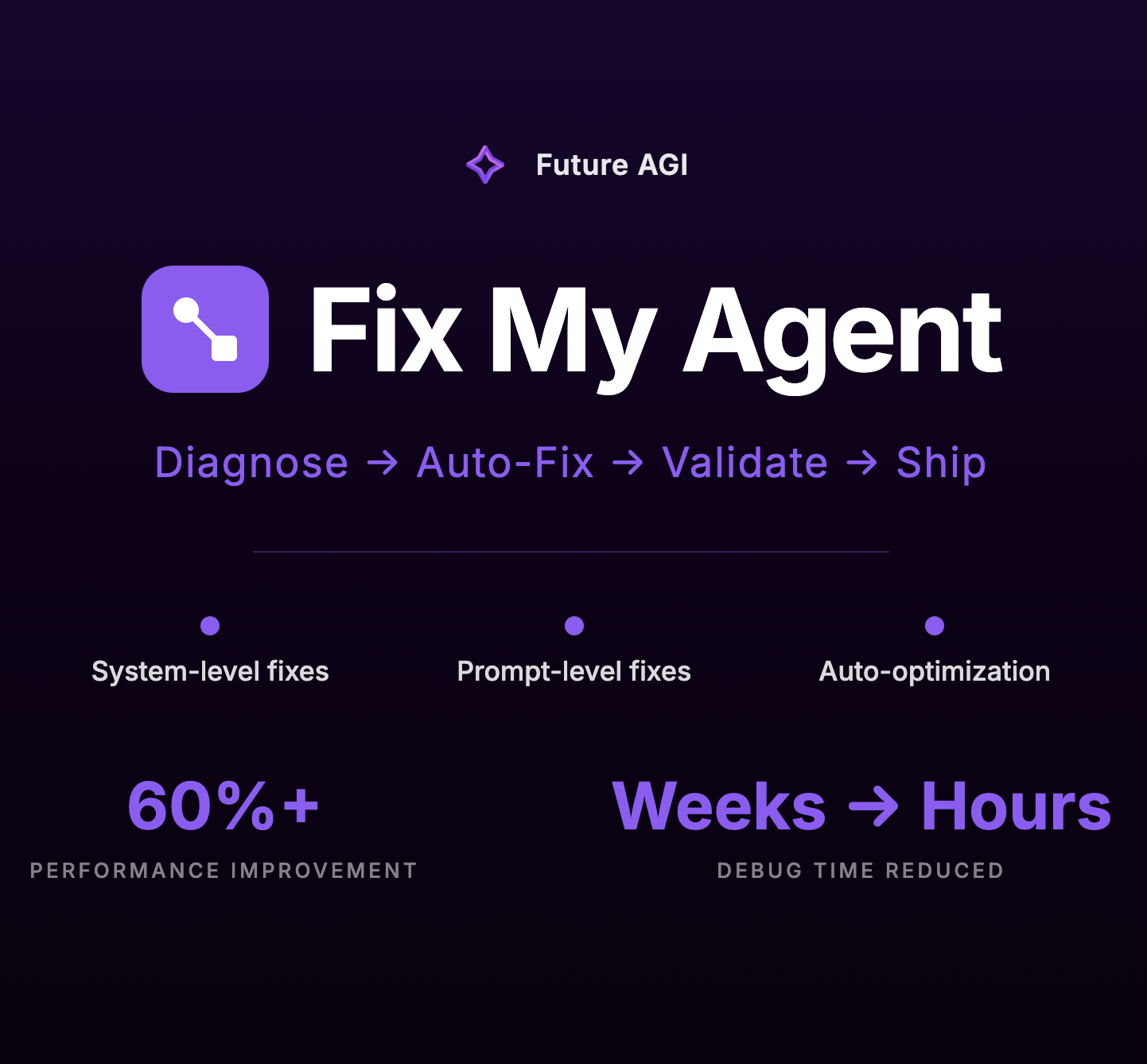
See what breaks your AI agent and fix it automatically
Jan 2026 · docs.futureagi.com · its alternatives →
- 16

We built an open sourced coordination layer for AI agents working on the same repository. Detects work duplication and design conflicts early
Aug 2026 · twing.dev · its alternatives →
- 17

Hi HN. I've been running AI coding agents (Claude Code, Codex, etc.) on real repos for a while now. The dirty secret of "autonomous coding" is that agents stop all the time — quota limits, test failures, policy violations, bad judgement calls. You end up babysitting them. So I asked a different question: what if the system was designed around the assumption that agents WILL fail, and the job of the infrastructure is to never let that failure become a dead end? openTiger is a "non-human-first" orchestration system that runs multiple AI agents in parallel — planner, workers, testers, judge —…
Feb 2026 · github.com · its alternatives →
- 18

An open-source cost controller for AI agent loops — stops a loop when it's actually converged and rolls back before it degrades, instead of running to a fixed max_iterations cap. Real-time loop-gain (Aβ) bands + best-so-far rollback. Adapters for LangGraph, CrewAI, AutoGen, LangChain, OpenAI Agents,
Jul 2026 · github.com · its alternatives →
- 19

We built meta-agent: an open-source library that automatically and continuously improves agent harnesses from production traces. Point it at an existing agent, a stream of unlabeled production traces, and a small labeled holdout set. An LLM judge scores unlabeled production traces as they stream. A proposer reads failed traces and writes one targeted harness update at a time, such as changes to prompts, hooks, tools, or subagents. The update is kept only if it improves holdout accuracy. On tau-bench v3 airline, meta-agent improved holdout accuracy from 67% to 87%. We open-sourced meta-agent.…
Apr 2026 · github.com · its alternatives →
- 20

Hello Folks! Agentic Orchestrator is a terminal tool that takes complex feature requests and builds them by orchestrating coding agents through a series of phases that emulate a full-fledged engineering flow: requirements clarification, research, design, multi-phase planning, implementation, and review. It is a single pane of glass for all your features and exposes post-publish utilities such as resolving merge conflicts and responding to review comments. The key design choice is that this is deterministic orchestration on top of undeterministic agents: things like "human review gates",…
Jun 2026 · github.com · its alternatives →
- 21

Improve results from AI agents by providing guidelines
2025 · tinytoolstack.com · its alternatives →
- 22

Coding agents are incredible, we use them every day. But the current wave of AI tooling has mostly handed engineers faster ways to yolo code into production. Th
Feb 2026 · wallfacer.ai · its alternatives →
- 23

Open Source Context Infrastructure for AI Agents
May 2026 · ravbyte-ai.github.io · its alternatives →
- 24

High-performance local AI coding agent for developers
Jun 2026 · uneven.dev · its alternatives →
Also compare
Ranked by how close each launch is in meaning, then by votes. Prices were read from each product’s own site when checked and can change. Refine with your own description →