Dev tools · alternatives · 2026

24 alternatives to Automated smooth Nth order derivatives of noisy data
This little project came about because I kept running into the same problem: cleanly differentiating sensor data before doing analysis. There are a ton of ways to solve this problem, I've always personally been a fan of using kalman filters for the job as its easy to get the double whammy of resampling/upsampling to a fixed consistent rate and also smoothing/outlier rejection. I wrote a little numpy only bayesian filtering/smoothing library recently (https://github.com/hugohadfield/bayesfilter/) so this felt like a fun and very useful first thing to…
This project provides automated computation of higher-order derivatives from noisy sensor data. It uses Kalman filtering to smooth data and remove outliers while simultaneously resampling to a consistent rate, built on… Below are 24 products that do a similar job, ranked by how close each is in meaning and then by launch-day votes. Automated smooth Nth order derivatives of noisy data launched in 2024; newer entries below may have overtaken it.
- 1

Trying to do gradient descent using automatic differentiation over branchy programs? Or to combine them with neural networks for end-to-end training? Then this might be interesting to you. We develped DiscoGrad, a tool for automatic differentiation through C++ programs involving input-dependent control flow (e.g., "if (f(x) < c) { ... }", differentiating wrt. x) and randomness. Our initial motivation was to enable the use of gradient descent with simulations, which often rely heavily on such discrete branching. The latter makes plain autodiff mostly useless, since it can only account for the…
2024 · github.com · its alternatives →
- 2

Arm neon optimization practice. Contribute to Ldpe2G/ArmNeonOptimization development by creating an account on GitHub.
2019 · github.com · its alternatives →
- 3

Experimental Global Optimization Algorithm. Contribute to chrisstroemel/Simple development by creating an account on GitHub.
2018 · github.com · its alternatives →
- 4

A Python toolkit for rule-based/unsupervised anomaly detection in time series - arundo/adtk
2019 · github.com · its alternatives →
- 5

Probabilistic data structures for processing continuous, unbounded streams. - tylertreat/BoomFilters
2015 · github.com · its alternatives →
- 6

A Python library for detecting patterns and anomalies in massive datasets using the Matrix Profile - target/matrixprofile-ts
2019 · github.com · its alternatives →
- 7

Optimal Quantile Approximation in Streams. Contribute to axiomhq/quantiles development by creating an account on GitHub.
2018 · github.com · its alternatives →
- 8

Turn arrays into smooth functions. Contribute to osuushi/Smooth.js development by creating an account on GitHub.
2012 · github.com · its alternatives →
- 9
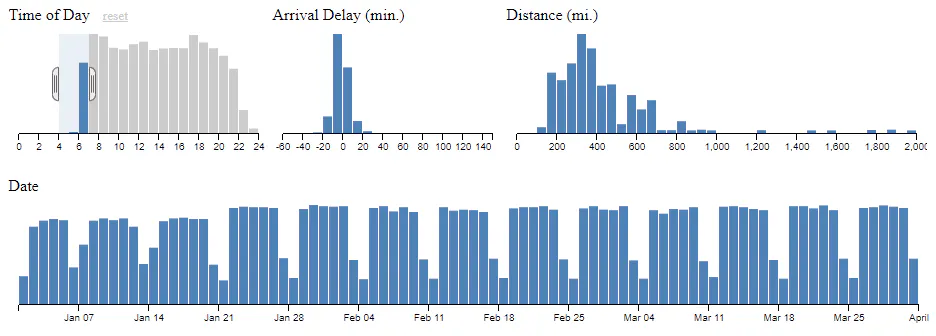 Crossfilter▲63
Fast multidimensional filtering for coordinated views
2018 · square.github.io · its alternatives →
- 10
 Marple▲86
Hi HN! I’m Nero from Marple, and we build time series tooling for Aerospace & Automotive. In 2020, we launched our first product: a sort of Grafana on steroids designed for high performance analysis. After integrating with a lot of different TS databases, we kept running into their design limits when trying to deliver the best performance & UX to our users. That’s why we are launching Marple DB today (https://www.marpledata.com/marple-db). Marple DB transforms measurements files (CSV, MAT, HDF5, TDMS, …) into a queryable lakehouse. We designed for extreme ingestion…
2022 · marpledata.com · its alternatives →
- 11

A beginners visual approach to Bayesian data analysis
2017 · amazon.com · its alternatives →
- 12

I wanted to record the aurora last weekend, but I only have a Blackmagic Design video camera which is clearly not made for this purpose. Recording a video of the night sky results in extreme noise to the point that you don't really see anything, so I wrote a tool to significantly reduce noise in such video recordings. Essentially it computes a moving average across video frames which significantly reduces the random sensor noise. This works because aurora changes very slowly, and it's roughly comparable to a long exposure time computed out of a video file where the individual frames have a…
2024 · github.com · its alternatives →
- 13

Hello everyone! I've been working on this project for a few months as part of my thesis in Machine Learning. It's meant to be a library that provides an easy-to-use but flexible API to design and train Diffusion Models. I decided to make it because I wanted to quickly prototype a Diffusion Model but there were no good tools to do it with. I think it really can help people prototype their own Diffusion Models a lot faster and only in a few lines of code. The base idea is to have a Model class that takes different modules corresponding to the different aspects of the Diffusion Model process…
2023 · github.com · its alternatives →
- 14

A stock backtesting engine written in Java. And a pairs trading (cointegration) strategy implementation using a bayesian kalman filter model - lukstei/trading-backtest
2016 · github.com · its alternatives →
- 15

This is a powerful online curve fitting tool that supports fitting dozens of commonly used functions and implicit functions. It features a clean interface and simple operation. If you need to perform curve fitting but don't want to learn professional software like Matlab or Origin, you can try this tool.
Nov 2025 · byx2000.github.io · its alternatives →
- 16

Read expert insights on synthetic data, data privacy, and modern software testing. Explore articles from Tonic.ai’s AI engineering team.
2022 · tonic.ai · its alternatives →
- 17

I've been working on deconvolution, a comprehensive Rust image deconvolution and restoration library. Deconvolution implements 28 different image deconvolution/restoration methods which range from practical blur removal techniques to research-grade scientific imaging algorithms. Features: - Top-level functions use image::DynamicImage and return images - Inverse filters, Wiener, Richardson-Lucy, constrained, proximal, Krylov, MLE restoration - Blind Richardson-Lucy, blind maximum likelihood, parametric PSF estimation - Kernel2D, Kernel3D, Transfer2D, Transfer3D, Blur2D/Blur3D -…
Jun 2026 · github.com · its alternatives →
- 18OE
2019 · observablehq.com · its alternatives →
- 19

Cuckoo Filter: Practically better than bloom filter - vedhavyas/cuckoo-filter
2017 · github.com · its alternatives →
- 20

Just small prototype showcasing diffusion models
2025 · github.com · its alternatives →
- 21

Hi, I've been working with other colleagues at University of Bristol for the last year to build an R-package that makes bayesian spatio-temporal modeling easy. That is, if you have some problem like predicting sea level rise over time, disease transmissions, etc., this package may be useful for you. It centers on a collection of Shiny apps that guide you through using the various pieces of spatio-temporal modeling packages like R-INLA or inlabru. Hopefully people find this useful. I think the nice part is that we really tried to design the package so you can add it to your modeling tool kit…
2023 · 4dmodeller.github.io · its alternatives →
- 22

I built sensor fusion for a mobile robot and reached for robot_localization like everyone does. After spending too long fighting navsat_transform, UTM zone boundaries, and YAML covariance tuning, I wrote my own. FusionCore is a 22 state UKF that fuses IMU, wheel encoders, and GPS in ECEF directly (no coordinate projection, no extra node). It estimates IMU bias, adapts its noise covariance automatically from the innovation sequence, and gates outliers with a chi squared test on every sensor. I benchmarked it against robot_localization EKF on 6 sequences from the NCLT public dataset…
Apr 2026 · github.com · its alternatives →
- 23

Timeseries Anomaly detection and Root Cause Analysis on data in SQL data warehouses and databases - cuebook/CueObserve
2021 · github.com · its alternatives →
- 24

Zero-cost epistemic uncertainty quantification & hallucination detection for LLMs (90,000x faster than Semantic Entropy) - Adarshent/Spnda
Sep 2026 · github.com · its alternatives →
Also compare
- Boldly go where Gradient Descent has never gone before with DiscoGrad alternatives
- C++ Implementation of the Paper Median Filter in Constant Time alternatives
- A radically more scalable alternative to Bayesian Optimization alternatives
- ADTK – new Python library for time series anomaly detection alternatives
- BoomFilters – Probabilistic data structures for processing streams alternatives
- Matrixprofile-ts – A Python library for timeseries motifs and discords alternatives
Ranked by how close each launch is in meaning, then by votes. Prices were read from each product’s own site when checked and can change. Refine with your own description →