AI · alternatives · 2026
24 alternatives to Backproto – network backpressure routing applied to AI agent payments
I’ve been applying backpressure routing (Tassiulas-Ephremides, 1992) to payment flows between AI agents. Streaming payment protocols let agents pay each other in real time, but there's no congestion control. When a downstream agent hits capacity, money keeps arriving. No reroute, no throttle, no feedback signal. TCP solved this for data networks. Agent payment networks haven’t. Backproto makes receiver-side capacity a protocol primitive. Agents stake tokens to declare capacity (concave sqrt cap makes Sybil splitting unprofitable), dual-signed completion receipts track actual performance, and…
Below are 24 products that do a similar job, ranked by how close each is in meaning and then by launch-day votes.
- 1

- 2OS
- 3

Hola HN! Long time lurker, sometimes commentor, first time poster here. I’ve been working alongside my two co-founders and a few colleagues on a project I’m excited (and a little nervous) to share with you all! Like many of us, I’ve lived a tortured existence with AI coding (is it vibes?) over the past few months - I think November was a big moment with this. But, one thing I’ve noticed after building orchestration layer after orchestration layer is that the thing I always came back to was “what the hell is Claude Code actually doing?” Perhaps it’s because of the time Claude Code got…
Jun 2026 · backplanes.com · its alternatives →
- 4
 delegare▲70
Hi guys, am building SecureLend.ai and when working on our underwriting agents (free trial, paid after) I had issues with seamless payment options. Of course I looked at x402 which I believe is a great protocol but not a fan of a) sharing private keys with the agent b) having a human in the loop or c) similar workaround e.g. pre-funded wallets So I started building out a solution. For my use case it was important to not only have stablecoins but also a fiat rail which is now implemented using Stripe. Initially I build a mandate system internally but am very glad and big shoutout to the guys…
Apr 2026 · delegare.dev · its alternatives →
- 5

New technology to maximize transaction approvals
2023 · akurateco.com · its alternatives →
- 6

Many teams connecting LLMs to external tools eventually encounter the same architectural issue: as more tools and agents are added, the integration pattern becomes an N×M mesh of direct connections. Each agent implements its own auth, retries, rate limiting, and logging; each tool needs credentials distributed to multiple places and observability becomes fragmented. We built LLM gateway with this goal to provide a single place to manage authentication, authorization, routing, and observability for MCP servers, with a path toward a more general agent-gateway architecture in the future. The…
Dec 2025 · truefoundry.com · its alternatives →
- 7

- 8

- 9

We built a model router that plugs into coding agents (e.g. Claude Code, Codex, Cursor, etc.) and intelligently sends requests to the best model to serve them. Here's a quick demo of running it locally: https://www.youtube.com/watch?v=isKhAyivtfM. At Weave, we write most of our code with AI, and it's been getting more expensive. This came to a head when Opus 4.7 was released and, thanks to its tokenizer changes, our costs shot up. We knew we didn't need Opus for everything but we didn't want to lose out on the intelligence for the cases where you really need it. So we decided…
Jun 2026 · github.com · its alternatives →
- 10

I think graph is a wrong abstraction for building AI agents. Just look at how incredibly hard it is to make routing using LangGraph - conditional edges are a mess. I built Laminar Flow to solve a common frustration with traditional workflow engines - the rigid need to predefine all node connections. Instead of static DAGs, Flow uses a dynamic task queue system that lets workflows evolve at runtime. Flow is built on 3 core principles: * Concurrent Execution - Tasks run in parallel automatically * Dynamic Scheduling - Tasks can schedule new tasks at runtime * Smart Dependencies - Tasks can…
2024 · github.com · its alternatives →
- 11
 IQ Routing▲100
Route every LLM call to the cheapest model that holds quality. Chatbots, RAG, agent loops, and finance. Cut spend 40 to 80 percent, measured on our own traffic, live in thirty seconds.
Aug 2026 · iq-routing.com · its alternatives →
- 12
 AgentReady▲118
Compression API that reduces prompt size by 40-60% before sending to your LLM. Your API key never leaves your environment.
Feb 2026 · agentready.cloud · its alternatives →
- 13TB
Hi HN, My team and I are building Tabstack to handle the "web layer" for AI agents. Launch Post: https://tabstack.ai/blog/intro-browsing-infrastructure-ai-ag... Maintaining a complex infrastructure stack for web browsing is one of the biggest bottlenecks in building reliable agents. You start with a simple fetch, but quickly end up managing a complex stack of proxies, handling client-side hydration, and debugging brittle selectors. and writing custom parsing logic for every site. Tabstack is an API that abstracts that infrastructure. You send a URL and an intent; we…
Jan 2026 · its alternatives →
- 14

The internet-native payment standard for AI agents
Mar 2026 · mpp.dev · its alternatives →
- 15
 TokenZip▲82
Open protocol for AI agents to share memory, not tokens
Mar 2026 · tokenzip.org · its alternatives →
- 16

- 17

A reverse proxy that detects recursive agent loops and enforces spend caps in volatile memory, without retaining prompt payloads.
17d ago · circuit-breaker-sage.vercel.app · its alternatives →
- 18
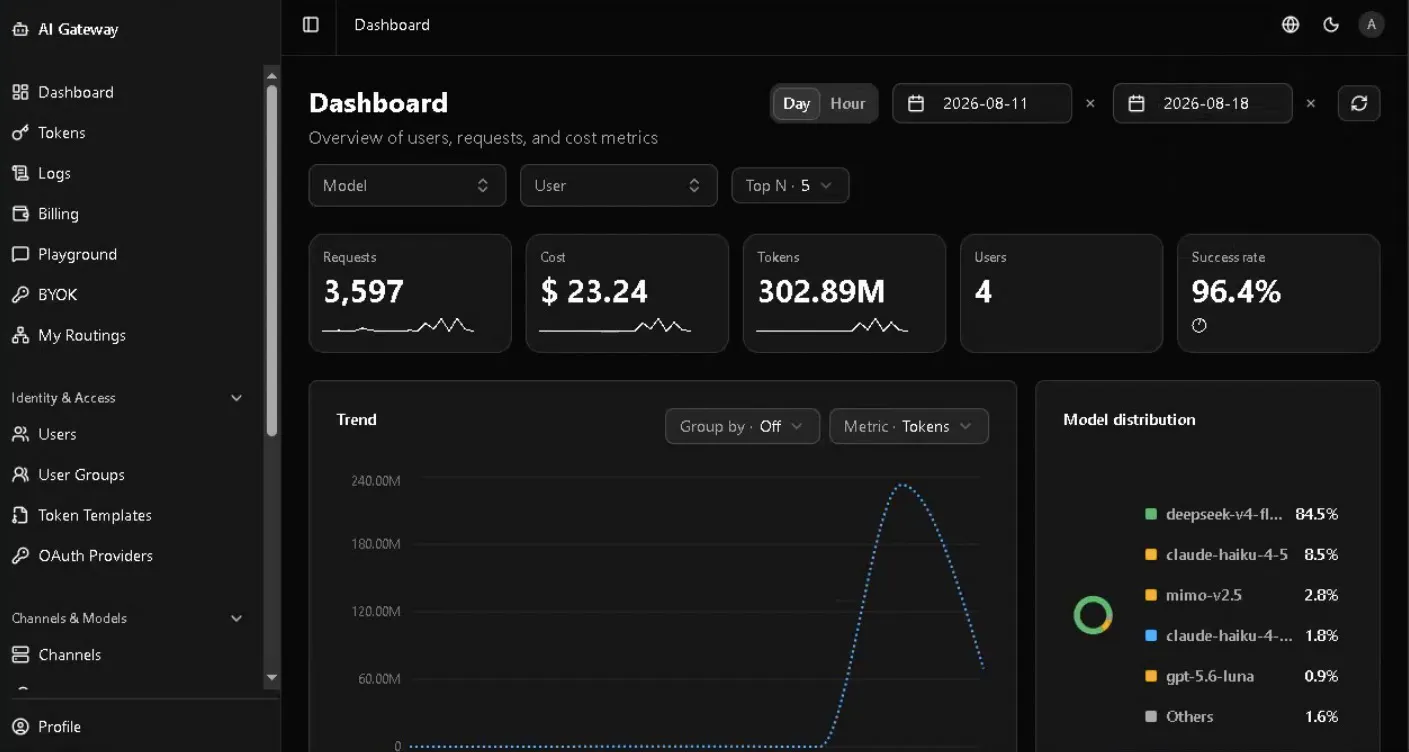
Lossless token compression reduces costs by 50%‑90%.
Aug 2026 · 154.12.86.206 · its alternatives →
- 19

I've been building https://routing24.com for a while, a free route optimization and planning app for businesses. One of the things that bothered me for quite a time is inability of browser agents to work with Routing24. We have tons of natural tasks for AI: - data ingestion, to figure out data coming from user's side (csv and Excel); - geocoding quality validation (to explain user what they need to correct and their addresses and how); - steep learning curve for business users (who have sense of what they want from route optimization, but setting up the model takes significant time…
Jul 2026 · github.com · its alternatives →
- 20

- 21
x402 commerce layer for AI agents — beyond raw HTTP payments
May 2026 · its alternatives →
- 22

ask an agent to buy something, and it hits a wall. Why?
Mar 2026 · github.com · its alternatives →
- 23PC
Hi HN, I’m Yahya, founder of Rocket Money (formerly Truebill, YC W16). I’m working with a team to launch Payloop, a lightweight infrastructure layer that helps teams understand the real costs of deploying AI agents - across tasks, workflows, and customers. Here's a quick demo: https://www.youtube.com/watch?v=Z-GkSl_7imY Most companies today can't see what it actually costs to deploy their agents, making it nearly impossible to manage margins or price confidently. Payloop solves this with an elegant approach: just a single line of code gives you real-time visibility into cost…
2025 · its alternatives →
- 24

We were spending a lot of time re-writing the same primitives in projects we were doing getting claude + codex + other harnesses communicating in real time. Many other projects forced us into using their framework or harness or into a specific stack. So we open sourced an SDK that acts as the messaging layer without the rest of it. Still early, but we've been working on it and found it useful.
Jun 2026 · github.com · its alternatives →
Also compare
Ranked by how close each launch is in meaning, then by votes. Prices were read from each product’s own site when checked and can change. Refine with your own description →