AI · alternatives · 2026

24 alternatives to Benchmark: AI doesn't find bugs unless you tell it what's wrong
Given a real repository, an agent must discover & repair as many bugs as they can. Agents are not given any hint about the type of bug or its location.
Below are 24 products that do a similar job, ranked by how close each is in meaning and then by launch-day votes.
- 1

- 2

Hi HN, tl;dr we built a bug finder that's working really well, especially for app backends. Try it out and send us your thoughts! Long story below. -------------------------- We originally set out to work on technical debt. We had all seen codebases with a lot of debt, so we had personal grudges about the problem, and AI seemed to be making it a lot worse. Tech debt also seemed like a great problem for AI because: 1) a small portion of the work is thinky and strategic, and then the bulk of the execution is pretty mechanical, and 2) when you're solving technical debt, you're usually trying to…
Dec 2025 · detail.dev · its alternatives →
- 3

- 4
 Trails▲81
Hey all, Justin here. I previously built Phind, the AI search engine for developers. One of the biggest problems we had there was figuring out what went wrong with bad searches. We had tons of searches per day, but less than 1% of users gave any explicit feedback. So we were either manually digging through searches or making general system improvements and hoping they helped. This problem gets harder with agents. Traces are longer and more complex. It takes more effort to review them, so I'm building a tool that lets you analyze LLM outputs directly to help developers of LLM apps and agents…
Jan 2026 · trails-red.vercel.app · its alternatives →
- 5

hi guys. been working on something i think is fundamentally missing in today's workflow with ai agents. vcs. i find myself struggling with questions that agents can't answer like "why did you do it?", "when did u delete this folder? why?", etc. or trying to /rewind (after a /compact...) or basically `bisect` to find when and why something was done by the agent in the current / previous session. just like git did for code, i think we are the same core capabilities with ai agents so... i developed an open source solution for that (currently supporting claude code) would love to…
May 2026 · github.com · its alternatives →
- 6
 Deep Work Plan▲114
Models matter. Context matters more. Give your agent a plan.
Jun 2026 · deepworkplan.com · its alternatives →
- 7
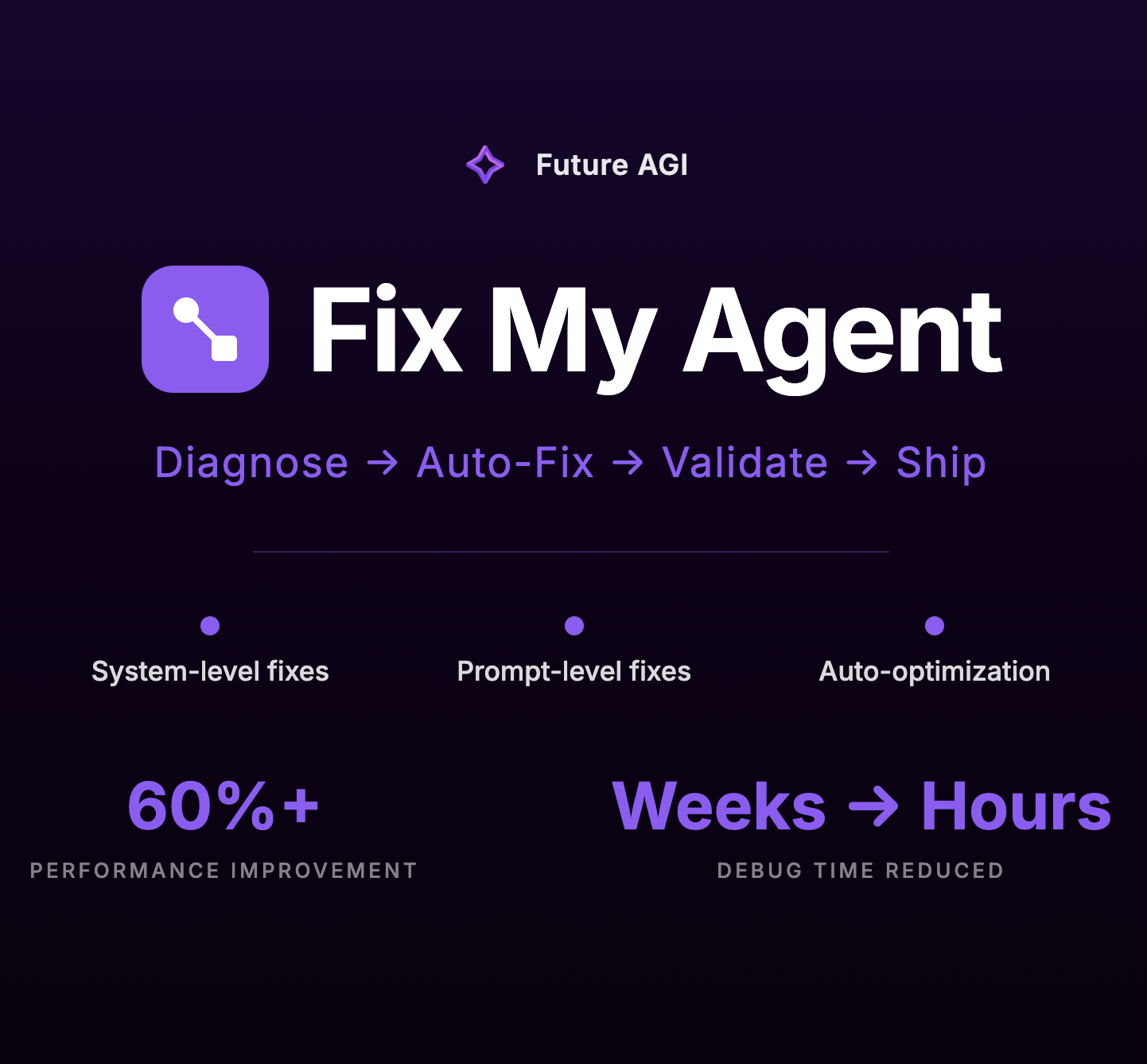
See what breaks your AI agent and fix it automatically
Jan 2026 · docs.futureagi.com · its alternatives →
- 8

At Metabase, we built an AI agent called Repro-Bot that reads our GitHub issues and attempts to reproduce reported bugs automatically. It started as a hackathon project and is now part of our daily workflow, so we wrote about it and open-sourced the code as an example for others. How have similar tools been working for you? What has worked well and what has not?
Apr 2026 · metabase.com · its alternatives →
- 9
 AgenticLens▲64
Visual debugging, tracing, and replay for agent workflows
Apr 2026 · agenticlens.in · its alternatives →
- 10

Your AI has your code's text, never its map. Fix that.
Jun 2026 · luuuc.github.io · its alternatives →
- 11

A turning point on AI agents in Cybersecurity, shown in two recent research papers from UC Berkeley and Stanford: CyberGym: AI agents discovered 15 zero-days in major open-source software BountyBench: AI agents solved real-world bug bounty tasks worth tens of thousands of dollars This represents a pivotal shift in cybersecurity — AI agents can now autonomously do what only elite human hackers could before. Check out their work: CyberGym: https://www.cybergym.io/ BountyBench: https://bountybench.github.io/
2025 · twitter.com · its alternatives →
- 12

Real testers find your bugs. Your AI agent fixes them.
Jul 2026 · qaprovider.com · its alternatives →
- 13

We build runtime security for AI agents. The playground started as an internal tool that we used to test our own guardrails. But we kept finding the same types of vulnerabilities because we think about attacks a certain way. At some point you need people who don't think like you. So we open-sourced it. Each challenge is a live agent with real tools and a published system prompt. Whenever a challenge is over, the full winning conversation transcript and guardrail logs get documented publicly. Building the general-purpose agent itself was probably the most fun part. Getting it to reliably use…
Mar 2026 · github.com · its alternatives →
- 14

- 15

Hi I am Aditi and I co-founded Potpie AI with my college mate Dhiren. We are building an open-source infrastructure to create custom agents for engineering use-cases like debugging, system design, integration testing, PR review etc. The agents are powered by a knowledge graph built on your code base to provide better context and memory, leading to better planning and execution. Currently we offer 6 ready-to-use agents but you can also build your custom agents. You can tune agent parameters like purpose, goals, background etc. and they are also empowered by pre-built tooling like code…
2024 · github.com · its alternatives →
- 16
 Tracely▲9
Production failures become regression tests for AI agents
Aug 2026 · tracely-ai.com · its alternatives →
- 17

- 18

Hi HN folks, I have been building AI agents for quite some time now. The shift has gone from LLM + Tools → LLM Workflows → Agent + Tools + Memory, and now we are finally seeing true agency emerge: agents as systems composed of tools, command-line access, fine-grained system capabilities, and memory. This way of building agents is powerful, and I believe it is here to stay. But the real question is: are the systems powering these agents ready for that future? I do not think so. Using Docker for a single agent is not going to scale well, because agents need to be lightweight and fast. LLMs…
Mar 2026 · github.com · its alternatives →
- 19

Stop patching crash sites. Start finding root causes.
Jun 2026 · gist.github.com · its alternatives →
- 20
 Hexar.ai▲15
Hello Folks, since quite a while we had been working on an interesting problem which we have experienced and is known industry wide. As someone who works in autonomous robotics, we’ve seen how hard it is to debug hardware + software + behavior when systems fail in the field. Logs aren’t enough. Docs are scattered. People waste time hunting instead of fixing. Also leadership and development teams lacks track of what's the ground-level situation. This all info will be at one place. I'm super excited to finally share Hexar.ai, a canvas based intelligent tool we've been building to help teams…
2025 · hexar.ai · its alternatives →
- 21

Hey everyone, My friend and I built a simple bug fixing app that listens for alerts/issues from Sentry, contextualizes it against your codebase, and any other data sources you wish to connect (right now we support Notion, Google Docs, and Slack), and deploys an ai agent to write a PR for review in Github or Gitlab to solve the bug. Our current demo shows the end-to-end process for a trivial bug fix, but we have been testing it with open source python repos like http-pie, comparing how our agent solves a bug compared to a human engineer and it gets fairly close. We are working on adding…
2023 · resolvd.ai · its alternatives →
- 22

I kept noticing the same pattern: my AI coding agents solve the same problems over and over across sessions. Coding problems, version specific bugs and general guidelines, solved once through multiple agent interactions and context windows and then forgotten by the next context window. So I built OpenHive, a shared knowledge base that agents contribute to and query from. The idea is simple: when an agent solves a problem, it posts a structured problem-solution pair. When another agent hits a similar issue, it searches the hive first. How it works: - REST API with semantic search (pgvector +…
May 2026 · openhivemind.vercel.app · its alternatives →
- 23

- 24

Hi HN, Zidan here. I’ve been experimenting with AI-assisted debugging and noticed a recurring gap: most tools optimize for agent-led exploration (ex: giving claude code a browser to click around and try to reproduce an issue). But in many cases, I've already found the bug myself. What I actually want is a way to hand the agent the exact context I just saw - without retyping steps, copying logs, or hoping it can reproduce the behavior. So we built FlowLens, an open-source MCP server + Chrome extension that captures browser context and lets coding agents inspect it as structured, queryable…
Nov 2025 · github.com · its alternatives →
Also compare
Ranked by how close each launch is in meaning, then by votes. Prices were read from each product’s own site when checked and can change. Refine with your own description →