AI · alternatives · 2026

24 alternatives to Cogency – Cognitive Architecture for AI Agents
Yesterday I built something that probably shouldn’t exist yet. In 9 hours, I created a cognitive architecture demonstrating emergent reasoning. It follows a 5-step loop: Plan → Reason → Act → Reflect → Respond. Adding a WebSearchTool to test extensibility, the agent initially failed its first search, reflected on poor results, adapted its query, and then succeeded. This behavior wasn’t programmed; it emerged naturally from the architecture. Five hours later, I integrated a FileManagerTool — it worked on the first try. Like code compiling first time, except this was intelligence composing…
Cogency is a cognitive architecture for building AI agents that separates reasoning from tool management. It operates on a five-step loop—Plan, Reason, Act, Reflect, Respond—enabling agents to adapt their behavior… Below are 24 products that do a similar job, ranked by how close each is in meaning and then by launch-day votes. Prices are shown for the 1 we have checked on their own sites, 1 of them free or with a free tier.
- 1AP
One memory, not one per tool. Cog gives AI agents a shared, structured memory layer using plain-text files — portable across Claude Code, Codex, Cursor, Gemini CLI, Windsurf, Copilot, and more.
Mar 2026 · lab.puga.com.br · its alternatives →
- 2
 Coval▲1,012
Simulation & evals to ship delightful voice & chat AI agents
2024 · coval.ai · its alternatives →
- 3

- 4
 Emergent▲582
Advanced AI app builder that ships full-stack apps
2025 · app.emergent.sh · its alternatives →
- 5

- 6
 CogniMemo▲120
AI that remembers, learns, and evolves
Dec 2025 · app.cognimemo.com · its alternatives →
- 7

Hi all, I'm Peter at Staff Engineer and Mozilla.ai and I want to share our idea for a standard for shared agent learning, conceptually it seemed to fit easily in my mental model as a Stack Overflow for agents. The project is trying to see if we can get agents (any agent, any model) to propose 'knowledge units' (KUs) as a standard schema based on gotchas it runs into during use, and proactively query for existing KUs in order to get insights which it can verify and confirm if they prove useful. It's currently very much a PoC with a more lofty proposal in the repo, we're trying to iterate from…
Mar 2026 · blog.mozilla.ai · its alternatives →
- 8
 Cognitorafree▲86
Built a multi-agent research system with OpenAI Agents SDK where specialized AI agents collaborate autonomously: Master Orchestrator → Data Analyst → Statistician → Report Writer Each agent has specific expertise. The orchestrator delegates tasks. All agents can execute code securely to solve problems. Example workflow: "Analyze e-commerce data" - Data Analyst: writes Python to load/clean data, spots trends - Statistician: performs significance tests, calculates growth rates - Report Writer: synthesizes findings into executive summary This demonstrates OpenAI Agents SDK's handoff system…
2025 · cognitora.dev · its alternatives →
- 9

- 10
 Cohesor▲78
A neutral control plane for enterprise AI agents
Aug 2026 · cohesor.com · its alternatives →
- 11

- 12
 Cognitia▲37
AI companion that remembers, learns, and grows with you
2025 · cognitia-ai.com · its alternatives →
- 13

- 14

- 15

Hi HN, I'm the creator of this project. For the past months, I've been working on building an AI agent that could move beyond simple generation and tackle inventive challenges autonomously. The core idea was to create a system with a "metacognitive loop"—the ability to recognize when it's stuck on a fundamental problem and then launch a sub-mission to solve that specific bottleneck before continuing. The linked article is a deeper introduction to the system's architecture and a snapshot from a recent run. I tried to design it to be evidence-grounded and self-critical to avoid the pitfalls of…
2025 · robw1se.substack.com · its alternatives →
- 16
- 17NC
Most orchestration frameworks today still behave like fragile chains — they break when faced with contradictions, long-term memory, or dynamic routing. Neuron is a cognitive multi-agent architecture that thinks in circuits instead of chains. Multiple agents collaborate in parallel, adapt their pathways in real time, and keep persistent context across extended interactions. Key components Agents: Intake, Reasoning, Response, Memory Circuits: Dynamic routing instead of linear chaining Memory: Episodic + contextual persistence Monitoring: Full reasoning traces for observability Why it matters…
2025 · its alternatives →
- 18
 Co-Op▲30
AI is in a weird place right now. Technical people marvel over it while non-technical people don't really care. So we built Co-Op, an app specifically designed for non-technical people to run AI agents without needing a Mac Mini or laptop running 24/7. Your agents run throughout the day and complete real work across your most important apps, no code required. For me, this looks like a daily notification with my unread emails across Outlook, Gmail, and any other inbox, the weather, commute time, flight prices I'm monitoring, and the news. But it goes way beyond that. Our agents can build…
Jan 2026 · co-op.software · its alternatives →
- 19

Visualize topology. Trace reasoning. Illuminate complexity
May 2026 · cognilumin.com · its alternatives →
- 20

Abstract page for arXiv paper 2601.14351: If You Want Coherence, Orchestrate a Team of Rivals: Multi-Agent Models of Organizational Intelligence
Jan 2026 · arxiv.org · its alternatives →
- 21BA
I'm one of the creators of The Edge Agent (TEA). We built this because we needed a way to deploy agents that was verifiable and robust enough for production/edge cases, moving away from loose scripts. The architecture aims to solve critical gaps in deterministic orchestration identified by *Prof. Claudionor Coelho Jr. (Stanford alum, ML/DL Faculty at Santa Clara Univ., and Senior Fellow for AI at Majestic Labs)* during our work on the Kiroku project. *Key Technical Features:* * *Neurosymbolic Native:* We integrated Prolog to logically validate LLM outputs. This combines neural…
Jan 2026 · fabceolin.github.io · its alternatives →
- 22
- 23
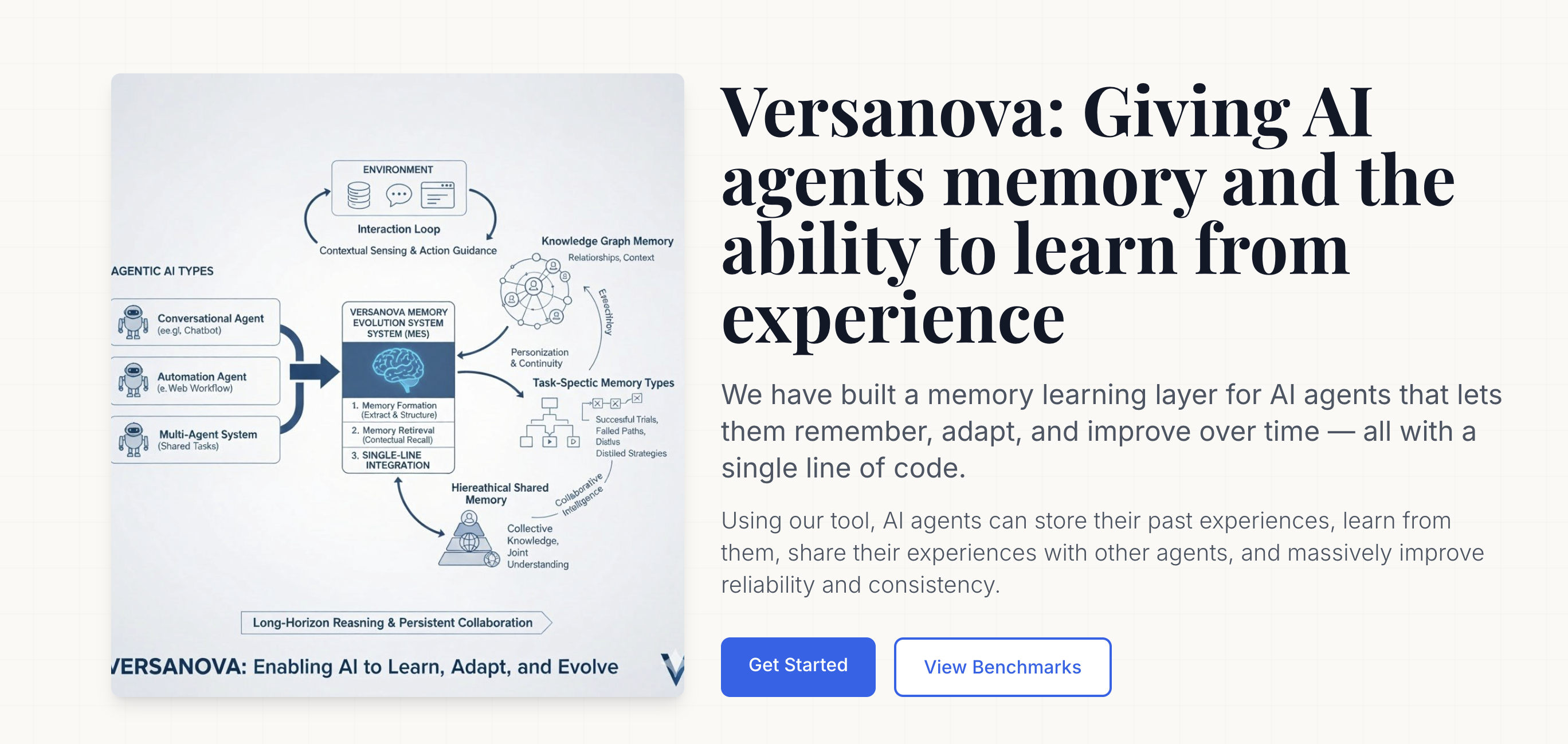
Versanova builds agent societies—systems of AI agents that collaborate, debate, and learn over time. Starting with autonomous stock research that delivers deeper insights through multi-agent collaboration powered by our proprietary memory layer.
Jan 2026 · versanovatech.com · its alternatives →
- 24


Also compare
Ranked by how close each launch is in meaning, then by votes. Prices were read from each product’s own site when checked and can change. Refine with your own description →