Dev tools · alternatives · 2026

24 alternatives to Frugal Tokens – explore costs and usage across coding agents
I wanted to share a project I’ve been working on called Frugal Tokens. I originally built it because I was curious to see how much all of my sessions cost and how much cache misses affected that spend. I’d noticed people had widely different spend profiles and wanted to better understand what might contribute to that. As I’ve worked on this, the tool has grown to show more usage patterns across all of your sessions. It shows overall usage, estimated working time and overlapping sessions, and where your spend is coming from across models and cache misses. I also have a few session level…
Frugal Tokens is a cost analysis tool for developers using coding agents. It tracks spending across AI model sessions, showing overall usage, estimated working time, and breaks down expenses by model type and cache… Below are 24 products that do a similar job, ranked by how close each is in meaning and then by launch-day votes.
- 1

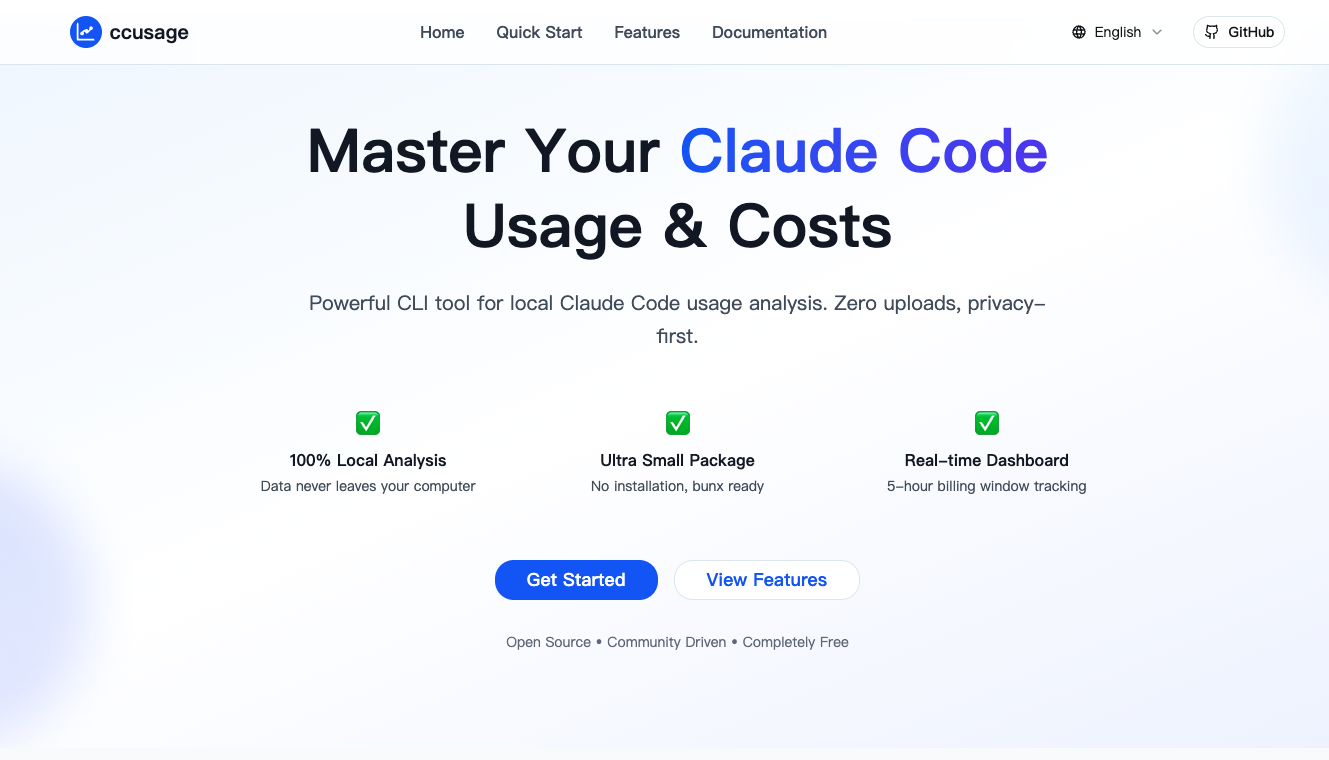
Built this after realizing I was spending ~$1400/week on Claude Code with almost no visibility into what was actually consuming tokens. Tools like ccusage give a cost breakdown per model and per day, but I wanted to understand usage at the task level. CodeBurn reads the JSONL session transcripts that Claude Code stores locally (~/.claude/projects/) and classifies each turn into 13 categories based on tool usage patterns (no LLM calls involved). One surprising result: about 56% of my spend was on conversation turns with no tool usage. Actual coding (edits/writes) was…
Apr 2026 · github.com · its alternatives →
- 2

Hey HN! Tokencost is a utility library for estimating LLM costs. There are hundreds of different models now, and they all have their own pricing schemes. It’s difficult to keep up with the pricing changes, and it’s even more difficult to estimate how much your prompts and completions will cost until you see the bill. Tokencost works by counting the number of tokens in prompt and completion messages and multiplying that number by the corresponding model cost. Under the hood, it’s really just a simple cost dictionary and some utility functions for getting the prices right. It also accounts for…
2024 · github.com · its alternatives →
- 3

I started leaning in on AI heavily this year, as I wanted to get more done autonomously, but then my token usage climbed dramatically to the point where my weekly quota would run out before the end of the week, sometimes a couple of days into the week. I realised I had to do something about it else I'd have to double my spend. So I decided to start tracking my cost per task type. This revealed that a lot of my spend went to searches/scans or simple things like scouting tasks. I then decided to turn this into a simple CLI tool that can be used to read your OpenAI-style logs locally, and…
Jul 2026 · github.com · its alternatives →
- 4
 TokenCounter▲117
Count tokens and estimate costs for any AI model
2024 · tokencounter.co · its alternatives →
- 5
 Toolspend▲377
Track AI spend, usage, and cost across tools
Feb 2026 · toolspend.com · its alternatives →
- 6

- 7
 CodeBurn▲103
See where your AI coding spend actually goes
Aug 2026 · codeburn.app · its alternatives →
- 8

See exactly how much you spend on Claude, across every tool
Mar 2026 · github.com · its alternatives →
- 9

Some technical context on what we ran into building this. MCP tools don't really work for financial data at scale. One tool call for five years of daily prices dumps tens of thousands of tokens into the context window. And data vendors pack dozens of tools into a single MCP server, schemas alone can eat 50k+ tokens before the agent does anything useful. So we auto-generate typed Python modules from the MCP schemas at workspace init and upload them into the sandbox. The agent just imports them like a normal library. Only a one-line summary per server stays in the prompt. We have around 80…
Apr 2026 · github.com · its alternatives →
- 10
- 11

I use Claude Code, Codex and Cursor (and sometimes Antigravity) basically every day, and could never tell how much I was actually consuming across all of them. So I built TokenMaxxer. A small CLI reads the files these tools already write locally and puts it all in one dashboard, broken out by tool, model, provider and day. It covers 18 tools now, and you get a profile page with your daily activity, cost estimates, and your top models and tools. There's also a global leaderboard if you want to compete against other TokenMaxxers! I'd love to see if anyone can beat the first place (currently…
Aug 2026 · tokenmaxxer.xyz · its alternatives →
- 12

Ask Claude Code where your usage went. Token audit, limit diagnosis and usage forensics — built from the session logs already on your machine, nothing leaves it. - kelviq/tare
Aug 2026 · github.com · its alternatives →
- 13

I code on Claude's pay as you go API and started budgeting my token usage with my own CLI wrapper. Basically I set a budget for a task that I'm working on in my project: Task: "Fix mobile responsiveness" Budget: $3.00 and the budget updates after each prompt: Task: "Fix mobile responsiveness" Budget: $2.34 / $3.00 78% It helps keep an eye on my spending when working on projects.
May 2026 · github.com · its alternatives →
- 14

Hi HN, I was once given the advice: Don't waste expensive frontier model credits (GPT/Claude/etc.) on bulk work. Send the boring, repetitive, high-volume jobs to a smaller model, and save the expensive prompts for when you actually need frontier-level reasoning. I complained and told my manager that I shouldnt have to think about using certain models for certain coding tasks, and that one model should handle everything. Well, here we are anyway. If anyone needs a place to absolutely abuse an LLM with high-volume tasks, come beat ours up at https://yolo-auto.com. Here are…
Jul 2026 · yolo-auto.com · its alternatives →
- 15

Usage, cost, and behavior tracking for AI coding agents
Jul 2026 · tokenbasehq.com · its alternatives →
- 16

Hi HN, I'm building Librarian (https://uselibrarian.dev/), an open-source (MIT) context management tool that stops AI agents from burning tokens by blindly re-reading their entire conversation history on every turn. The Problem: If you're building agentic loops in frameworks like LangGraph or OpenClaw, you hit two walls fast: Financial Cost: Token usage scales quadratically over long conversations. Passing the whole history every time gets incredibly expensive. Context Rot: As the context window fills up, the LLM suffers from the "Lost in the Middle" effect. Response latency…
Feb 2026 · uselibrarian.dev · its alternatives →
- 17

I use multiple AI tools for work and also my side projects, and the annoying part was to track my costs and token usage across tools. Everytime I had to visit each tool and its respective usage setting to check it and I was losing patience and also was getting hit by surprise limits Now I know that there are already free/open-source trackers for Cursor or Claude usage, and they are useful if that is all you need. My problem is broader as I wanted one small place to see tokens, spend, subscriptions and limits across the AI tools I actually use. I was really tired of switching tabs and…
Jul 2026 · lifehacksgermany.com · its alternatives →
- 18
 delegare▲70
Hi guys, am building SecureLend.ai and when working on our underwriting agents (free trial, paid after) I had issues with seamless payment options. Of course I looked at x402 which I believe is a great protocol but not a fan of a) sharing private keys with the agent b) having a human in the loop or c) similar workaround e.g. pre-funded wallets So I started building out a solution. For my use case it was important to not only have stablecoins but also a fiat rail which is now implemented using Stripe. Initially I build a mandate system internally but am very glad and big shoutout to the guys…
Apr 2026 · delegare.dev · its alternatives →
- 19IB
Hey HN: I'm Kaveh, the founder of Usage (https://www.usage.ai/) We help companies drive down AWS costs. Why? Because the way it's done now is a pain. Stakeholders, especially engineers, are required to spend unnecessary time manually finding underutilized or overly expensive EC2s. We believe the optimization process should be done automatically through a series of sophisticated algorithms. At the moment, there are over 70,000 AWS EC2 prices - doing that manually just won't scale at most organizations. My background is in software engineering. Previous to founding Usage, I…
2020 · its alternatives →
- 20

Hey HN - there are lots of tools to understand how many tokens you use and how much it costs, but we haven't found any that tell you where those tokens are going! Decant helps you understand what you are spending tokens on (context gathering, planning, code, chat, etc), so you can optimize it.
Aug 2026 · github.com · its alternatives →
- 21

- 22

Hi HN! Token cost has started to become a high topic of concern to all of us. I tried a few (awesome) tools such as rtk, caveman, and the recent (hillarious but effective) ponytail. What they usually do, is in-line token reduction, e.g. try to compress requests / responses as much as possible. But then it hit me (and I’m sure others had similar ideas) - just like we have routers that pick the right model, why not have something that will also narrow down the amount of available tools, skills and mcps based on repo/context? People usually accumulate skills, agents, MCP servers,…
Jun 2026 · github.com · its alternatives →
- 23IN
Tl;dr: I trained a classifier to route to the least expensive model and reasoning depth to complete the request. Coupling that with additional automated token efficiency techniques has yielded 3x usage for the same spend. For anyone interested in trying it themselves: https://nerfguard.com Various teammates and I switched over to Codex from Claude Code recently. We still bounce between the tools, but Codex’s speed and steerability coupled with performance gains were hard to ignore. One of the downsides was that the per token pricing kicked in way sooner. This is happening across…
Jun 2026 · its alternatives →
- 24

See what your AI coding agents think, cost and do
Jul 2026 · tokentelemetry.com · its alternatives →
Also compare
Ranked by how close each launch is in meaning, then by votes. Prices were read from each product’s own site when checked and can change. Refine with your own description →