AI · alternatives · 2026

24 alternatives to Tokenbase
Usage, cost, and behavior tracking for AI coding agents
Below are 24 products that do a similar job, ranked by how close each is in meaning and then by launch-day votes.
- 1
 The New Waydev▲299
Measure the full AI SDLC. From token to production.
Apr 2026 · waydev.co · its alternatives →
- 2
 Agentmemory▲310
Persistent memory for Claude Code, Codex & coding agents
May 2026 · agent-memory.dev · its alternatives →
- 3
 Replicas▲239
Hey HN! I'm Connor, creator of Replicas. I'm a heavy Codex/Claude Code user, and I wanted to hand off tasks to agents like I would to an engineer - kick something off before work, let it scaffold while I'm at lunch, even come back to a ready PR. The problem: existing alternatives use workspace VMs that are black boxes. I have no access to any of them - they can't run tests, read logs, or use tools like the Playwright MCP (which I use to verify agents actually fixed what they claim to fix). Replicas gives agents real cloud workspaces where they can: - Run your test suite and read the…
Jun 2026 · replicas.dev · its alternatives →
- 4

- 5
 AgentGrid▲77
Hi HN, I’m Michael, I built AgentGrid with my friend Souren because we were tired of losing our coding sessions and couldn't keep track of what was actually being built across our many projects. Our approach was to use an infinite canvas desktop app for the TUIs we already know and love, mainly claude + codex. We drew inspiration from Figma and Railway. Overtime we added image nodes, notes, terminals, coding editors, source control, etc. I wasn't sure about it at first. It took me a month to give the first version Souren built a real try. What got me was an Apple System Update I've been…
Jul 2026 · agentgrid.sh · its alternatives →
- 6

See what your AI coding agents think, cost and do
Jul 2026 · tokentelemetry.com · its alternatives →
- 7
 Polygraph▲160
Let AI agents see cross repo and maintain session memory.
Jun 2026 · trypolygraph.com · its alternatives →
- 8

hi guys. been working on something i think is fundamentally missing in today's workflow with ai agents. vcs. i find myself struggling with questions that agents can't answer like "why did you do it?", "when did u delete this folder? why?", etc. or trying to /rewind (after a /compact...) or basically `bisect` to find when and why something was done by the agent in the current / previous session. just like git did for code, i think we are the same core capabilities with ai agents so... i developed an open source solution for that (currently supporting claude code) would love to…
May 2026 · github.com · its alternatives →
- 9

I wanted to share a project I’ve been working on called Frugal Tokens. I originally built it because I was curious to see how much all of my sessions cost and how much cache misses affected that spend. I’d noticed people had widely different spend profiles and wanted to better understand what might contribute to that. As I’ve worked on this, the tool has grown to show more usage patterns across all of your sessions. It shows overall usage, estimated working time and overlapping sessions, and where your spend is coming from across models and cache misses. I also have a few session level…
Aug 2026 · demo.frugaltokens.com · its alternatives →
- 10
 TokenCounter▲117
Count tokens and estimate costs for any AI model
2024 · tokencounter.co · its alternatives →
- 11
 CodeBurn▲103
See where your AI coding spend actually goes
Aug 2026 · codeburn.app · its alternatives →
- 12

- 13

Built this after realizing I was spending ~$1400/week on Claude Code with almost no visibility into what was actually consuming tokens. Tools like ccusage give a cost breakdown per model and per day, but I wanted to understand usage at the task level. CodeBurn reads the JSONL session transcripts that Claude Code stores locally (~/.claude/projects/) and classifies each turn into 13 categories based on tool usage patterns (no LLM calls involved). One surprising result: about 56% of my spend was on conversation turns with no tool usage. Actual coding (edits/writes) was…
Apr 2026 · github.com · its alternatives →
- 14
 AgenticLens▲64
Visual debugging, tracing, and replay for agent workflows
Apr 2026 · agenticlens.in · its alternatives →
- 15

Hey HN, I’m Henry, cofounder and CTO at Span (https://span.app/). Today we’re launching AI Code Detector, an AI code detection tool you can try in your browser. The explosion of AI generated code has created some weird problems for engineering orgs. Tools like Cursor and Copilot are used by virtually every org on the planet – but each codegen tool has its own idiosyncratic way of reporting usage. Some don’t report usage at all. Our view is that token spend will start competing with payroll spend as AI becomes more deeply ingrained in how we build software, so understanding how…
2025 · code-detector.ai · its alternatives →
- 16

- 17
 Skilled▲76
Dashboard to find agent skills you no longer need
May 2026 · github.com · its alternatives →
- 18
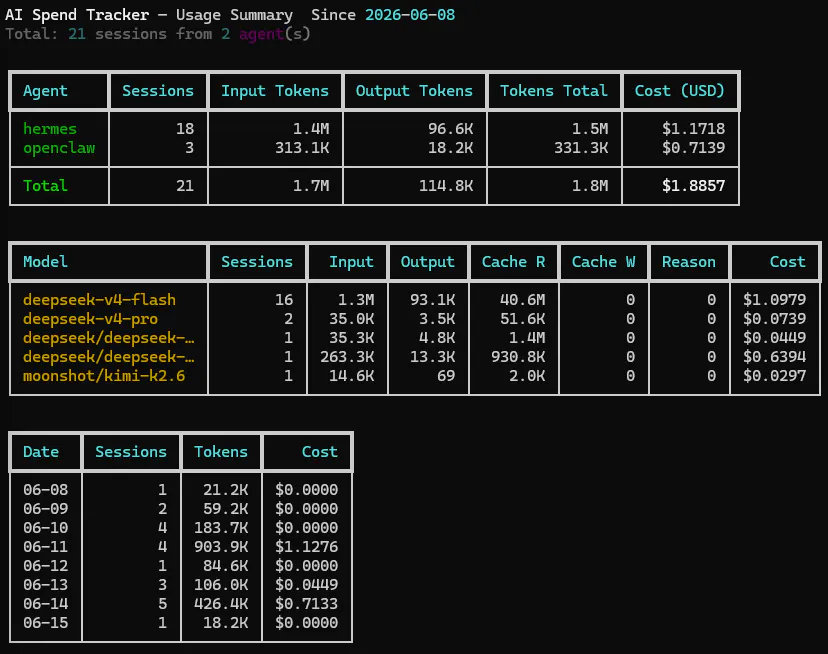
oken-usage , cost-tracking , ai-coding-agent
Jun 2026 · pypi.org · its alternatives →
- 19
 Vexp▲14
I built vexp because AI coding agents have two expensive problems: they waste tokens reading irrelevant code, and they forget everything between sessions. The token problem: agents read entire files linearly to build context. On a medium TypeScript project, a single query was consuming ~18k tokens — most of it irrelevant. vexp builds a dependency graph from the AST (who calls what, who imports what, what types flow where) and serves only the relevant subgraph as a token-budgeted capsule. ~2.4k tokens instead of ~18k, with better response quality because the context is precise. The memory…
Mar 2026 · vexp.dev · its alternatives →
- 20
 agentfdr▲12
See why your coding agent looped, drifted, or burned tokens
Jul 2026 · kamihork.github.io · its alternatives →
- 21

Your AI has your code's text, never its map. Fix that.
Jun 2026 · luuuc.github.io · its alternatives →
- 22

Hi HN, we're Kiran and Vijay! Over the past two years, we have built a columnar storage engine for observability: logs, metrics, and traces. Today, it's exciting for us to show what we've built on top of that foundation: LLM Agent Observability. Given how non-deterministic agents are, storing all traces without sampling was critical for us. But these traces tend to be in the MBs, sometimes GBs - we needed to store them inexpensively. We also needed the queries and analyses to be fast. To meet both these goals, we store them in S3 in our own parquet-like file format, and query them using AWS…
Jul 2026 · oodle.ai · its alternatives →
- 23IN
Tl;dr: I trained a classifier to route to the least expensive model and reasoning depth to complete the request. Coupling that with additional automated token efficiency techniques has yielded 3x usage for the same spend. For anyone interested in trying it themselves: https://nerfguard.com Various teammates and I switched over to Codex from Claude Code recently. We still bounce between the tools, but Codex’s speed and steerability coupled with performance gains were hard to ignore. One of the downsides was that the per token pricing kicked in way sooner. This is happening across…
Jun 2026 · its alternatives →
- 24

I use Claude Code, Codex and Cursor (and sometimes Antigravity) basically every day, and could never tell how much I was actually consuming across all of them. So I built TokenMaxxer. A small CLI reads the files these tools already write locally and puts it all in one dashboard, broken out by tool, model, provider and day. It covers 18 tools now, and you get a profile page with your daily activity, cost estimates, and your top models and tools. There's also a global leaderboard if you want to compete against other TokenMaxxers! I'd love to see if anyone can beat the first place (currently…
Aug 2026 · tokenmaxxer.xyz · its alternatives →
Also compare
Ranked by how close each launch is in meaning, then by votes. Prices were read from each product’s own site when checked and can change. Refine with your own description →