AI · alternatives · 2026

24 alternatives to Jido 2.0, Elixir Agent Framework
Hi HN! I'm the author of an Elixir Agent Framework called Jido. We reached our 2.0 release this week, shipping a production-hardened framework to build, manage and run Agents on the BEAM. Jido now supports a host of Agentic features, including: - Tool Calling and Agent Skills - Comprehensive multi-agent support across distributed BEAM processes with Supervision - Multiple reasoning strategies including ReAct, Chain of Thought, Tree of Thought, and more - Advanced workflow capabilities - Durability through a robust Storage and Persistence layer - Agentic Memory - MCP and Sensors to interface…
Jido 2.0 is an Elixir agent framework for building and running autonomous agents on the BEAM virtual machine. It provides tool calling, multi-agent coordination across distributed processes, multiple reasoning… Below are 24 products that do a similar job, ranked by how close each is in meaning and then by launch-day votes.
- 1

Hi HN! I'm Mike Hostetler and I built Jido, an Agent SDK in Elixir that lets you run thousands of agents without heavy infrastructure. Repo: https://github.com/agentjido/jido Getting Started: https://hexdocs.pm/jido/getting-started.html Why another framework? After using several popular Agent frameworks and platforms, I had two key challenges: - Running multiple agents required process-heavy infrastructure like Docker or K8s. Running 50,000 agents in parallel was costly and diminished the benefits of agentic programming. - Today's agents require too…
2024 · github.com · its alternatives →
- 2

Hello HN! The day has finally come to stop adding features and start sharing what I've been building the last 5-6 months. It's a bit of CrewAI, OpenDevon, LangFuse/Cloud all in one, providing devs who prefer TypeScript an integrated framework thats provides a lot out of the box to start experimenting and building agents with. It started after peeking at the LangChain docs a few times and never liking the example code. I began experimenting with automating a simple Jira request from the engineering team to add an index to one of our Google Spanner databases (for context I'm the…
2024 · github.com · its alternatives →
- 3
 HAR▲110
Open Source harness for multi-agent coding workflows
Aug 2026 · github.com · its alternatives →
- 4

Build AI agents. Share org-wide. 100+ Tools&MCP
2025 · docs.zencoder.ai · its alternatives →
- 5
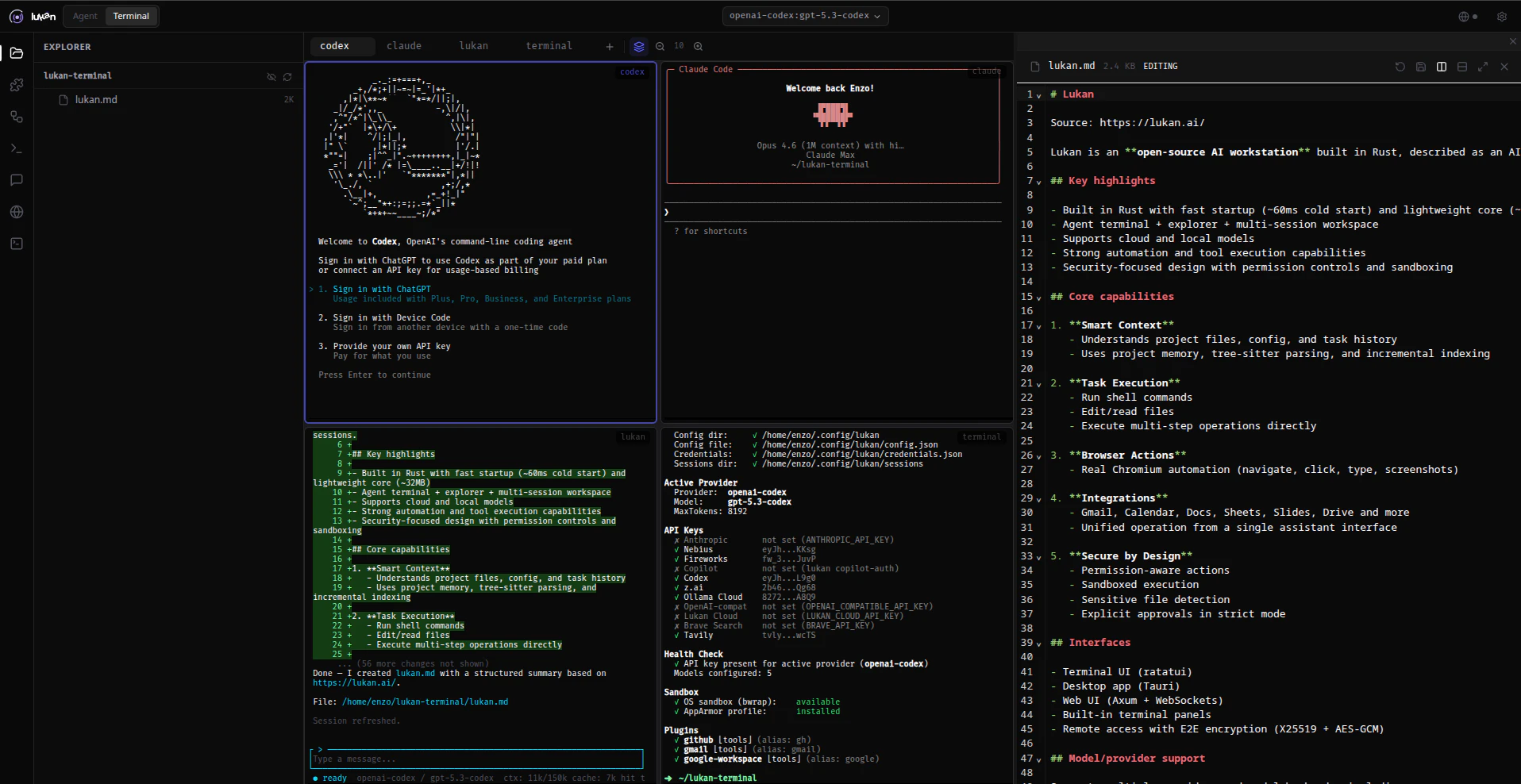
Hi HN, I've been building Lukan, an open-source (MIT) agentic workstation that runs entirely as a single Rust binary with zero runtime dependencies. I started this because I wanted a unified workstation optimized for my own productivity. My goal was to build an environment where I could securely remote into my machine from anywhere, seamlessly view and modify local files, and run AI agents or drop into a terminal side-by-side, all integrated with a rich set of built-in tools. Here is what makes it different: Multi-agent sessions: Run multiple agents in parallel, each with its own isolated…
Apr 2026 · lukan.ai · its alternatives →
- 6

Hey HN, I've been working on an open-source framework for creating AI agents that evolve, communicate, and collaborate to solve complex tasks. The Evolving Agents Framework allows agents to: Reuse, evolve, or create new agents dynamically based on semantic similarity Communicate and delegate tasks to other specialized agents Continuously improve by learning from past executions Define workflows in YAML, making it easy to orchestrate agent interactions Search for relevant tools and agents using OpenAI embeddings Support multiple AI frameworks (BeeAI, etc.) Current Status & Roadmap This is…
2025 · github.com · its alternatives →
- 7
 Jitera▲104
The product was there for the past two years, but we're only now approaching a release on global market. In a nutshell, it's a workspace for non-technical people to work with AI without forcing anyone at the hard end of the slop, as the agents artifacts are shared and available to everyone in the team equally. Jitera agents have all the typical features: memory, skills, MCP, scheduled tasks, access to enterprise data storage, but go a step beyound in customization and integrations.
Apr 2026 · jitera.com · its alternatives →
- 8

Power your AI agents with enterprise-ready tools via MCP
2025 · merge.dev · its alternatives →
- 9Verdent Deck▲295
Hi HN! We just launched Verdent, an AI coding agent that actually plans before it codes, tests its own work, and delivers production-ready results without you having to clean up after it. tl;dr Check out the website [1] and read the story [2] - The problem: Current AI tools dump code and leave you to debug. You ask for "build a login endpoint" and get a passwordless JWT mess that doesn't fit your project. We've talked to hundreds of engineers who are frustrated with having to micromanage AI output. - What we built: Verdent works more like a senior engineer. It asks clarifying questions…
2025 · verdent.ai · its alternatives →
- 10

Hey HN, We’ve been building browser agents for a while. In production, we kept converging on the same pattern: deterministic scripts for the happy path, agents only for edge cases. So we built Demonstrate Mode. The idea is simple: You perform your workflow once in a remote browser. Notte records the interactions and generates deterministic automation code. How it works: - Record clicks, inputs, navigations in a cloud browser - Compile them into deterministic code (no LLM at runtime) - Run and deploy on managed browser infrastructure Closest analog is Playwright codegen but: - Infrastructure…
2025 · notte.cc · its alternatives →
- 11

Hey HN! We’re Arne and Raban, the founders of Emdash (https://github.com/generalaction/emdash). Emdash is an open-source and provider-agnostic desktop app that lets you run multiple coding agents in parallel, each isolated in its own git worktree, either locally or over SSH on a remote machine. We call it an Agentic Development Environment (ADE). You can see a 1 minute demo here: https://youtu.be/X31nK-zlzKo We are building Emdash for ourselves. While working on a cap-table management application (think Stripe Atlas + Pulley), we found our development…
Feb 2026 · github.com · its alternatives →
- 12
 Kodosumi▲167
Hi Hacker News, I’m part of the team behind Kodosumi. We built it because deploying agentic services in production was much harder than building proof-of-concepts. Many frameworks let you build agents, but when you want them to run long tasks, scale across machines, or be observed/monitored reliably, things fall apart. Kodosumi is our answer to that. It’s an open-source runtime that uses Ray + FastAPI + Litestar to let you: Deploy “agents” and “flows” and expose APIs easily, with minimal config (just one YAML) Scale horizontally for bursty workloads and long-running tasks without losing…
2025 · kodosumi.io · its alternatives →
- 13RE
Hey HN! We built a browser-based agent that runs inside an authenticated web app, watches how the app calls its own APIs, and automatically turns those into agent tools. You can think of it as an auto-generated MCP server that self-updates as the host app changes. The result is a skilled AI assistant that actually integrates deeply with any product (not just chat and RAG) with minimal effort. Check out these short demos below that show the agent in software you're probably familiar with: - Jira: https://demo.frigade.com/hn?skill=jira - Spotify:…
Jul 2026 · its alternatives →
- 14
 Velane▲95
n8n is built for humans dragging nodes on a canvas. That breaks down at B2B scale (embedding in a product, multi-tenant scalability, etc). n8n does have an MCP server so agents can create workflows too, but it outputs raw JSON. That's fine for n8n's engine, but painful for a coding agent (or a human reviewing its output) to read, write, diff, or debug. I'm building an alternative where workflows are authored by a coding agent in [a more dev-legible format] instead of JSON blobs, and execute it at scale.
Jul 2026 · velane.sh · its alternatives →
- 15

Title: Show HN: PageAgent, A GUI agent that lives inside your web app Hi HN, I'm building PageAgent, an open-source (MIT) library that embeds an AI agent directly into your frontend. I built this because I believe there's a massive design space for deploying general agents natively inside the web apps we already use, rather than treating the web merely as a dumb target for isolated bots. Currently, most AI agents operate from external clients or server-side programs, effectively leaving web development out of the AI ecosystem. I'm experimenting with an "inside-out" paradigm instead. By…
Mar 2026 · alibaba.github.io · its alternatives →
- 16
 Heym▲83
Self-hosted AI workflow automation with agents, RAG, and MCP
Apr 2026 · heym.run · its alternatives →
- 17

Hi HN, I’m Vincent from Aden. We spent 4 years building ERP automation for construction (PO/invoice reconciliation). We had real enterprise customers but hit a technical wall: Chatbots aren't for real work. Accountants don't want to chat; they want the ledger reconciled while they sleep. They want services, not tools. Existing agent frameworks (LangChain, AutoGPT) failed in production - brittle, looping, and unable to handle messy data. General Computer Use (GCU) frameworks were even worse. My reflections: 1. The "Toy App" Ceiling & GCU Trap Most frameworks assume synchronous sessions.…
Feb 2026 · github.com · its alternatives →
- 18

Single-agent LLMs suck at long-running complex tasks. We’ve open-sourced a multi-agent orchestrator that we’ve been using to handle long-running LLM tasks. We found that single LLM agents tend to stall, loop, or generate non-compiling code, so we built a harness for agents to coordinate over shared context while work is in progress. How it works: 1. Orchestrator agent that manages task decomposition 2. Sub-agents for parallel work 3. Subscriptions to task state and progress 4. Real-time sharing of intermediate discoveries between agents We tested this on a Putnam-level math problem, but the…
Feb 2026 · github.com · its alternatives →
- 19
 Hopper▲100
Hi HN, we’re Sai and Aayush, and we’re building Hypercubic (https://www.hypercubic.ai/), bringing AI tools to the mainframe and COBOL world. (We did a Launch HN last year: https://news.ycombinator.com/item?id=45877517.) Today we’re launching Hopper, an agentic development environment for mainframes. You can download it here: https://www.hypercubic.ai/hopper, and you can also request access and immediately get a mainframe user account to play with. There's also a video runthrough at https://www.youtube.com/watch?v=q81L5DcfBvE.…
May 2026 · hypercubic.ai · its alternatives →
- 20BA
I'm one of the creators of The Edge Agent (TEA). We built this because we needed a way to deploy agents that was verifiable and robust enough for production/edge cases, moving away from loose scripts. The architecture aims to solve critical gaps in deterministic orchestration identified by *Prof. Claudionor Coelho Jr. (Stanford alum, ML/DL Faculty at Santa Clara Univ., and Senior Fellow for AI at Majestic Labs)* during our work on the Kiroku project. *Key Technical Features:* * *Neurosymbolic Native:* We integrated Prolog to logically validate LLM outputs. This combines neural…
Jan 2026 · fabceolin.github.io · its alternatives →
- 21

A collection of open-source TypeScript tools by @enmanuelmag. heimdall-mcp for MCP proxy telemetry. agent-harness-kit for multi-agent orchestration.
May 2026 · ahk.cardor.dev · its alternatives →
- 22

Hey HN! Wanted to show our open source agent harness called Gambit. If you’re not familiar, agent harnesses are sort of like an operating system for an agent... they handle tool calling, planning, context window management, and don’t require as much developer orchestration. Normally you might see an agent orchestration framework pipeline like: compute -> compute -> compute -> LLM -> compute -> compute -> LLM we invert this so with an agent harness, it’s more like: LLM -> LLM -> LLM -> compute -> LLM -> LLM -> compute -> LLM Essentially you describe each agent in either a self contained…
Jan 2026 · github.com · its alternatives →
- 23

An embeddable cross-platform AI agent library written in C. Cloud and local LLMs, tool calling, long-term memory, voice, sessions, research mode, self-evolving loops. The SQLite of agent frameworks: small, portable, just works. - sqliteai/adam
May 2026 · github.com · its alternatives →
- 24

Hi HN! I want to share our latest project at NEXA AI. We developed AI agent foundation models designed to transform how developers create AI agent powered apps. One major challenge we've observed with current human-computer interactions is that many simple, one-step tasks become unnecessarily complex, multi-step workflows due to limitations of current GUIs. AI agents can solve this, but existing AI agent models are slow and costly. To tackle these issues, we built lightweight AI agent models based on our Octopus V2, small language models for function calling (You can learn more about our…
2024 · nexa4ai.com · its alternatives →

Also compare
Ranked by how close each launch is in meaning, then by votes. Prices were read from each product’s own site when checked and can change. Refine with your own description →