Jido – Run 10k agents at 25KB each (Elixir)
Hi HN! I'm Mike Hostetler and I built Jido, an Agent SDK in Elixir that lets you run thousands of agents without heavy infrastructure. Repo: https://github.com/agentjido/jido Getting Started: https://hexdocs.pm/jido/getting-started.html Why another framework? After using several popular Agent frameworks and platforms, I had two key challenges: - Running multiple agents required process-heavy infrastructure like Docker or K8s. Running 50,000 agents in parallel was costly and diminished the benefits of agentic programming. - Today's agents require too…
Jido – Run 10k agents at 25KB each (Elixir) launched on December 30, 2024 with 13 votes, #1,204 of 5,365 launches that month and more than 75% of that year's launches. The site was still online in September 2026, 1 year on.
In plain words
Jido is an Agent SDK built in Elixir that enables developers to run thousands of autonomous agents with minimal infrastructure overhead, using only about 25KB per agent. It addresses the challenge of scaling multi-agent systems by eliminating the need for heavy containerization like Docker or Kubernetes, making large-scale parallel agent deployment more cost-effective. The framework is designed to support agents managing their own workflows with less human intervention than traditional agent frameworks.
written from the facts on this page · September 2026
From the sources
🤖 Autonomous agent framework for Elixir. Built for distributed, autonomous behavior and dynamic workflows. - agentjido/jido
In the maker’s words, at launch
Hi HN! I'm Mike Hostetler and I built Jido, an Agent SDK in Elixir that lets you run thousands of agents without heavy infrastructure. Repo: https://github.com/agentjido/jido Getting Started: https://hexdocs.pm/jido/getting-started.html Why another framework? After using…
Does a similar job
all alternatives → Jido 2.0, Elixir Agent FrameworkMar 2026 · jido.run · ▲323
Hi HN! I'm the author of an Elixir Agent Framework called Jido. We reached our 2.0 release this week, shipping a production-hardened framework to build, manage and run Agents on the BEAM. Jido now supports a host of Agentic features, including: - Tool Calling and Agent Skills - Comprehensive multi-agent support across distributed BEAM processes with Supervision - Multiple reasoning strategies including ReAct, Chain of Thought, Tree of Thought, and more - Advanced workflow capabilities - Durability through a robust Storage and Persistence layer - Agentic Memory - MCP and Sensors to interface…

 Tilde.run – Agent sandbox with a transactional, versioned filesystemMay 2026 · tilde.run · ▲205
Tilde started from a simple observation: AI agents are only as useful as the environment they can work in. Giving an agent a prompt is easy. Giving it the right files, credentials, tools, context, and execution environment, safely and repeatably, is much harder. Over the past year, we learned a lot
 Nous – Open-Source Agent Framework with Autonomous, SWE Agents, WebUI2024 · github.com · ▲155
Hello HN! The day has finally come to stop adding features and start sharing what I've been building the last 5-6 months. It's a bit of CrewAI, OpenDevon, LangFuse/Cloud all in one, providing devs who prefer TypeScript an integrated framework thats provides a lot out of the box to start experimenting and building agents with. It started after peeking at the LangChain docs a few times and never liking the example code. I began experimenting with automating a simple Jira request from the engineering team to add an index to one of our Google Spanner databases (for context I'm the…
 Kodosumi2025 · kodosumi.io · ▲167
Hi Hacker News, I’m part of the team behind Kodosumi. We built it because deploying agentic services in production was much harder than building proof-of-concepts. Many frameworks let you build agents, but when you want them to run long tasks, scale across machines, or be observed/monitored reliably, things fall apart. Kodosumi is our answer to that. It’s an open-source runtime that uses Ray + FastAPI + Litestar to let you: Deploy “agents” and “flows” and expose APIs easily, with minimal config (just one YAML) Scale horizontally for bursty workloads and long-running tasks without losing…
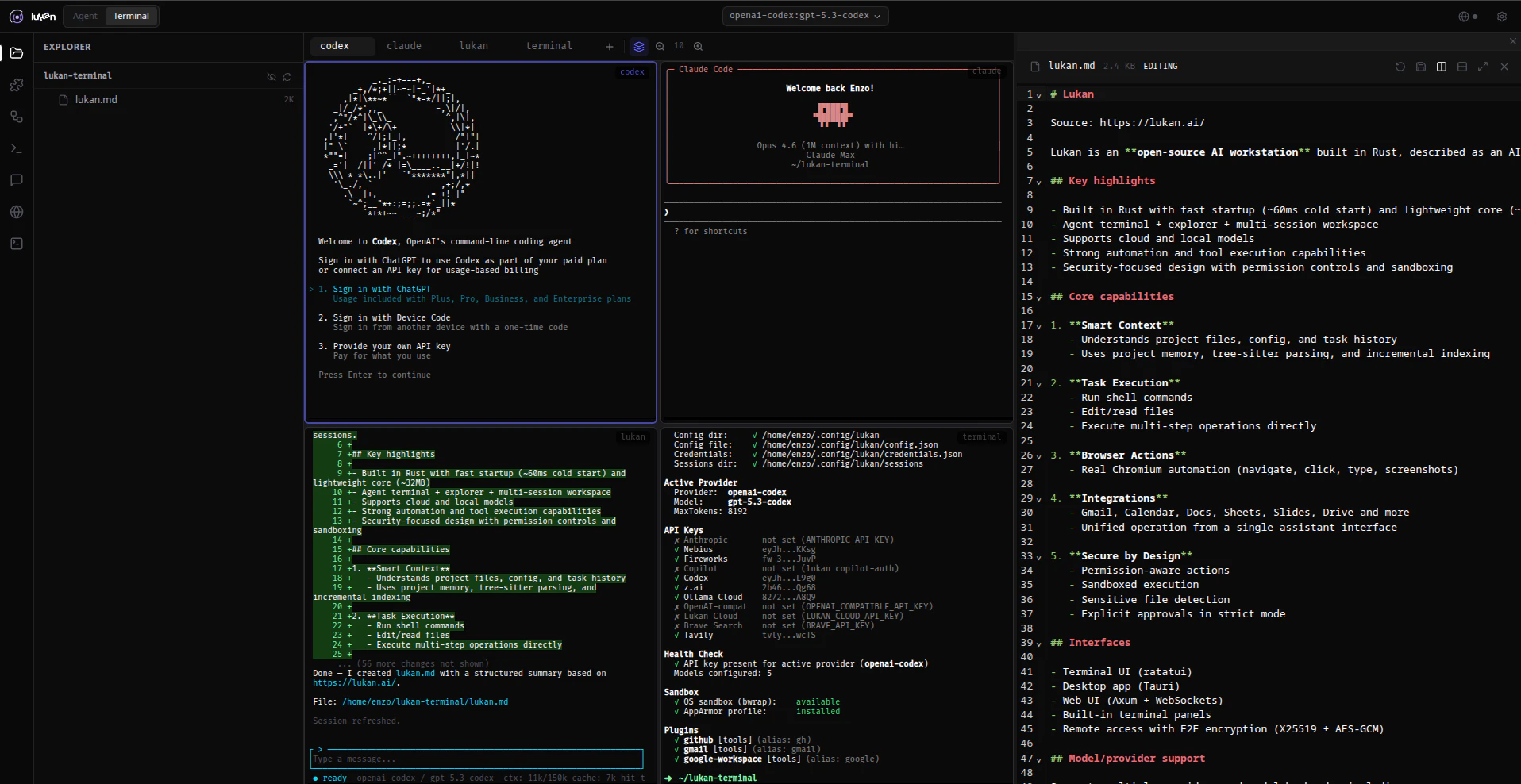 Lukan AI Agent, IDE and workstation.Apr 2026 · lukan.ai · ▲92
Hi HN, I've been building Lukan, an open-source (MIT) agentic workstation that runs entirely as a single Rust binary with zero runtime dependencies. I started this because I wanted a unified workstation optimized for my own productivity. My goal was to build an environment where I could securely remote into my machine from anywhere, seamlessly view and modify local files, and run AI agents or drop into a terminal side-by-side, all integrated with a rich set of built-in tools. Here is what makes it different: Multi-agent sessions: Run multiple agents in parallel, each with its own isolated…
More ai this month
the category →


Paintings by AI models: programs run through a simulation of oil paint.
AI · 21d ago · stillwet.art
 PixVerse R2▲381
A real-time world model you can explore and change
AI · 30d ago · world.pixverse.video

Source: Show HN post ↗ · launch text quoted in part