AI · alternatives · 2026

24 alternatives to Jido – Run 10k agents at 25KB each (Elixir)
Hi HN! I'm Mike Hostetler and I built Jido, an Agent SDK in Elixir that lets you run thousands of agents without heavy infrastructure. Repo: https://github.com/agentjido/jido Getting Started: https://hexdocs.pm/jido/getting-started.html Why another framework? After using several popular Agent frameworks and platforms, I had two key challenges: - Running multiple agents required process-heavy infrastructure like Docker or K8s. Running 50,000 agents in parallel was costly and diminished the benefits of agentic programming. - Today's agents require too…
Jido is an Agent SDK built in Elixir that enables developers to run thousands of autonomous agents with minimal infrastructure overhead, using only about 25KB per agent. It addresses the challenge of scaling… Below are 24 products that do a similar job, ranked by how close each is in meaning and then by launch-day votes. Prices are shown for the 1 we have checked on their own sites, 1 of them free or with a free tier. Jido – Run 10k agents at 25KB each (Elixir) launched in 2024; newer entries below may have overtaken it.
- 1

Hi HN! I'm the author of an Elixir Agent Framework called Jido. We reached our 2.0 release this week, shipping a production-hardened framework to build, manage and run Agents on the BEAM. Jido now supports a host of Agentic features, including: - Tool Calling and Agent Skills - Comprehensive multi-agent support across distributed BEAM processes with Supervision - Multiple reasoning strategies including ReAct, Chain of Thought, Tree of Thought, and more - Advanced workflow capabilities - Durability through a robust Storage and Persistence layer - Agentic Memory - MCP and Sensors to interface…
Mar 2026 · jido.run · its alternatives →
- 2

- 3

Tilde started from a simple observation: AI agents are only as useful as the environment they can work in. Giving an agent a prompt is easy. Giving it the right files, credentials, tools, context, and execution environment, safely and repeatably, is much harder. Over the past year, we learned a lot
May 2026 · tilde.run · its alternatives →
- 4Agent 37▲401
Hey HN, I noticed there are 1,000+ MCP skills on GitHub with zero way for creators to charge for them. So I built Agent37. Selling Claude skills today means asking customers to download your skill, set up Claude Code on their laptops, configure MCP servers, and pray it works. No trial, no updates, often you're just handing over the source. Agent37 lets creators upload a skill, share a link, and anyone can try it instantly (no Claude account needed). Built-in Stripe, creators keep 80%. Looking for feedback on the approach. Would you use something like this?
Mar 2026 · agent37.com · its alternatives →
- 5

Hello HN! The day has finally come to stop adding features and start sharing what I've been building the last 5-6 months. It's a bit of CrewAI, OpenDevon, LangFuse/Cloud all in one, providing devs who prefer TypeScript an integrated framework thats provides a lot out of the box to start experimenting and building agents with. It started after peeking at the LangChain docs a few times and never liking the example code. I began experimenting with automating a simple Jira request from the engineering team to add an index to one of our Google Spanner databases (for context I'm the…
2024 · github.com · its alternatives →
- 6
 Kodosumi▲167
Hi Hacker News, I’m part of the team behind Kodosumi. We built it because deploying agentic services in production was much harder than building proof-of-concepts. Many frameworks let you build agents, but when you want them to run long tasks, scale across machines, or be observed/monitored reliably, things fall apart. Kodosumi is our answer to that. It’s an open-source runtime that uses Ray + FastAPI + Litestar to let you: Deploy “agents” and “flows” and expose APIs easily, with minimal config (just one YAML) Scale horizontally for bursty workloads and long-running tasks without losing…
2025 · kodosumi.io · its alternatives →
- 7
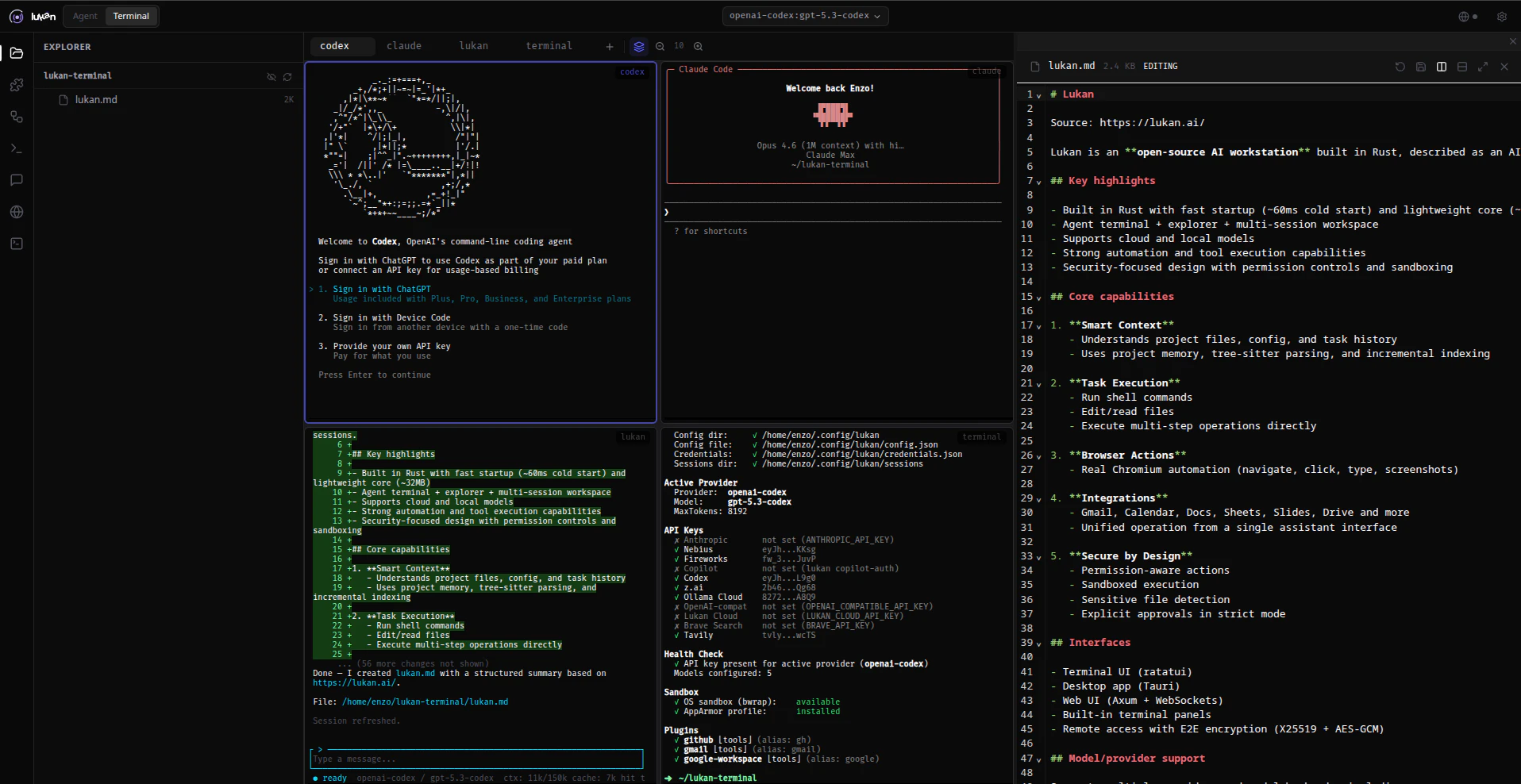
Hi HN, I've been building Lukan, an open-source (MIT) agentic workstation that runs entirely as a single Rust binary with zero runtime dependencies. I started this because I wanted a unified workstation optimized for my own productivity. My goal was to build an environment where I could securely remote into my machine from anywhere, seamlessly view and modify local files, and run AI agents or drop into a terminal side-by-side, all integrated with a rich set of built-in tools. Here is what makes it different: Multi-agent sessions: Run multiple agents in parallel, each with its own isolated…
Apr 2026 · lukan.ai · its alternatives →
- 8

I've built this to make it easy to host your own infra for lightweight VMs at large scale. Intended for exec of AI-generated code, for CICD runners, or for off-chain AI DApps. Mainly to avoid Docker-in-Docker dangers and mess. Super easy to use with CLI / Python SDK, friendly to AI engs who usually don't like to mess with VM orchestration and networking too much. Defense-in-depth philosophy. Would love to get feedback (and contributors: clear & exciting roadmap!), thx
2025 · github.com · its alternatives →
- 9
 Velane▲95
n8n is built for humans dragging nodes on a canvas. That breaks down at B2B scale (embedding in a product, multi-tenant scalability, etc). n8n does have an MCP server so agents can create workflows too, but it outputs raw JSON. That's fine for n8n's engine, but painful for a coding agent (or a human reviewing its output) to read, write, diff, or debug. I'm building an alternative where workflows are authored by a coding agent in [a more dev-legible format] instead of JSON blobs, and execute it at scale.
Jul 2026 · velane.sh · its alternatives →
- 10
 1DevTool▲94
Multi-project IDE with persistent terminals and 9 dev tools
Mar 2026 · 1devtool.com · its alternatives →
- 11

Single-agent LLMs suck at long-running complex tasks. We’ve open-sourced a multi-agent orchestrator that we’ve been using to handle long-running LLM tasks. We found that single LLM agents tend to stall, loop, or generate non-compiling code, so we built a harness for agents to coordinate over shared context while work is in progress. How it works: 1. Orchestrator agent that manages task decomposition 2. Sub-agents for parallel work 3. Subscriptions to task state and progress 4. Real-time sharing of intermediate discoveries between agents We tested this on a Putnam-level math problem, but the…
Feb 2026 · github.com · its alternatives →
- 12
 HeyZoku▲91
Orchestrate an army of coding agents with your voice.
Jul 2026 · heyzoku.com · its alternatives →
- 13

Hi HN, we're Kiran and Vijay! Over the past two years, we have built a columnar storage engine for observability: logs, metrics, and traces. Today, it's exciting for us to show what we've built on top of that foundation: LLM Agent Observability. Given how non-deterministic agents are, storing all traces without sampling was critical for us. But these traces tend to be in the MBs, sometimes GBs - we needed to store them inexpensively. We also needed the queries and analyses to be fast. To meet both these goals, we store them in S3 in our own parquet-like file format, and query them using AWS…
Jul 2026 · oodle.ai · its alternatives →
- 14LL
Some time ago I built a simple app to run swarms of coding agents — I call it fleet (https://news.ycombinator.com/item?id=48256389). It's based on centralized beads with a Python orchestrator and can run any coder (Claude, agy, Codex). Recently I added a UI to manage the whole agent lifecycle: adding new tasks, monitoring running ones, and a chat interface built on MCP with a centralized SQLite DB. From the UI I can spawn agents to run in any directory, define dependencies on other tasks, and specify which coder/model should do the job. Today I can run 10–15 agents…
Jun 2026 · its alternatives →
- 15

Hi HN folks, I have been building AI agents for quite some time now. The shift has gone from LLM + Tools → LLM Workflows → Agent + Tools + Memory, and now we are finally seeing true agency emerge: agents as systems composed of tools, command-line access, fine-grained system capabilities, and memory. This way of building agents is powerful, and I believe it is here to stay. But the real question is: are the systems powering these agents ready for that future? I do not think so. Using Docker for a single agent is not going to scale well, because agents need to be lightweight and fast. LLMs…
Mar 2026 · github.com · its alternatives →
- 16

Hey HN, I've made a groundbreaking discovery: procrastination can lead to questionable projects! While avoiding real work, I somehow created a directory of 130+ AI agents and frameworks. It's like I tried to organize a robot party and everyone showed up. What's inside: - A list of AI agents - Frameworks to build more agents So, HN, before I spiral into an existential crisis: did I accidentally create something useful, or should I go touch grass? P.S. If this somehow becomes the next big thing, I promise to pretend it was intentional all along.
2024 · aiagentsdirectory.com · its alternatives →
- 17

- 18

RunAgent eliminates the complexity of AI agent deployment across different frameworks and languages. Today's developers face deployment nightmares with fragmented frameworks (LlamaIndex, LangChain, LangGraph, CrewAI, Letta, Agno, etc.) each requiring different deployment processes, creating unnecessary friction. The Solution: Like MCP (Model Context Protocol), RunAgent provides a standardized approach to agent deployment. Developers simply provide a config file and their agent code - RunAgent handles the rest with REST API and WebSocket (Streaming and non streaming). Our open-source platform…
2025 · github.com · its alternatives →
- 191D
We just open-sourced the internal system we built at Assembled for running coding agents as a team. Coding agents worked well for individual engineers, but the surrounding workflow was a bit of a mess. We generally found that many engineers had different MCP connections and context for their agents, personal automations running that other people couldn’t access, and very little introspection for what a human’s input into the coding agent looked like. So we built an internal system that converted coding agents into shared team infrastructure. The system runs Codex, Claude Code, OpenCode, and…
Jun 2026 · its alternatives →
- 20

Build production-ready AI agents in Go.
Nov 2025 · github.com · its alternatives →
- 21
 Run AI Agents on your cloud infrastructurefree tier▲12
Hi, founder of Okteto here! We’ve been experimenting with AI agents in our workflows at Okteto. Running them locally worked at first, but quickly became painful. git worktrees, multiple terminals, and messy context switches slowed us down. So we built Agent Fleets: ephemeral, fully managed environments for AI agents, built on top of Okteto’s development platform. Each agent runs in its own containerized environment on your infrastructure, with the services, tools, and policies it needs. You can spin up agents with a single click or API call. No local setup. No git worktrees. The beta…
2025 · okteto.com · its alternatives →
- 22

At my last job I spent a year building an agentic coding platform used by hundreds of thousands of people. Along the way I tried building a hosting service on OpenClaw, and also ran Hermes myself for a while. Both projects have some great feature ideas, but when I tried to use them for real work they failed more often than not, and their security models worried me. I just couldn't see either one becoming something I'd trust enough for myself/friends/family. After a lot of exploration I realized that what I really wanted all along was to create automations using the coding agent I…
2018 · clor.com · its alternatives →
- 23

Open-source agent runtime — SSH-native isolation, eBPF egress policy, Kubernetes + LXC backends, GPU passthrough, MCP-native CLI - FootprintAI/Containarium
Jan 2026 · github.com · its alternatives →
- 24

Hey HN, we're Jon and Kristiane, and we're building Orloj (https://orloj.dev), an open-source orchestration runtime for multi-agent AI systems. You define agents, tools, policies, and workflows in declarative YAML manifests, and Orloj handles scheduling, execution, governance, and reliability. Over the past year we tried to use many different platforms/frameworks to build out agent systems and while building we hit some sort of problem with all of them, so we decided to have a go at it. Jon has worked with kubernettes and terraform for years and always liked the declarative…
Mar 2026 · github.com · its alternatives →

Also compare
Ranked by how close each launch is in meaning, then by votes. Prices were read from each product’s own site when checked and can change. Refine with your own description →