AI · alternatives · 2026

24 alternatives to ModelFit
Find the best local LLM your Mac or GPU can actually run
Below are 24 products that do a similar job, ranked by how close each is in meaning and then by launch-day votes.
- 1

A few days ago I found myself trying out GLM 5.2 and was really positively impressed. The capabilities and security I was getting from this LLM are similar to those I've gotten from models like Claude or GPT, and this really surprised me. But then I thought, "I wonder how it would work on a normal computer like mine," and above all, "I wonder if it would work without going into OOM on a computer like mine." So I started working with the help of agents to test this possibility. I started converting the model to int4, understanding MTP usage, and if possible implementing DSA for long context.…
Jul 2026 · github.com · its alternatives →
- 2

Hi Hackers, Excited to share a macOS app I've been working on: https://recurse.chat/ for chatting with local AI. While it's amazing that you can run AI models locally quite easily these days (through llama.cpp / llamafile / ollama / llm CLI etc.), I missed feature complete chat interfaces. Tools like LMStudio are super powerful, but there's a learning curve to it. I'd like to hit a middleground of simplicity and customizability for advanced users. Here's what separates RecurseChat out from similar apps: - UX designed for you to use local AI as a daily driver.…
2024 · recurse.chat · its alternatives →
- 3
 1Code▲569
Just to clarify the background a bit. This project wasn’t planned as a big standalone release at first. On January 16, Ollama added support for an Anthropic-compatible API, and I was curious how far this could be pushed in practice. I decided to try plugging local Ollama models directly into a Claude Code-style workflow and see if it would actually work end to end. Here is the release note from Ollama that made this possible: https://ollama.com/blog/claude Technically, what I do is pretty straightforward: - Detect which local models are available in Ollama. - When…
Jan 2026 · github.com · its alternatives →
- 4
 Ollama v0.19▲410
Massive local model speedup on Apple Silicon with MLX
Apr 2026 · ollama.com · its alternatives →
- 5
 ModelHub▲317
The missing menu bar app for local LLMs on Mac.
May 2026 · studio.consciousengines.com · its alternatives →
- 6

Find the local LLM that actually runs and performs best on your hardware. Ranked by real, recency-aware benchmarks, not parameter count. One command, run it instantly. - Andyyyy64/whichllm
May 2026 · github.com · its alternatives →
- 7

Vibe-check many open-source and proprietary LLMs at once
2024 · its alternatives →
- 8WM
Try it out! https://glhf.chat/ Hey HN! We’ve been working for the past few months on a website to let you easily run (almost) any open-source LLM on autoscaling GPU clusters. It’s free for now while we figure out how to price it, but we expect to be cheaper than most GPU offerings since we can run the models multi-tenant. Unlike Together AI, Fireworks, etc, we’ll run any model that the open-source vLLM project supports: we don’t have a hardcoded list. If you want a specific model or finetune, you don’t have to ask us for it: you can just paste the Hugging Face link in and…
2024 · glhf.chat · its alternatives →
- 9
 LM Studio▲209
Discover, download, and run local LLMs (incl. DeepSeek R1)
2025 · lmstudio.ai · its alternatives →
- 10

- 11
 Cai▲179
Hi HN, Cai runs actions on your selection via ⌥C, pick an action (AI, shell, GitHub issue, Linear ticket), done. Bundled local model (MLX Community), create custom actions with prompts, scripts and more. Free, MIT. Built after my Raycast extension sat in review queue for 3+ months. Wanted no typing, no app switching, no cloud. Repo: https://github.com/cai-layer/cai Demo: https://youtu.be/LH2MYNQ_wsk
Apr 2026 · getcai.app · its alternatives →
- 12

Local transcripts with speaker labels, timestamps, + export
Dec 2025 · whispersnapper.com · its alternatives →
- 13
 Viberia▲146
Hey HN, This is my take on the agent harness. Everything on an isometric map. Agents are grouped into "buildings" that run in a sequence or a loop; e.g., the CodeForge has an agent that writes a PRD, another one that implements, and a third that reviews. Everything is customizable, you build your own buildings/teams however you want. It's a Tauri app, really light (about 8x less energy than the closest competitor I benchmarked, so it actually runs from a coffee shop on battery). It's macOS only for now, but ping me if you are willing to test the Windows or Linux version. I've been…
May 2026 · getviberia.com · its alternatives →
- 14

- 15AT
I recently built a small open-source tool to benchmark different LLM API endpoints — including OpenAI, Claude, and self-hosted models (like llama.cpp). It runs a configurable number of test requests and reports two key metrics: • First-token latency (ms): How long it takes for the first token to appear • Output speed (tokens/sec): Overall output fluency Demo: https://llmapitest.com/ Code: https://github.com/qjr87/llm-api-test The goal is to provide a simple, visual, and reproducible way to evaluate performance across different LLM providers, including…
2025 · llmapitest.com · its alternatives →
- 16
 Lekh AI▲80
Run powerful AI models on your Mac:fully offline and private
Jan 2026 · apps.apple.com · its alternatives →
- 17

I started leaning in on AI heavily this year, as I wanted to get more done autonomously, but then my token usage climbed dramatically to the point where my weekly quota would run out before the end of the week, sometimes a couple of days into the week. I realised I had to do something about it else I'd have to double my spend. So I decided to start tracking my cost per task type. This revealed that a lot of my spend went to searches/scans or simple things like scouting tasks. I then decided to turn this into a simple CLI tool that can be used to read your OpenAI-style logs locally, and…
Jul 2026 · github.com · its alternatives →
- 18CI
One of the most frequent questions one faces while running LLMs locally is: I have xx RAM and yy GPU, Can I run zz LLM model ? I have vibe coded a simple application to help you with just that. Update: A lot of great feedback for me to improve the app. Thank you all.
2025 · can-i-run-this-llm-blue.vercel.app · its alternatives →
- 19MG
Hello HN, I've been working on this project for a while, and it has been in an "open" beta for some time. I finally believe it's ready for its first release. I hope you like it. Here are some potential questions that may arise: 1. How does it compare to LM Studio? It's likely that if you're already using LM Studio, you'll continue to do so. This project is designed to be more user-friendly. 2. Is it open-source? No, it is not. 3. Does it use any open-source libraries? Yes, it uses llama.cpp and a few others, as indicated in the license information included with the application. 4. Why is not…
2023 · avapls.com · its alternatives →
- 20

Pick a Mac mini, Mac Studio, DGX Spark or Strix Halo box, see which open models fit and how fast they run, and how much usage it takes to break even against paying an API. It is willing to say: it doesn
Sep 2026 · sunkcost.ai · its alternatives →
- 21
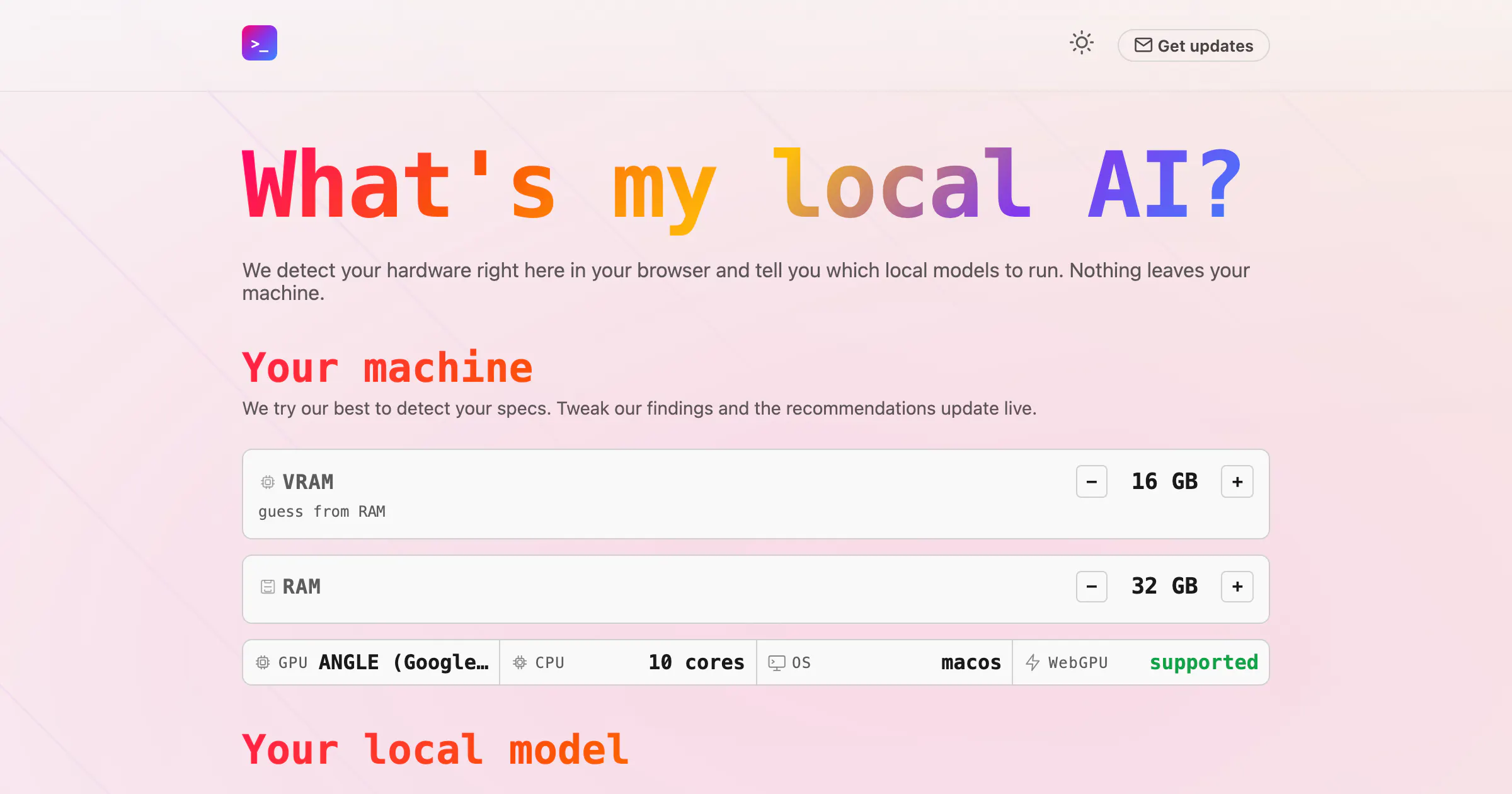
Find the best local model for your machine
Aug 2026 · whatsmylocal.ai · its alternatives →
- 22TF
I’d originally launched my app: Private LLM[1][2] on HN around 10 months ago, with a single RedPajama Chat 3B model. The app has come a long way since then. About a month ago, I added support for 4-bit OmniQuant quantized Mixtral 8x7B Instruct model, and it seems to outperform Q4 models at inference speed and Q8 models at text generation quality, while consuming only about 24GB of RAM[3] at 8k context length. The trick is: a) to use a better quantization algorithm and b) to use unquantized embeddings and the MoE gates (the overhead is quite small). Other notable features include many more…
2024 · its alternatives →
- 23

What it is A single 45 MB Windows .exe that embeds llama.cpp and a minimal Tk UI. Copy it (plus any .gguf model) to a flash drive, double-click on any Windows PC, and you’re chatting with an LLM—no admin rights, Cloud, or network. Why I built it Existing “local LLM” GUIs assume you can pip install, pass long CLI flags, or download GBs of extras. I wanted something my less-technical colleagues could run during a client visit by literally plugging in a USB drive. How it works PyInstaller one-file build → bundles Python runtime, llama_cpp_python, and the UI into a single PE. On first launch, it…
2025 · github.com · its alternatives →
- 24

The fastest local AI engine for Apple Silicon. 4.2x faster than Ollama, 0.08s cached TTFT, 100% tool calling. 17 tool parsers, prompt cache, reasoning separation, cloud routing. Drop-in OpenAI replacement. Works with Claude Code, Cursor, Aider. - raullenchai/Rapid-MLX
Apr 2026 · github.com · its alternatives →
Also compare
Ranked by how close each launch is in meaning, then by votes. Prices were read from each product’s own site when checked and can change. Refine with your own description →