Work · alternatives · 2026

24 alternatives to SQZ – Low complexity, scalable lossy to lossless image compression
I'd like to share a little toy project of mine, a really simple image codec that can do lossy to full lossless image compression with complete scalability at a byte level granularity - you can compress an image just once, even fully losslessly if needed, and then get any lossy version possible by simply stopping decompression at any offset in the compressed data. This "encode onde, serve many" approach is especially interesting for providing downscaled low quality image previews (LQIP) in as tight a storage budget as possible, and then allowing seamless, transparent refinement as deemed…
Below are 24 products that do a similar job, ranked by how close each is in meaning and then by launch-day votes. SQZ – Low complexity, scalable lossy to lossless image compression launched in 2024; newer entries below may have overtaken it.
- 1

We combine Generative Adversarial Networks with learned compression to obtain a state-of-the-art generative lossy compression system.
2020 · hific.github.io · its alternatives →
- 2

Simple image compression full website code written in node, react and next.js framework. Easy to deploy as a microservice. - eashish93/imgsquash
2019 · github.com · its alternatives →
- 3
 CompressImage.io▲261
Reduce image size up to 90% in seconds, free & works offline
2022 · compressimage.io · its alternatives →
- 4

I've spent the last few months working on this codec. It has the following characteristics: - SOTA decompression throughput in its ratio class - Decent ratios (comparable to LZ4 at high effort levels) - Slow compression Most of the gains can be attributed to reducing branches and making decompression very friendly to out-of-order cores, by using a smart format. Results on the tarred Silesia corpus on Intel x86-64 follow: codec decode ratio encode misa77 -0 5219 MB/s 42.64% 54.5 MB/s misa77 -1 4274 MB/s 39.65% 51.2 MB/s lz4 2505 MB/s 47.59% 371 MB/s lz4hc -12…
Jul 2026 · github.com · its alternatives →
- 5
 TinyPNG▲119
Compress PNG images that preserves full alpha transparency
2014 · tinypng.com · its alternatives →
- 6
 Compress Image▲175
Hi HN, CompressImageX.com is a straightforward image compressor that helps reduce file sizes without killing quality. •Adjustable quality settings (lossy/lossless) •Batch compression supported •Fast, works offline (thanks to WebAssembly) •No watermarks, no tracking Useful for devs, bloggers, or anyone who wants lighter images. Let me know what you think!
2024 · compressimage.app · its alternatives →
- 7

- 8

Hello HN, author here. I built ZXC, a lossless compression library designed specifically for "Write Once, Read Many" scenarios (Game assets, Firmware, App bundles). The Concept: Standard real-time codecs (LZ4, Snappy) are designed for symmetry. ZXC explores an asymmetric approach: it spends significantly more CPU cycles at compression time to generate a bitstream specifically structured for modern, wide-issue execution pipelines (maximizing Instruction Level Parallelism). Performance (Verified via lzbench integration): ZXC was merged into the official lzbench repository monday. ARM64 (Apple…
Dec 2025 · github.com · its alternatives →
- 9OA
I built an experiment that uses an overfitted transformer and arithmetic coding to compress individual files. Instead of training the model to generalize, I train a 900KB transformer to memorize a single file and predict the next byte. Those predictions are fed into an arithmetic coder to produce the compressed output. On a 100MB NYC taxi CSV, it compresses to about 7MB (~0.5 bits/byte). On a 100MB slice of enwik9, it compresses to about 21MB (~1.68 bits/byte). It's pretty slow right now (roughly 20–30 minutes of training and 45 minutes each for compression and decompression on my…
Jun 2026 · its alternatives →
- 10

- 11

- 12
 Squeezr▲6
Squeeze the weight, keep the quality - Free image compressor
Jan 2026 · getsqueezr.com · its alternatives →
- 13AB
Hi, so over the weekend I built a free to use service to compress one or more images using MozJEPG encoding enabled via WASM. It's a static site, all the processing happens on the client side, no file uploads or sign-ups needed! Why? The existing services are either filled with ads or require you to sign-up / pay. would greatly appreciate any feedback! TIA!
2024 · captaindavinci.github.io · its alternatives →
- 14

Embeddable minimal in-memory GZIP decompression library for embedded systems - wkoszek/mini_gzip
2015 · github.com · its alternatives →
- 15

100% Free, No Login, Privacy Friendly
2024 · imagetoolshub.com · its alternatives →
- 16

- 17

- 18

lossless compression algorithm for online images
2015 · 209.208.79.122 · its alternatives →
- 19
 ProCompress▲18
Professional image compression without quality loss.
2024 · procompress.xyz · its alternatives →
- 20
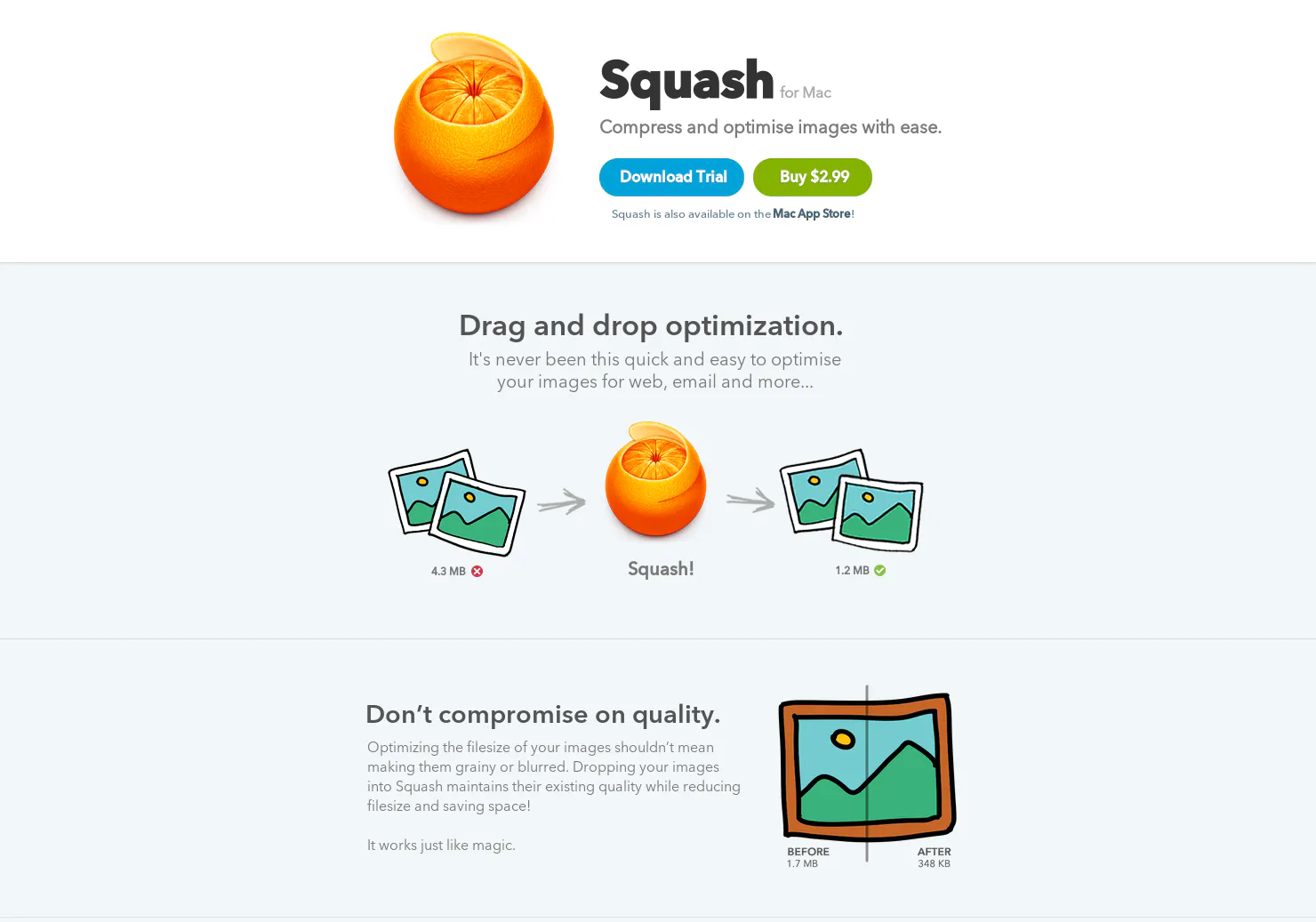
- 21

- 22

I’ve spent the last year developing a decomposition kernel that addresses the "Linear Bottleneck" in standard compression (Zstd, LZMA, Brotli). The Problem: Traditional algorithms operate on 1D streams. They are blind to the spatial, temporal, or hierarchical architecture of modern data (3D models, nested JSON, multi-modal blobs). When you force these structures into a 1D window, you leave significant entropy on the table. The Solution: PXG v3.0 maps binary data to a 13505x13505 grayscale grid. By treating data as a coordinate system rather than a line, our engine utilizes adaptive tiling to…
2025 · limitpixel.com · its alternatives →
- 23IB
Compress high quality JPEG images 35% more than traditional codecs.
2024 · optimize.photos · its alternatives →
- 24
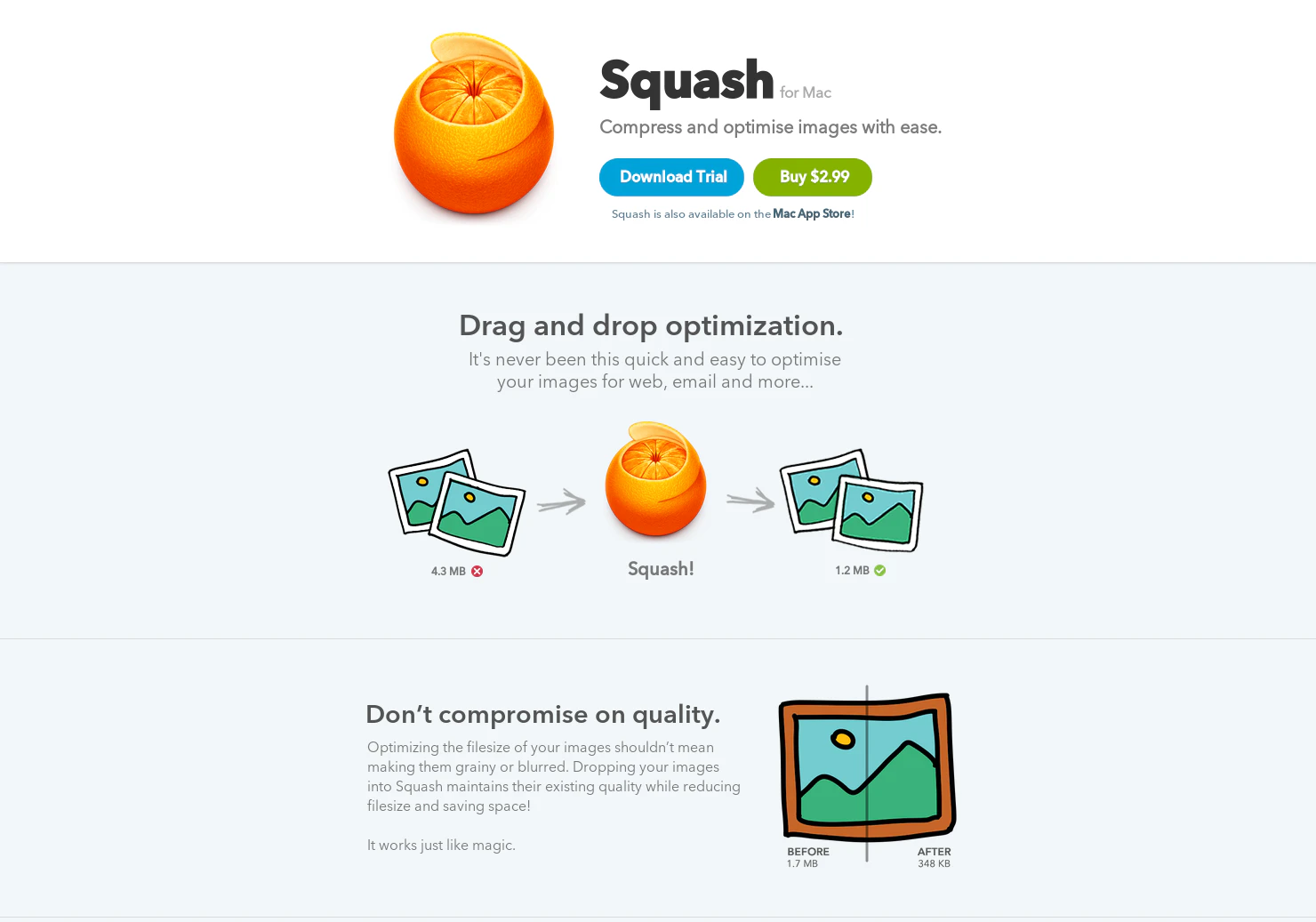
Also compare
Ranked by how close each launch is in meaning, then by votes. Prices were read from each product’s own site when checked and can change. Refine with your own description →