Life & fun · alternatives · 2026

24 alternatives to Tamagotchi P1 for FPGAs
After being thrust headfirst into FPGA development thanks to the Analogue Pocket, my first from scratch creation was a gate level implementation of the original Tamagotchi toy. The core, running on both the Analogue Pocket and MiSTer platforms, lets users re-experience the very first Tamagotchi from 1996 with accurate emulation, but modern features. The core has savestates (which is much harder to do in hardware vs software emulation), high turbo speeds (1,800x was the max clock speed I've reached so far), and more. Learning more about hardware and FPGAs is something I've wanted to do for…
Tamagotchi P1 for FPGAs is a gate-level hardware implementation of the original 1996 Tamagotchi toy that runs on the Analogue Pocket and MiSTer platforms. The emulation recreates the classic handheld experience with… Below are 24 products that do a similar job, ranked by how close each is in meaning and then by launch-day votes.
- 1
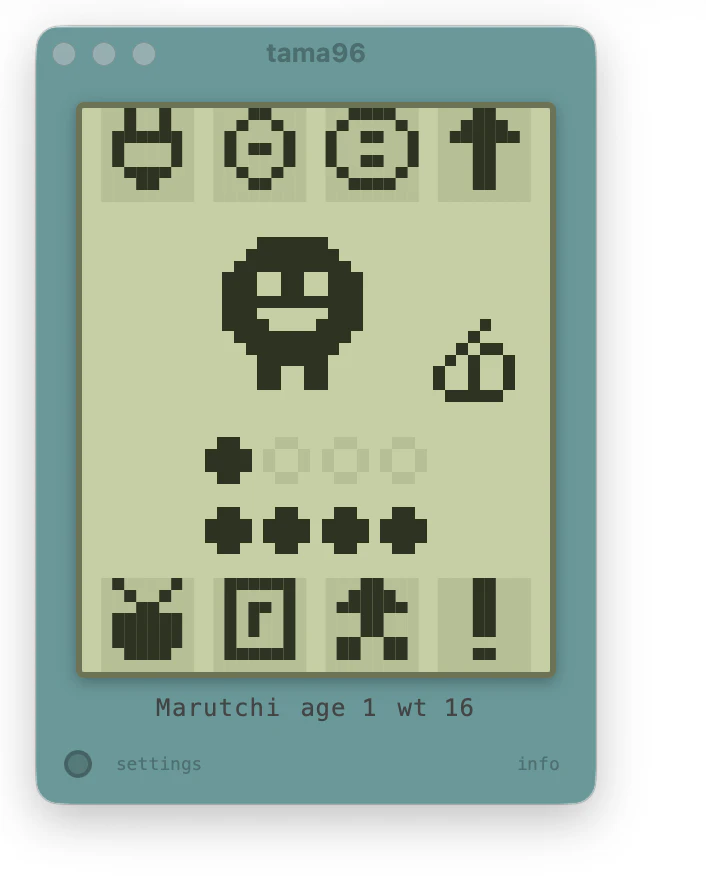 tama96▲141
Inspired by the 1996 original. Your care choices shape who your pet becomes.
Apr 2026 · tama96.com · its alternatives →
- 2

I am proud to present my solo hobby project NAND. This year-long undertaking follows the completed Nand to Tetris course, but ported to the web with its own runtime, user interface, and IDE. Using the "Load example program" selector, you can try out some programs I wrote on NAND's emulated hardware such as 2048, a genetic algorithm, and a manual stack overflow to corrupt the screen. Check out NAND at https://nand.arhan.sh Additionally, I've authored an extensive writeup about the project. Read about it on the GitHub repository's readme.
2024 · github.com · its alternatives →
- 3

Run KolibriOS, Linux or Windows 98 in your browser
2013 · copy.sh · its alternatives →
- 4

- 5

A Flipper Zero clone, but cheapest, DIY and simply Open Source, made with Arduino IDE - lraton/FlopperZiro
2025 · github.com · its alternatives →
- 6

A while back I wrote a CHIP-8 emulator (which is considered the Hello, World! of emulators and is more accurately a virtual machine since historically CHIP-8 was an interpreted language running on top of the COSMAC VIP to make game programming easier). But a few months ago I got really interested in embedded software, so decided it would be neat to port my emulator to a STM32 MCU and design a console around it as a learning experience, since CHIP-8 never existed as a physical system. I didn't know much about embedded software when I began, and even less about electronics, but I managed to…
2022 · github.com · its alternatives →
- 7
 Hugging Face▲405
The Tamagotchi powered by Artificial Intelligence 🤗
2017 · apps.apple.com · its alternatives →
- 8

Not sure if I would post this for the last day of #marchintosh OR wait for tomorrow the 1st of April. Both apply equally. Anyway, here's a pet project of mine, I made it as a glued on for another pet project of mine, but it developed a life of it's own now and can soar skyward toward success, fame, and glory.
2024 · github.com · its alternatives →
- 9

Hey HN, I'm Nate, the creator of Tamagui. One is a React framework that does two things differently in hopes of simplifying how we build websites and apps: 1. It unifies React Native and React web with typed file system routing by making Vite able to serve RN. This lets you share (or diverge) your code in a simpler way for cross-platform apps. 2. We've partnered with Zero (https://zerosync.dev) to make local-first work well. We've been building a solution in One that makes Zero supporting server rendering, without waterfalls, and with seamless server/client handoff. ---…
2024 · onestack.dev · its alternatives →
- 10

Adventures in hardware hacking, low-level software, FPGAs, and more!
2019 · craigjb.com · its alternatives →
- 11GB
Hey HN, Over the past ~1.5 years, I built an open-source FPGA retro emulation handheld that can play Game Boy, Game Boy Color, and Game Boy Advance cartridges. To my knowledge, there isn't an existing open-source FPGA emulator that can play physical cartridges like this. One of my main goals was to do all of the pieces myself, and be able to understand every component of it, so I designed my own PCB, wrote the firmware, wrote a Game Boy and Game Boy Advance emulator for the FPGA (using the Chisel HDL), and designed a 3D-printed case. I detailed the design and development process in the…
2025 · eli.lipsitz.net · its alternatives →
- 12

CHIP-8 console on FPGA. Contribute to pwmarcz/fpga-chip8 development by creating an account on GitHub.
2018 · github.com · its alternatives →
- 13
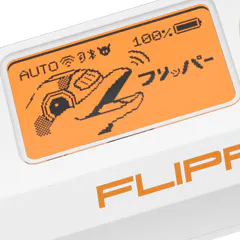 Flipper Zero▲88
A portable multi-tool device styled as a Tamagotchi
2020 · flipper.net · its alternatives →
- 14
 Once UI 1.5▲299
When I started my career and built my first design system, I was beyond excited. It took a lot of iterations, learning and 6 months of work to launch it internally. In the next job, I did it again, then at the following job, again… And no matter which company I worked for, 80% of the design system was the same. I’ve decided to work full-time on the design system I’ve always wanted, and today I’m launching and open-sourcing it. You can use it to build Next.js apps faster, and I’ve designed it in a way that it’s hard to go wrong with it: you can choose any settings, and you’ll end up with a…
Dec 2025 · once-ui.com · its alternatives →
- 15

- 16

- 17

I've developed a Tamagotchi-like virtual characters drawn in JavaScript. These characters can be manually controlled or interact dynamically with AI assistants, adding a visual identity and fun to AI. Imagine having an AI character that responds to user requests with different states, making interactions playful and engaging. Demo: https://barqawiz.github.io/Tamagotchi/ Code: https://github.com/Barqawiz/Tamagotchi
2024 · github.com · its alternatives →
- 18

Hi! me and my friends together built an 8 bit CPU implemented in Logisim purely from scratch. The control unit of this system does not implement the generic microcode ROM or any kind of RAM. This was made purely from discrete logic gates and coded the system to run different programs. key features: Custom 16-instruction Harvard ISA, 8-bit fixed format, 4 general purpose registers Hardwired control unit built entirely from AND/OR gate logic matrix Dual-phase clocking to eliminate race conditions Bootstrap Control Unit that cold-boots via ROM-to-RAM transfer Early-exit conditional…
Jun 2026 · github.com · its alternatives →
- 19

React Native style library and UI kit with the best web performance
2021 · tamagui.dev · its alternatives →
- 20

Retro RPG Game Maker. Contribute to ericoporto/fgmk development by creating an account on GitHub.
2016 · github.com · its alternatives →
- 21

- 22
 UXPin Forge▲244
Generate UI from your design system, not around it
Apr 2026 · uxpin.com · its alternatives →
- 23IB
We wanted to do something very challenging to prove to ourselves that we can do anything we put our mind to. The reasoning for why we chose to build a toy TPU specifically is fairly simple: - Building a chip for ML workloads seemed cool - There was no well-documented open source repo for an ML accelerator that performed both inference and training None of us have real professional experience in hardware design, which, in a way, made the TPU even more appealing since we weren't able to estimate exactly how difficult it would be. As we worked on the initial stages of this project, we…
2025 · tinytpu.com · its alternatives →
- 24

First Release is Here! I'm excited to announce the first release of i486SX_soft_FPU — a software FPU emulator for the classic Intel 486SX CPU, running on NetBSD 10! This project brings floating-point support back to life for 486SX machines, even though modern NetBSD versions no longer natively support processors without a hardware FPU. If you're into retrocomputing, operating system hacking, or just love old-school hardware, check it out! Project page: https://github.com/mezantrop/i486SX_soft_FPU Contributions, feedback, and testing are all very welcome! Let's keep these…
2025 · github.com · its alternatives →
Also compare
Ranked by how close each launch is in meaning, then by votes. Prices were read from each product’s own site when checked and can change. Refine with your own description →