AI · alternatives · 2026

24 alternatives to Tomosu
AI Production Reliability Governance, Powered by PRI.
Below are 24 products that do a similar job, ranked by how close each is in meaning and then by launch-day votes.
- 1

- 2
 Replicas▲239
Hey HN! I'm Connor, creator of Replicas. I'm a heavy Codex/Claude Code user, and I wanted to hand off tasks to agents like I would to an engineer - kick something off before work, let it scaffold while I'm at lunch, even come back to a ready PR. The problem: existing alternatives use workspace VMs that are black boxes. I have no access to any of them - they can't run tests, read logs, or use tools like the Playwright MCP (which I use to verify agents actually fixed what they claim to fix). Replicas gives agents real cloud workspaces where they can: - Run your test suite and read the…
Jun 2026 · replicas.dev · its alternatives →
- 3

Hey HN, We’re two developers (co-founders) with a team of 20 who got tired of spending hours reviewing PRs, so we built Infinitcode.ai, an AI-powered code reviewer that: - *Summarizes PRs in plain English*: No more deciphering 1,000-line diff jungles - *Catches more than bugs*: Security holes, performance pitfalls, code smells, even typos (yes, we’ll flag “vurnerabilities” and vulnerabilities) - *Zero onboarding*: Works instantly—no “let me learn your codebase for weeks” nonsense. Why we’re posting: We’re in alpha and need brutal honesty. Roast our tool, mock our UI, or tell us why AI will…
2025 · infinitcode.ai · its alternatives →
- 4
 WarpGrep▲114
I review PRs all day and I've basically stopped reading them. Someone opens a 2000-line PR, I scroll, see it's mostly AI-generated React components, leave a comment, merge. I felt bad about it until I realized everyone on my team does the same thing. The problem is diffs are the wrong format. A PR might change how three buttons behave. Staring at green and red lines to understand that is crazy. The core reason we built this is that we feel that products today are built with assumptions from the past. 100x code with the same review systems means 100x human attention. Human attention cannot…
Dec 2025 · morphllm.com · its alternatives →
- 5
 Deep Work Plan▲114
Models matter. Context matters more. Give your agent a plan.
Jun 2026 · deepworkplan.com · its alternatives →
- 6

- 7

- 8

Drift score for any GitHub repo
Aug 2026 · drift.reweaver.ai · its alternatives →
- 9

Private GitHub repo with setup under 2 minutes
2025 · interviewcopilot.info · its alternatives →
- 10

I built RepoExplainer to quickly understand unfamiliar codebases without cloning them locally. What it does: Paste any public GitHub repo URL and get an AI-generated explanation with architecture diagrams, directory structure, and tech stack breakdown. How it works: FastAPI backend fetches the repo's directory tree and key files (README, package.json, etc.) in parallel from GitHub's API, then sends that context to Claude for structured analysis. Try it: https://repex.thienbao.dev. Tech highlights: - Parallel file fetching with asyncio.gather (70% faster than sequential) - Smart…
Feb 2026 · repex.thienbao.dev · its alternatives →
- 11

A few weeks ago I posted about GoodToGo https://news.ycombinator.com/item?id=46656759 - a tool that gives AI agents a deterministic answer to "is this PR ready to merge?" Several people asked about the larger orchestration system I mentioned. This is that system. I got tired of being a project manager for Claude Code. It writes code fine, but shipping production code is seven or eight jobs — research, planning, design review, implementation, code review, security audit, PR creation, CI babysitting. I was doing all the coordination myself. The agent typed fast. I was still the…
Feb 2026 · github.com · its alternatives →
- 12

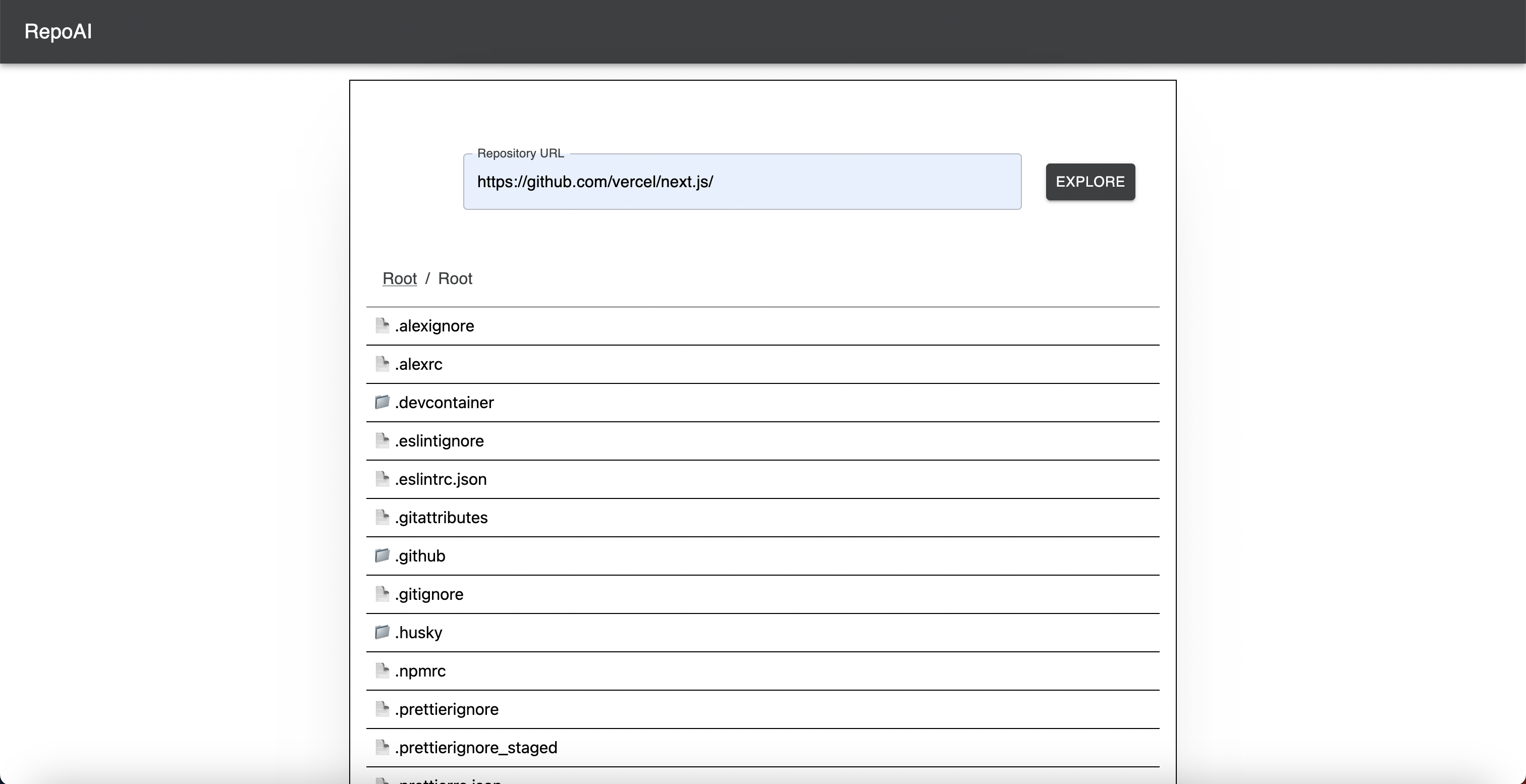
Explore Postgres, AutoGPT and 300+ open source repos with AI
2024 · its alternatives →
- 13

Hi everyone! I've been loving building with AI, and over the past few years I've been leaning more and more into Typescript (and bun). My team at inference.net is constantly trying to get more leverage out of AI and find ways to setup our codebase to be able to increase the level of correctness that our AI is able to write code at. This starter repo is a very opinionated way to lay out a repo to lean into AI heavily. It leverages Cloudflare Workers as a deployment target for the API (my goal is to never have to deploy an API on a AWS/Azure/GCP server ever again unless I get to a…
2025 · abeahmed.com · its alternatives →
- 14

- 15

Hi HN, Lately Github PRs have been drowning in a flood of AI slop. I’ve been seeing it myself, and I’m not the only one: https://x.com/mitchellh/status/2011819428061855915 I think it’s great that folks are using AI tools to code faster and better, but too many folks are abusing them to make low-quality contributions to public repos. This takes a lot of reviewers’ mindshare. IMO there needs to be a mechanism to flag low-effort PRs with AI slop, so you can just skip reading them. So I built one: https://haystackeditor.com/slop-detector It’s a simple AI…
Jan 2026 · haystackeditor.com · its alternatives →
- 16
 Kryon AI▲3
AI that catches risky PRs before they break prod
Aug 2026 · kryon-ai.vercel.app · its alternatives →
- 17
- 18

Hi HN, We are researchers from ETH Zurich interested in the real-world adoption and impact of Code Agents. To measure this, we built a dashboard, scraping all public PRs on GitHub, analyzing which are created by different code agents (Codex, Jules, Copilot, Devin, etc.), and measuring their merge rates, sliced by various repository and PR characteristics. https://insights.logicstar.ai Since mid-May, we've analyzed over 10 million PRs and already found some interesting trends: Usage is high, but shallow. Agents submit ~7% of all PRs overall, but only ~1–2% on popular repos. Most…
2025 · github.com · its alternatives →
- 19

I'm a CTO with a ~16-person engineering team. Last year I wanted real data on what was actually shipping, not guesswork or story point theater. So we built GitVelocity. Every merged PR gets scored 0–100 by Claude across six dimensions: scope (0–20), architecture (0–20), implementation (0–20), risk (0–20), quality (0–15), perf/security (0–5). Six dimensions added up, then scaled by change size — a 10-line fix scores lower than a 500-line refactor even at the same complexity. Full formula at gitvelocity.dev/scoring-guide. After scoring 50,000+ PRs across TypeScript, Python, Rust, Go,…
Mar 2026 · gitvelocity.dev · its alternatives →
- 20

Open source maintainers are drowning in low effort PRs. Someone sees a help wanted issue, pastes it into an AI, submits without testing, loops through review comments without understanding the code. The PR looks plausible at first glance but falls apart under review. Maintainers waste 30 minutes before realizing it's garbage. This is happening at scale now. And it's worst in projects with bounty programs or GSoC where there's incentive to “contribute.” GitHub tells you if someone is a first-time contributor to your repo. It doesn't tell you anything about their history elsewhere. I built a…
Jan 2026 · github.com · its alternatives →
- 21

- 22

Hi there, I've created this side project to make it easier to find interesting repositories using AI. There's still a lot of work to be done to improve it, so any suggestions for enhancements would be greatly appreciated. Thank you!
2024 · awesome-repositories.com · its alternatives →
- 23

AI that ships code directly to GitHub. No PRs.
Jun 2026 · auremcto.com · its alternatives →
- 24IB
For the last 6 months, I've been building ORUS Builder, an open-source AI code generator. My goal was to fix the biggest issue I have with tools like v0, Lovable, etc. – they generate broken, non-compiling code that needs hours of debugging. ORUS Builder is different. It uses a "Compiler-Integrity Generation" (CIG) protocol, a set of cognitive validation steps that run before the code is generated. The result is a 99.9% first-time compilation success rate in my tests. The workflow is simple: 1.Describe an app in a single prompt. 2.It generates a full-stack application…
Nov 2025 · its alternatives →
Also compare
Ranked by how close each launch is in meaning, then by votes. Prices were read from each product’s own site when checked and can change. Refine with your own description →