
I spent 2 years designing a mechanical Magic Keyboard
Hi HN, today I’m revealing Altar II, an ultra-low profile (4.75mm) mechanical keyboard designed to replace your Magic Keyboard. It’s the keyboard I wish Apple made. Altar II has fully mechanical switches, plus a magnetically detachable dial, haptic feedback, a red backlight, and a native macOS companion app. I’m a heavy Mac user and I feel that Apple hasn’t given its keyboards the attention they deserve, in terms of hardware, software, and features, so I set out to try and change that. It was a massive undertaking and it has taken almost 2 years to get to this stage. One of the main…
I spent 2 years designing a mechanical Magic Keyboard launched on August 6, 2026 with 306 votes, #80 of 23,274 launches that month and more than 99% of that year's launches.
In plain words
Altar II is an ultra-low profile mechanical keyboard designed as an alternative to Apple's Magic Keyboard. It features mechanical switches, a magnetically detachable dial, haptic feedback, red backlighting, and a macOS companion app. Built after two years of development, the keyboard prioritizes the hardware and software features the creator felt were missing from Apple's own offerings, with careful attention to battery life and component optimization within its compact 4.75mm frame.
written from the facts on this page · September 2026
From the sources
Shockingly thin, fully mechanical. Altar II combines a superlative typing experience with an unbelievable design.
Shockingly thin, fully mechanical. Altar II combines a superlative typing experience with an unbelievable design. Amazing feel. Thanks to breakthrough engineering, Altar II houses a fully mechanical switch inside a tiny chassis. Durable design. Steel construction means an incredibly durable mechanism with long operating life. Vertical challenge. A preloaded tension spring arranged laterally rather than vertically enables a vertical travel depth of just 1.8mm. Intuitive. Twist for volume adjustment, single click for play/pause, double click for skip, triple for back. Press and hold for Siri. Detachable. M-Dial ™ snaps off quickly and easily for travelling or stowing Altar II away. Swappable.…from electronicmaterialsoffice.com
In the maker’s words, at launch
Hi HN, today I’m revealing Altar II, an ultra-low profile (4.75mm) mechanical keyboard designed to replace your Magic Keyboard. It’s the keyboard I wish Apple made. Altar II has fully mechanical switches, plus a magnetically detachable dial, haptic feedback, a red backlight, and a native macOS companion app. I’m a…
Pricing, as stated on its site
Paid from $249/mo — Altar II is a mechanical keyboard priced at $249 (reserve price, regular $349). One-time purchase model with no subscription or free tier.
checked September 2026 · prices change
Does a similar job
all alternatives → I made a 5-key keyboard2021 · stavros.io · ▲221
 I've built a tiny hand-held keyboard2025 · github.com · ▲411
I bet you didn't knew you can use modelling clay (as opposed to 3d printing) to make nice devices by hand :)
 Apple Magic Accessories2015 · apple.com · ▲302
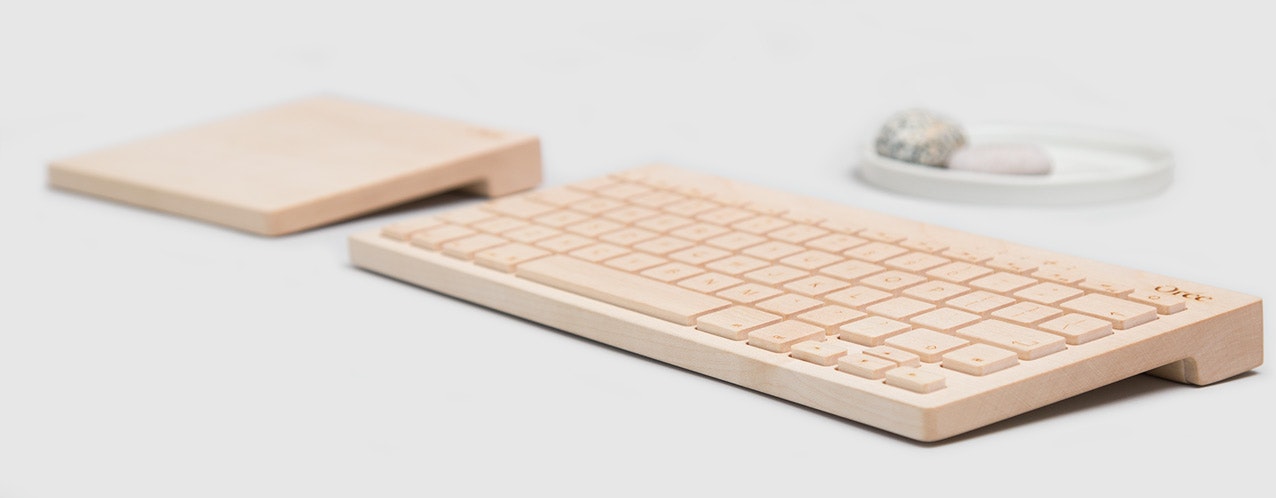
Hands down, the best way to click, scroll, swipe, and type.

More life & fun this month
the category →
A free city-building game in your browser. You are the mayor. You know what the city needs. Now get it past the zoning board, the neighbors, the appeals court and the next election.
Life & fun · 2d ago · permit.petercai.com
- IV
Life & fun · 15d ago · tanzaniaeducationproject.org

Turn a phone, tablet or TV into a sign. Type a message and it fills the screen: welcome signs, timers, Wi-Fi passwords and more. No app, no account, free.
Life & fun · 16d ago · bigwords.page

Play a free virtual guitar online with your keyboard or by touch. Slow songs down and see every chord, string and strum. Acoustic, classic, electric and bass.
Life & fun · 9d ago · guitoro.com

Carrier settings from iPhone, Pixel and Galaxy firmware, decoded and compared: APNs, VoLTE, 5G and Wi-Fi Calling per carrier, and what each build changed.
Life & fun · 14d ago · carrierexplode.com

Life & fun · 23d ago · space.bl2.net
Source: Show HN post ↗ · launch text quoted in part
Launched alongside, August 2026
the whole month →- TL
Life & fun · Aug 2026 · louisabraham.github.io

 Clipto MCP▲655
Hey HN, We recently built Clipto. It’s a tool that lets you search over terabytes of video, audio, and images on your computer, without relying on the cloud. Motivation: we probably all had this similar experience, we know a moment exists in a video or audio, but finding it takes hours scrubbing the timeline. You can send all the media to process in the cloud, but it’s slow, expensive and raises privacy concerns. So we decided to build our own on-device media search engine. How it works (high level): 1. We ingest video, audio, image; normalize formats via ffmpeg; run content analysis to…
Work · Aug 2026 · clipto.com

Hello HN! I found that picking out plausible but diverse skin tones for my digital art and game development projects was kind of difficult, and I got curious about if there was a way to define a color space that made it easy. I've built a color picker and procedural generation algorithm based on the space as well as a bunch of other fun js features and demos throughout the page that use the equations. If you find it interesting, I have lots of explanations of how I built it and what properties the space has. The methodology might be a bit shaky, but hopefully the result is as helpful for…
Life & fun · Aug 2026 · toneyalexander.github.io

 Astute▲606
Automate your B2B brand going viral, with new media creators
AI · Aug 2026 · company-app.joinastute.com