
Llm2sh – Translate plain-language requests into shell commands
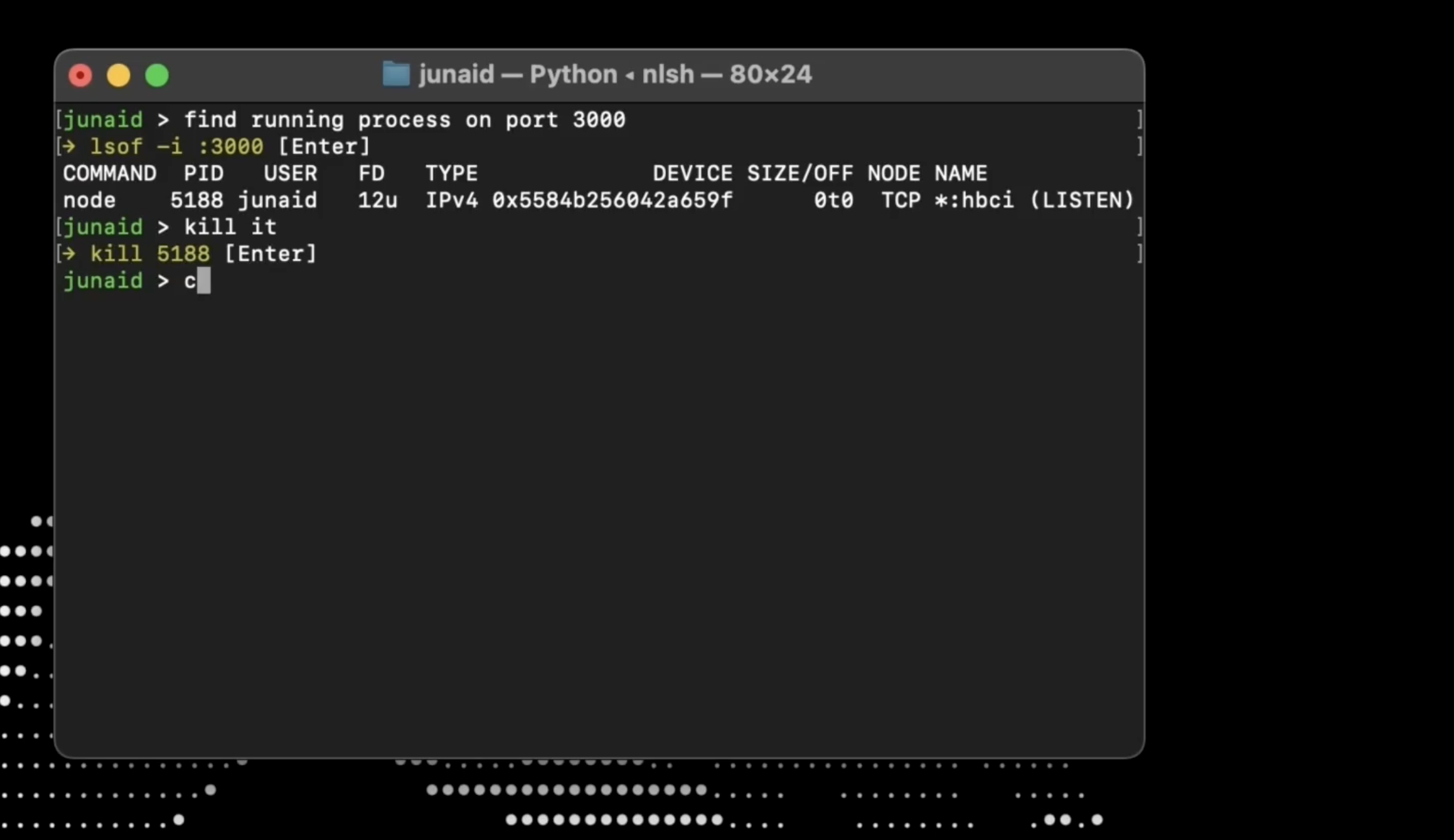
This is my take on the common "use llms to generate shell commands" utility. Emphasis is placed on good CLI UX, simplicity, and flexibility. `llm2sh` supports multiple LLM providers and lets LLMs generate multi-command sequences to handle complex tasks. There is also limited support for commands requiring `sudo` and other basic input. I recommend using Groq llama3-70b for day-to-day use. The ultra-low latency is a game-changer - its near-instant responses helps `llm2sh` integrate seamlessly into day-to-day tasks without breaking you out of the 'zone'. For more advanced tasks, swapping to…
Llm2sh – Translate plain-language requests into shell commands launched on July 18, 2024 with 67 votes, #864 of 5,184 launches that month and more than 90% of that year's launches. The site was still online in September 2026, 2 years on.
In plain words
Llm2sh translates plain-language requests into shell commands using large language models. It works with multiple LLM providers and can generate sequences of commands for complex tasks, with basic support for sudo and input prompts. The tool prioritizes responsive CLI design and flexibility, allowing users to switch between different models depending on task complexity. It is for developers and system administrators who want to quickly convert natural language into executable shell commands.
written from the facts on this page · September 2026
From the sources
Ask GPT to run a command. Contribute to randombk/llm2sh development by creating an account on GitHub.
In the maker’s words, at launch
This is my take on the common "use llms to generate shell commands" utility. Emphasis is placed on good CLI UX, simplicity, and flexibility. `llm2sh` supports multiple LLM providers and lets LLMs generate multi-command sequences to handle complex tasks. There is also limited support for commands requiring `sudo` and…
Does a similar job
all alternatives → Prompting LLMs in Bash scripts2025 · elijahpotter.dev · ▲79
https://github.com/elijah-potter/ofc
 My LLM CLI tool can run tools now, from Python code or plugins2025 · simonwillison.net · ▲529
LLM 0.26 is out with the biggest new feature since I started the project: support for tools. You can now use the LLM CLI tool—and Python library—to grant LLMs from …
 Bash4LLM+ – A lightweight, dependency-free Bash wrapper for LLM APIsJun 2026 · github.com · ▲60
Bash4LLM is a single-file Bash wrapper for interacting with LLMs from the terminal. I created it because I wanted something simple that worked without installing Python, Node, or any other runtime. It uses only Bash, curl, and jq. You can send prompts, start a small chat, process files line by line, stream output, and save session metadata in JSON format. I tried to make it safe and predictable: no use of the system /tmp, no use of eval. Groq is supported by default, and other providers can be added with dedicated Bash scripts in the extras/providers/ folder. Example: echo…
 LLM, a Rust Crate/CLI for CPU Inference of LLMs (LLaMA, GPT-NeoX, etc.)2023 · github.com · ▲45
G'day, HN! I'm one of the maintainers of `llm`. I've been working alongside a trusty group of contributors to bring this project to life, and we're now at a point where we're ready to share it with the world. Large language models (LLMs) are taking the computing world by storm due to their emergent abilities that allow them to perform a wide variety of tasks, including translation, summarization, code generation, and even some degree of reasoning. However, the ecosystem around LLMs is still in its infancy, and it can be difficult to get started with these models. `llm` is a one-stop shop for…
 Ell – A command-line interface for LLMs written in Bash2024 · github.com · ▲214
Hi HN! I've created a CLI tool called "ell" that allows you to interact with LLMs directly from your terminal. Designed with the Unix philosophy in mind, ell is simple, modular, and extensible. You can easily pipe input and output to integrate with other tools. Its templates and hook-based plugins enable you to customize and extend its functionality to suit any needs. Check out the README for usage instructions and examples. I developed this tool because existing solutions often felt too heavy, with many dependencies, or they weren't friendly to piping and customization. I, on the contrary,…
More ai this month
the category →


Paintings by AI models: programs run through a simulation of oil paint.
AI · 21d ago · stillwet.art
 PixVerse R2▲381
A real-time world model you can explore and change
AI · 29d ago · world.pixverse.video

Source: Show HN post ↗ · launch text quoted in part
Launched alongside, July 2024
the whole month →


Many years ago, I made VJ softwares (to mix live visuals in clubs) for unexpected platforms like the Game Boy Advance, the Playstation 2 and the Raspberry Pi. This year, I’m back with a new web-app: Pikimov. Inspired by Photopea (a free Photoshop clone), I created this web-based motion design & video editor as an alternative to After Effects, to fill empty void. It's free, without signup, without cloud uploads (your files stay on your machine), and your projects are not used for AI models training.
AI · 2024 · pikimov.com
