The Magic of Code – book about the wonders and weirdness of computation
I recently published a book called “The Magic of Code” which is about the delights of the computational world, examining computing as a kind of “humanistic liberal art” that connects to so many topics, from art and biology to philosophy and language. The link I’ve shared is to a page on my book’s website where you can download a pdf of the introduction, to give HN readers a taste of what is inside. Right now there is so much worry and concern around technology that I feel like some people—though not the folks here—have forgotten how much fun that code and computation can also be. So I wanted…
The Magic of Code – book about the wonders and weirdness of computation launched on July 22, 2025 with 112 votes, #379 of 9,223 launches that month and more than 95% of that year's launches. The site was still online in September 2026, 1 year on.
In plain words
The Magic of Code" is a book exploring computation as a humanistic liberal art, connecting computer science to fields like art, biology, philosophy, and language. Written for people curious about computing's broader cultural significance, the book examines the wonder and delight of code rather than focusing on technical implementation. It offers readers—particularly those new to programming—a perspective that situates computational thinking within wider intellectual traditions and demonstrates how coding intersects with fundamental human concerns and creative pursuits.
written from the facts on this page · September 2026
From the sources
The Magic of Code by Samuel Arbesman
The Magic of Code is all about the wonders and weirdness of computation, viewing computing as a humanistic liberal art that touches on everything from language and philosophy to biology and how wefrom themagicofcode.com
In the maker’s words, at launch
I recently published a book called “The Magic of Code” which is about the delights of the computational world, examining computing as a kind of “humanistic liberal art” that connects to so many topics, from art and biology to philosophy and language. The link I’ve shared is to a page on my book’s website where you…
Does a similar job
all alternatives →
- IWI wrote a technical history book on LispFeb 2026 · berksoft.ca · ▲252
The book page links to a blog post that explains how I got about it (and has a link to sample content), but the TL&DR is that I could not find a lot of books that were on "our" history _and_ were larded with technical details. So I set about writing one, and some five years later I'm happy to share the result. I think it's one of the few "computer history" books that has tons of code, but correct me if I'm wrong (I wrote this both to tell a story and to learn :-)). My favorite languages are Smalltalk and Lisp, but as an Emacs user, I've been using the latter for much longer and for my…
 Nature of Code2017 · natureofcode.com · ▲107
Learn to program computer simulations of natural systems
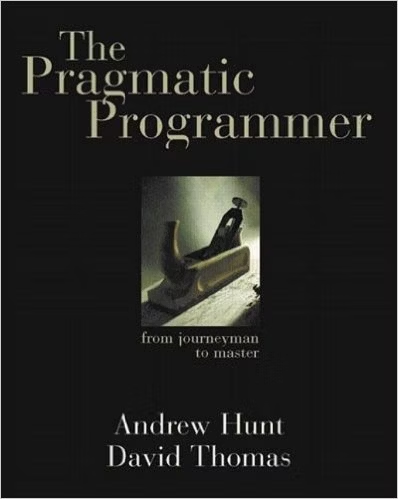
 I wrote a book about Python2021 · pragprog.com · ▲181
Hey HN! I wrote a book on programming called The Elements of Code. I put the entire book online here: https://elementsofcode.io/ When mentoring (usually new) programmers, I noticed there were a few common mistakes that seemed to account for about 80% of the complexity in their code. I couldn’t find a concise guide to fixing those mistakes, so I decided to write one. The title is an homage to The Elements of Style by Strunk and White, which is the classic guide for communicating well using prose. That guide is quite tactical in nature, and I wanted to parallel its focus in The…
 I made an esoteric programming language that's read like a spellbook2025 · github.com · ▲176
i made an esoteric programming language which i call spellscript. every program is a "spell" written in a "grimoire," and you have to use keywords like summon, enchant, inscribe, and conjure. it's literally read like a spellbook because the syntax consists of all natural language, and newlines are optional. your code can now be an essay, like everybody wants! for example, if you want to print something, you'd write: `begin the grimoire. inscribe whispers of "hello, world!". close the grimoire.` it has variables, dynamic typing, arrays, functions, conditionals, loops, string manipulation,…
More dev tools this month
the category →
Contribute to oosexgang/hackios-xnu-kernel development by creating an account on GitHub.
Dev tools · 1d ago · github.com


open-source IDE for thoughtful software design. Contribute to devdotfast/whiteboard development by creating an account on GitHub.
Dev tools · 29d ago · github.com

Contribute to reladraw/reladraw development by creating an account on GitHub.
Dev tools · 27d ago · github.com
 OpenBot▲362
Grok Bot alternative: free, local, open-source, multiplayer
Dev tools · 25d ago · openbot.run
 Talanoa▲346
Hi HN, I’m a fullstack developer, and honestly, I’ve lost count of how many side projects I’ve worked on over the years. But one idea kept coming back to me: a different kind of email client. It first came to me in 2014: “What if we could handle emails more like conversations?” Every year, I’d revisit this concept in my “Build Notes.” Ten years later, no one had built exactly what I had in mind — so I finally decided to do it myself. That’s how Talanoa was born. I wanted something focused on people, not timelines. I was tired of marking messages as unread just to remember to reply later, or…
Dev tools · 22d ago · talanoa.email
Source: Show HN post ↗ · launch text quoted in part
Launched alongside, July 2025
the whole month →
 Trickle - Magic Canvas ▲1,064
Hey HN! Introducing Trickle Magic Canvas: the world’s first Agentic Canvas, where you can visually co-create apps and websites with AI, from idea to production. Why is a canvas better? Most AI tools today rely on linear chats or text prompts. We believe that limits creativity and clarity. Canvas changes the game. 1. Every version & page at a glance. Each page and sub-page lives on a timeline. You can quickly browse, edit, and preview progress like a living, visual document — no more digging through chat logs or scattered states. 2. The canvas is the context. Unlike linear chats, you can…
AI · 2025 · trickle.so
- TB
Life & fun · 2025 · trytender.app

Today marks ten years, 3653 consecutive days, of running at least one mile every day under the USRSA rules [1]. To celebrate, I built an interactive dashboard that turns a decade of GPX files into charts you can explore. Running has truly changed my life: I've made lifelong friends, explored beautiful places, and more importantly invested into my own health and fitness, which I'm starting to see the positive benefits as I get older. The stack is pretty simple: a NextJS app, with a Postgres database to keep all my running data, and all the stats are pre-computed and cached in Redis, so I…
Dev tools · 2025 · nodaysoff.run

Made this website as an exercise in vibe-coding and GCP. It was posted about a few times around the internet, on sites like Morning Brew (https://www.morningbrew.com/issues/business-buzzkill), MetaFilter (https://www.metafilter.com/209703/Draw-A-Fish), boingboing.net, etc. I think it's cute! I built a basic CNN trained against penises and swastikas, and then anything that doesn't hit the 63% confidence score gets sent to a mod queue, a vibe-coded fish-tinder…
AI · 2025 · drawafish.com

Hi HN - I made a site that takes a UK postcode, grabs the local MP's information and generates an AI mockup of what their ID might look like. It's a small, silly protest at the stupidity of the Online Safety Act that just came into force. edit - My open AI credits got hugged to death, please use a known postcode (like one from Kier Starmer's constituency, WC2B6NH) in the meantime.
AI · 2025 · use-their-id.com