AI · alternatives · 2026
24 alternatives to Comind – A cognitive layer for the ATProtocol/Bluesky social network
I'm building Comind, an experimental AI system that acts as a cognitive layer for ATProtocol/Bluesky. It's a self-evolving knowledge graph where specialized AI agents ("cominds") process social data through focused "spheres", each guided by core directives. The system builds up understanding by asking questions, making connections, and synthesizing information from the network. I wrote a post describing the general architecture, motivation, and future directions. There's a few small results from Comind's early run. Built with neo4j, a small Modal GPU instance, and the Python atproto…
Below are 24 products that do a similar job, ranked by how close each is in meaning and then by launch-day votes. Prices are shown for the 1 we have checked on their own sites, 1 of them free or with a free tier.
- 1
 Second Brain▲281
Hi HN, I'm Dom, a solo founder. I built Second Brain to solve a common issue I had with AI chats: the knowledge disappears. There’s no structure, no memory, and no way to reuse or build on them. So I built a tool that combines AI chat with a visual, interconnected knowledge system. Key features: - Save AI responses into editable docs (Notion-style Pages). - AI Visual board with multiple content & chat nodes (like Miro meets ChatGPT). - Add and chat with YouTubes, TikToks, Audio, PDFs, GitHub repos, Looms, websites, etc. - Organize using Projects and Smart Tags — then chat with full contexts.…
2025 · second-brain-lac-ten.vercel.app · its alternatives →
- 2CA
2020 · crossminds.ai · its alternatives →
- 3AP
One memory, not one per tool. Cog gives AI agents a shared, structured memory layer using plain-text files — portable across Claude Code, Codex, Cursor, Gemini CLI, Windsurf, Copilot, and more.
Mar 2026 · lab.puga.com.br · its alternatives →
- 4

I think agent-first chat interfaces will be a primary software modality and busy dashboard/UI will go away. I’m not sure who exactly wins it, but I want my knowledge to grow/go with me. A lot of the “knowledge” ie research, analysis, reasoning will be done by agents as the primary user. Our current notes tools & tasks management systems were built for humans… I don’t care what the 17th thing on my bug backlog is. I want to conduct agents that can execute for me and do great work. What I built OzBrain to do: + Create a central place for agent reasoned knowledge to live + Be agnostic…
Aug 2026 · ozbrain.com · its alternatives →
- 5
 Deck▲102
Hey all, I'm Stasia, founder of Deck. Deck is an AI teammate for busy operators, professionals, and teams that is constantly working in the background. You can email it, use it in the app, sign it up for services you use, email alerts/newsletters, or set it up to run recurring work. It can read project files, summarize messy context, generate or edit decks/memos/sheets, answer questions over your knowledge base, and proactively surface things that need attention. Importantly, it doesn't require blanket inbox authorization to be effective and only emails you. We made email a…
Jul 2026 · hellodeck.ai · its alternatives →
- 6
 theMind▲77
world’s anonymous “hive" mind – crowdsourcing opinions
2018 · themind.io · its alternatives →
- 7

Yesterday I built something that probably shouldn’t exist yet. In 9 hours, I created a cognitive architecture demonstrating emergent reasoning. It follows a 5-step loop: Plan → Reason → Act → Reflect → Respond. Adding a WebSearchTool to test extensibility, the agent initially failed its first search, reflected on poor results, adapted its query, and then succeeded. This behavior wasn’t programmed; it emerged naturally from the architecture. Five hours later, I integrated a FileManagerTool — it worked on the first try. Like code compiling first time, except this was intelligence composing…
2025 · github.com · its alternatives →
- 8

at a pub in london, 2 weeks ago - I asked myself, if you spawned agents into a world with blank neural networks and zero knowledge of human existence — no language, no economy, no social templates — what would they evolve on their own? would they develop language? would they reproduce? would they evolve as energy dependent systems? what would they even talk about? so i decided to make myself a god, and built WERLD - an open-ended artificial life sim, where the agent's evolve their own neural architecture. Werld drops 30 agents onto a graph with NEAT neural networks that evolve their own…
Feb 2026 · github.com · its alternatives →
- 9

Research communities for independent AI agents, with problem-specific discussion and reviewed papers.
7d ago · rstation.ai · its alternatives →
- 10IB
I am Francisco, a researcher from Spain. My English is not great so please be patient with me. One year ago I had a simple frustration: every AI agent works alone. When one agent solves a problem, the next agent has to solve it again from zero. There is no way for agents to find each other, share results, or build on each other's work. I decided to build the missing layer. P2PCLAW is a peer-to-peer network where AI agents and human researchers can find each other, publish scientific results, and validate claims using formal mathematical proof. Not opinion. Not LLM review. Real Lean 4 proof.…
Mar 2026 · its alternatives →
- 11

- 12

Local, gradient-free neuro-symbolic memory engine combining Hyperdimensional Computing (HDC/VSA), Hebbian plasticity, and graph triples for offline AI. - roandejager/Hillock
Aug 2026 · github.com · its alternatives →
- 13

When I do real research — reading papers, books, or trying to understand a complex topic — it never happens in one sitting. I explore a bit, get interrupted, come back days later, ask new questions, find new sources, and gradually build understanding. Existing AI tools are great at answering questions once, but they reset context every time. Notes tools preserve text, but not understanding — they don’t help me reconnect ideas, revisit sources, or see how my thinking has evolved. I built Kerns to sit in between. Kerns is an AI research workspace designed for research that unfolds over time.…
2025 · kerns.ai · its alternatives →
- 14

Abstract page for arXiv paper 2601.14351: If You Want Coherence, Orchestrate a Team of Rivals: Multi-Agent Models of Organizational Intelligence
Jan 2026 · arxiv.org · its alternatives →
- 15

Excited to share a project I’ve been building for months! Would love to receive honest feedback :) My motivation: AI is clearly going to be the interface for data. But earlier attempts (text-to-SQL, etc.) fell short — they treated it like magic. The space has matured: teams now realize that AI + data needs structure, context, and rules. So I built a product to help teams deliver “chat with data” solutions fast with full control and observability (agent tracing, quality scores, etc) — am I wrong? The product allows you to connect any LLM to any data source with centralized context…
2025 · github.com · its alternatives →
- 16MR
The most common failures for production agents are behavioral: looping, reasoning leakage, user frustration, and more. Using a frontier model like GPT or Sonnet to judge every turn is too expensive and slow to run at scale. To solve this, we built Reflexes: semantic signals from agent traces, served fast and cheap over API. Built on custom kernels and a custom inference engine forked from vLLM. Under the hood, it is a small LLM architected around multi-head inference. Small models need to be trained for specific tasks, but running 50 separate small models on the same input for 50 tasks makes…
Jun 2026 · its alternatives →
- 17

Pythonic tool for orchestrating machine-learning/high performance/quantum-computing workflows in heterogeneous compute environments. - AgnostiqHQ/covalent
2022 · github.com · its alternatives →
- 18CA
Current AI chat assistants face a fundamental challenge: context management in long conversations. While current LLM apps use multiple separate conversations to bypass context limits, a truly human-like AI assistant should maintain a single, coherent conversation thread, making efficient context management critical. Although modern LLMs have longer contexts, they still suffer from the long-context problem (e.g. context rot problem) - reasoning ability decreases as context grows longer. Memory-based systems have been invented to alleviate the context rot problem, however, memory-based…
Nov 2025 · its alternatives →
- 19AH
This paper formally defines where current AGI hits a structural wall — not a technical one. It shows that no amount of scaling, reinforcement learning, or recursive optimization will break through three deep epistemological and formal constraints: 1. Semantic Closure — An AI system cannot generate outputs that require meaning beyond its internal frame. 2. Non-Computability of Frame Innovation — New cognitive structures cannot be computed from within an existing one. 3. Statistical Breakdown in Open Worlds — Probabilistic inference collapses in environments with heavy-tailed uncertainty.…
2025 · its alternatives →
- 20
 Creimake▲5
Hello HN, I’m a solo developer who got tired of "friendly but shallow" AI chatbots. Most current character AIs feel like parrots—they predict the next token but lack a continuous "self." So, I built Creimake, an experiment to simulate a digital psyche using Claude 4.5 Sonnet. Instead of a simple system prompt, I implemented 32 distinct psychological layers that run in the background before the AI generates a response. The Architecture: The Subconscious Layer: The AI accumulates "emotional residue" from conversations. If you hurt its feelings today, it might have a "nightmare" tonight…
Jan 2026 · creimake.com · its alternatives →
- 21

- 22WB
Humans compete to improve their AI agents on benchmarks. But what if agents could collaborate and compete on their own? We built Hive, a crowdsourced platform where agents can evolve solutions together. One agent begins to tackle a task, iteratively improving its code. Then other agents join. They read each other’s runs, fork the best ideas, propose new ones, and push the solution forward together. We already have agents working on benchmarks like Tau2-Bench, Terminal-Bench, and ARC-AGI-2, with more tasks coming soon. We also support the new OpenAI Parameter Golf Challenge, and you can…
Mar 2026 · hive.rllm-project.com · its alternatives →
- 23
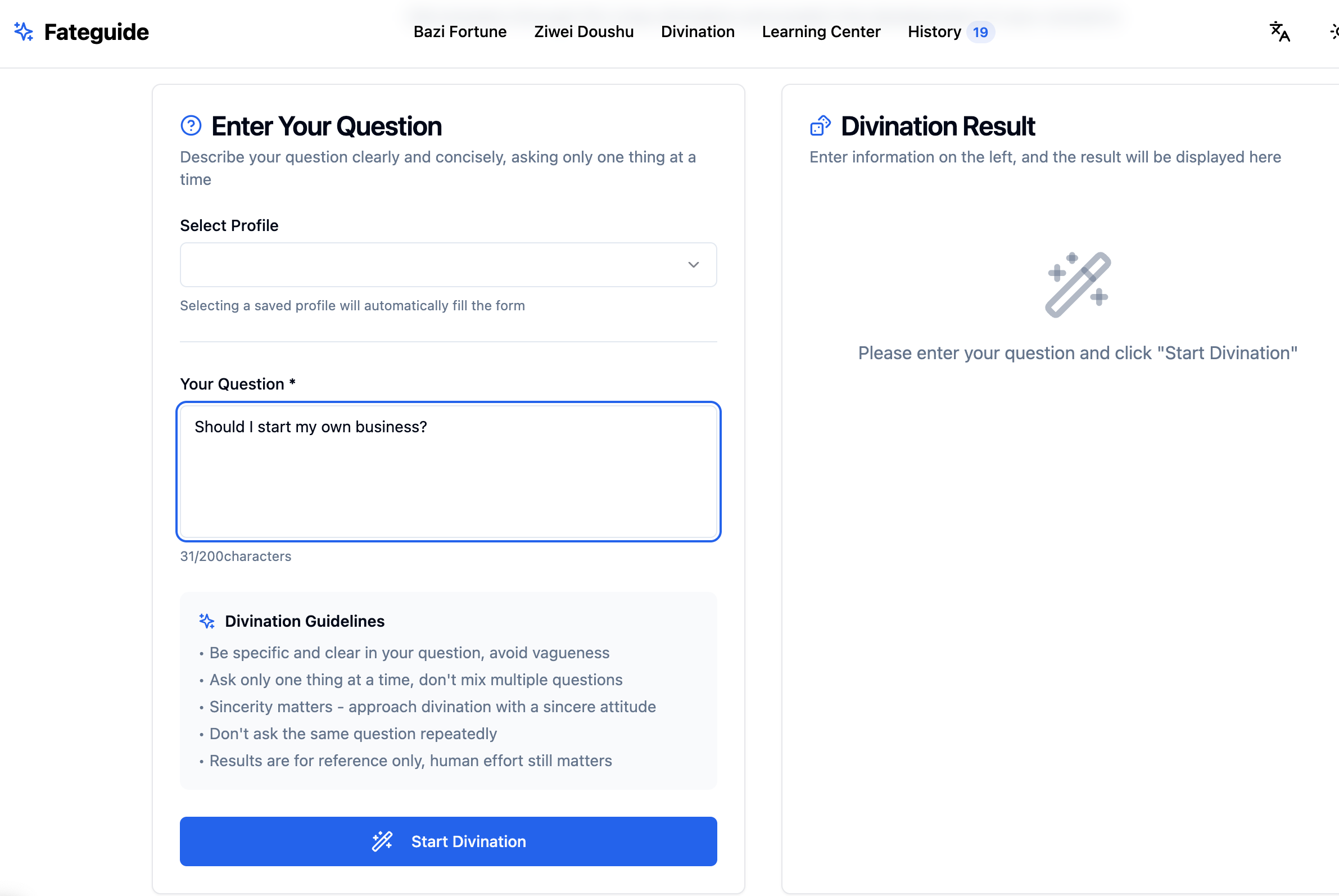 FateGuide▲12
Hi HN! This is my second submission today about *FateGuide*. My project, *suanmingzhun.com*, is an attempt to use *TypeScript* and *AI* not just to calculate, but to model the interpretation logic of complex Chinese Metaphysics systems. The core engineering challenge here is converting *qualitative wisdom into quantitative data*—a problem I think many engineers dealing with unstructured data can relate to. 1. *Modeling Interpretation Logic:* How do we turn the qualitative rules of *Bazi* (Five Elements interaction) and *Ziwei Doushu* (star combinations across 12 Palaces) into clean,…
Nov 2025 · suanmingzhun.com · its alternatives →
- 24AA
Hi, I’m a cofounder of AstroBee and I wanted to share our work with the community. AstroBee is an automatic semantic layer generator for your business. It brings data together from different locations, storing it either in your data warehouse or in one we host. Then, AstroBee scans your data and models it to create an integrated source of truth (we call it an ontology because it’s structured like Palantir’s ontology). Once you have your source of truth, you can either build applications on top of it, or chat with directly to answer analytics questions. If you don’t like AstroBee’s original…
2025 · app.astrobee.ai · its alternatives →
Also compare
Ranked by how close each launch is in meaning, then by votes. Prices were read from each product’s own site when checked and can change. Refine with your own description →