Life & fun · alternatives · 2026

24 alternatives to Erudity
Learn anything. Actually anything.
Below are 24 products that do a similar job, ranked by how close each is in meaning and then by launch-day votes.
- 1

I think LLMs are overused to summarise and underused to help us read deeper. I built a system for Claude Code to browse 100 non-fiction books and find interesting connections between them. I started out with a pipeline in stages, chaining together LLM calls to build up a context of the library. I was mainly getting back the insight that I was baking into the prompts, and the results weren't particularly surprising. On a whim, I gave CC access to my debug CLI tools and found that it wiped the floor with that approach. It gave actually interesting results and required very little orchestration…
Jan 2026 · trails.pieterma.es · its alternatives →
- 2

Hey HN! Lathe is an experiment in using LLMs to teach me something new, instead of doing the work for me. It generates a hands-on, source-backed tutorial for any technical topic you want to learn. Then you work through it yourself by reading and typing the code by hand (gasp) in a local UI built for exactly that. It's a Go CLI plus LLM agent skills (Claude Code / Cursor / Codex). You prompt something like "/lathe build a 3D slicer in Erlang", run `lathe serve` to spin up a local webapp, and read it in your browser. Every tutorial comes with the things that have made…
Jun 2026 · github.com · its alternatives →
- 3HL
All content is based on Andrej Karpathy's "Intro to Large Language Models" lecture (youtube.com/watch?v=7xTGNNLPyMI). I downloaded the transcript and used Claude Code to generate the entire interactive site from it — single HTML file. I find it useful to revisit this content time to time.
Apr 2026 · ynarwal.github.io · its alternatives →
- 4

Adaptive, personal and proactive learning platform
2025 · eruditions.org · its alternatives →
- 5

- 6

- 7

Here is a tool I built initially for myself to help with my German and Greek language studies. It started as a hack for creating Anki cards from native language audio. It extracts the words, finds their base forms (lemmas) and groups the examples by the lemma. At some point I realised that I have a transcription with word level timestamps that opens a lot of other opportunities. So I added a mode to click the first and last word in the transcript and it starts looping with the right gap and repeat count. Another feature I use a lot is selecting an audio fragment, sending a predefined prompt…
Jun 2026 · lingochunk.com · its alternatives →
- 8

ErisForge is a Python library designed to modify Large Language Models (LLMs) by applying transformations to their internal layers. Named after Eris, the goddess of strife and discord, ErisForge allows you to alter model behavior in a controlled manner, creating both ablated and augmented versions of LLMs that respond differently to specific types of input. It is also quite useful to perform studies on propaganda and bias in LLMs (planning to experiment with deepseek). Features - Modify internal layers of LLMs to produce altered behaviors. - Ablate or enhance model responses with the…
2025 · github.com · its alternatives →
- 9

- 10

- 11
 Slay School▲154
Turn your notes into flashcards, essays & audio in seconds
2024 · slayschool.com · its alternatives →
- 12

Collect and practice your individual foreign language words
2023 · wokabulary.com · its alternatives →
- 13
 Wokabulary▲83
Flash card language learning app for Mac, iPhone and iPad
2021 · wokabulary.com · its alternatives →
- 14FA
Made this app because I was tired of not knowing 50 words/book when I read in English. You can try it on the AppStore searching "Quicky app". For Android user please use the web mobile version at https://quicky.app/. The Desktop version has a shitty responsive design. IMPORTANT NOTE: If you are not French, you will want to tell you are to try the features of the app (sorry it's only in French though) I'd love to hear your feedback.
2019 · its alternatives →
- 15

- 16
- 17
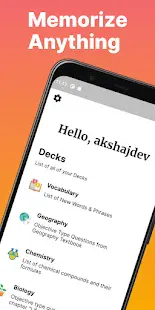
 Cardy▲64
A simple and easy to use flashcard app to learn vocabulary
2019 · play.google.com · its alternatives →
- 18

Memorize everything, everywhere, everyone
2023 · everycards.app · its alternatives →
- 19EL
Hey HN! I'd love to get some people to mess around with a little side project I built to teach myself DSPy! I've been a big fan of reading fiction + webnovels for a while now, and have always been curious about two things: how can LLMs iteratively learn to write better based on reader feedback, and which LLMs are actually best at creative writing (research benchmarks are cool, but don't necessarily translate to real-world usage). That's exactly why I built narrator.sh! The platform takes in a user input for a novel idea, then generates serialized fiction chapter-by-chapter by using DSPy to…
2025 · narrator.sh · its alternatives →
- 20UL
Shopping online can be pretty tedious if you care about the quality of what you are buying. The time it takes can scale pretty proportionally to some combination of the value, relative importance, and complexity of the purchase. I think LLMs can help expedite and personalize the online shopping experience to a degree marketplaces just don't currently provide. I don't think anybody really wants to read the product descriptions of a bunch of products, read reviews, do pairwise product comparisons, and find the best deals across different websites? Or am I wrong? That's why I think this…
2024 · claros.so · its alternatives →
- 21

- 22IB
Hi HN, I’m Felipe, a 9-5 developer aiming to become a full-time indie hacker. I struggled with flashcard apps that focus on decorating cards instead of learning concepts, so I built FlipCards to solve that problem. What it does: FlipCards lets you: - Create cards for any concept (math, language, coding, etc.) - Add multiple variations per card – the more variations, the better your understanding - Study smarter – the algorithm randomly selects variations so you can’t just memorize Q→A patterns Why it’s different: - Most apps use reverse cards (Q→A, A→Q). FlipCards uses variations to…
2025 · flipcardsapp.vercel.app · its alternatives →
- 23
 Periplus▲20
I've been building this for a few months now, started because I was frustrated with how I learn using LLMs. You get a wall of text that vanishes into chat history. Wikipedia's the opposite: endless rabbit holes without structure. I wanted something in between. Periplus generates courses as connected markdown documents, tailored to your level. It asks a few questions upfront, builds a syllabus, and each concept links to related ones. Click a term you don't understand and it opens a new document side-by-side. Heavy inspiration from Obsidian - the graph view is similar, and there's an Obsidian…
2025 · periplus.app · its alternatives →
- 24

Also compare
- I used Claude Code to discover connections between 100 books alternatives
- Lathe – Use LLMs to learn a new domain, not skip past it alternatives
- How LLMs Work – Interactive visual guide based on Karpathy's lecture alternatives
- Eruditions alternatives
- Figy.ai alternatives
- Studyy - Instant Flashcards alternatives
Ranked by how close each launch is in meaning, then by votes. Prices were read from each product’s own site when checked and can change. Refine with your own description →