AI · alternatives · 2026
24 alternatives to I've trained my neural network to play Tinder
The video is here: https://www.youtube.com/watch?v=Ohs6sgmVNYI This video is a prof of concept. I always wanted to see if I could make my Neural Network play tinder for me. So I gather some pictures, created a fake tinder app (so I don't expose real people) and began the training. For this experiment I'm using scrcpy to control my cellphone and pyautogui alongside my neural network. The script is very simple: Get the image, run it trough a neural network, move the mouse to the output (yes or no) and click. There's a lot of hard coded things in my code, but as I said earlier,…
A proof-of-concept project that uses a neural network to automate swiping decisions on a dating app interface. The developer trained the model on gathered images and created a fake Tinder app to test the concept… Below are 24 products that do a similar job, ranked by how close each is in meaning and then by launch-day votes. I've trained my neural network to play Tinder launched in 2019; newer entries below may have overtaken it.
- 1IT
Before the pandemic, my tiny startup was doing quite well selling Edge AI systems, based on our own lightweight AI inference engine, with object detection and face recognition for smart city and smart retail & food service applications. When the real world shut down, there was suddenly nothing to monitor on streets and in restaurants, so I set out to try and evolve our real time face recognition system into a video codec for high quality face-to-face online interactions, as I was not satisfied with the quality of Zoom and friends. I got it to work, and the first release for IOS was just…
2022 · vertigo.ai · its alternatives →
- 2

2024 · graphgame.sabrina.dev · its alternatives →
- 3

Parody dating game with a twist and a bunch of swipes!
2015 · apps.apple.com · its alternatives →
- 4TTinder4Cats▲104
Couldn't resist when I saw Tinder for the other day! Thanks https://twitter.com/DasSurma for making the source code for Tinder for Bananas available!
2022 · tinder4cats.com · its alternatives →
- 5

Generate a personalized Tinder bio within seconds using AI.
2022 · play.google.com · its alternatives →
- 6
 Copyhat▲139
Say goodbye to boring Tinder openers with your AI wingbot
2021 · copyhat.com · its alternatives →
- 7

Play BangBang against a Neural Network. Contribute to victorqribeiro/bangBang development by creating an account on GitHub.
2022 · github.com · its alternatives →
- 8
 Lexie▲102
Built this because kids 10-15 can't prompt AI effectively. They'd type "make quiz plz" and get confused when ChatGPT asks for context. Lexie takes 46 steps of AI prompting, context explanation, and output formatting and makes it one step: point camera, get quiz. The photo constraint isn't just better UX, it's the only way to get usable output from that age group. This demographic gets the worst deal in edtech. Too advanced for baby apps, too young for adult tools. They get gamification theater instead of real learning tools. I stripped all that out. Photo your geology notes, get instant…
Apr 2026 · lexielearn.com · its alternatives →
- 9
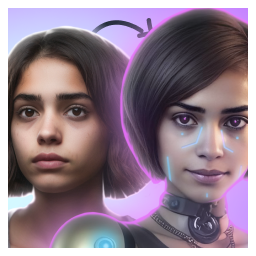 GenYOU ▲102
Make AI photos that are 100% "That's me!" not "Who's that?"
2024 · generated.photos · its alternatives →
- 10

Hey everyone, I made this thing: https://tryflux.ai/. Here's a demo video: https://screen.studio/share/1y2EnC26 Context: I've tried probably 15 different AI apps over the past year. ChatGPT, note-taking apps, productivity apps, all of it. But most of them are just clutter on my iphone. They live in some app I have to deliberately open. And I just... don't. But you know what I open 50 times a day without thinking? iMessage. So out of mild frustration with the "AI app graveyard" on my phone, I built Flux. What it does: - You describe a personality and what…
Jan 2026 · tryflux.ai · its alternatives →
- 11

- 12
 TinderBot▲69
A chat bot to help you deicide what way you should swipe
2019 · premade.outgrow.us · its alternatives →
- 13IC
I spent the past week implementing a 1 Layer Neural Net and training it on MNIST within the visual scripting language provided by scratch.mit.edu. It was tedious, but ultimately not too difficult. The code runs incredibly slowly, so much so that 64 samples of MNIST takes 5+ hours to train on my machine. There were a lot of little mini challenges that were fun to overcome (implementing softmax was very tricky). If you're interested, I encourage you to try and improve on it! More details in the linked blog post.
2024 · bell-boy.github.io · its alternatives →
- 14W1
Hey HackerNews, I built this project over the last few weeks as a palette cleanser from a failed game launch. I wanted to learn a bit about AI/Neural-Networks and naively thought I could build a tiny maze-solving AI in a weekend with a 100% solve rate. Well - I couldn't, but I got pretty close. 14 Bytes total model size, and a 96.5% solve rate on unseen mazes. Trained across 46 phases experimenting with different ideas to improve the model (better performance, smaller size). Its quite fun to watch the model attempt to solve the maze, when they fail its usually due to getting stuck in a…
Jul 2026 · con-dog.github.io · its alternatives →
- 15

I’ve spent the last few months building a deep learning engine completely from scratch in Python (using only math and random). What started as a basic linear algebra calculator project grew into a symbolic tensor system with autodiff, custom matrix ops, attention mechanisms, LayerNorm, GELU, and even a text generation demo trained on the Brown corpus. I'm still an undergrad, so my main goal is to deeply understand how deep learning actually works under the hood - gradients, attention, backpropagation, optimizers - by building it step-by-step with full visibility into everything, and without…
2025 · github.com · its alternatives →
- 1610XSWIPE▲7
AI-powered dating profile optimization that actually works
Jan 2026 · 10xswipe.com · its alternatives →
- 17

AI generation of realistic images for dating profiles.
2024 · tinderprofile.ai · its alternatives →
- 18

I’m 15 and self-taught. I'm learning ML from scratch because I want to really understand how things work. I’m not into frameworks. I prefer math, logic, and C++. I implemented a basic MLP that supports different activation and loss functions. It was trained via mini-batch gradient descent. I wrote it from scratch, using no external libraries except Eigen (for linear algebra). I learned how a Neural Network learns (all the math) -- how the forward pass works, and how learning via backpropagation works. How to convert all that math into code. I’ll write a blog soon explaining how MLPs work in…
2025 · github.com · its alternatives →
- 19
Built a Tinder-style investing app for Gen Z
Feb 2026 · investswipe-demo-v1.vercel.app · its alternatives →
- 20FO
Hey HN! We're Ayman and Dylan, co-founders of Nuanced (https://www.nuanced.dev/). We want to share a tool we’re working on to detect fake and real images: https://trial.nuanced.dev/demo/. The UI is bare-bones but you’ll get the idea. Drag or upload an image and our tool will display the probabilities with which it thinks that the image might be AI-generated or not. If you want, you can click “No, it’s AI” to confirm that the image was AI-generated, or “No, it’s real” to confirm that the image was not AI-generated. Why we’re working on this: as AI-generated…
2024 · trial.nuanced.dev · its alternatives →
- 21

Automate your Tinder swipes with AI
2024 · wizardofswipe.com · its alternatives →
- 22

- 23

A Tinder Card Stack Prototype that uses iOS 14's Vision Hand Pose Request to let you do a thumbs up or down for swiping left or right. - anupamchugh/iOS14VisionHandPose
2021 · github.com · its alternatives →
- 24

Hey HackerNews folks! I first launched DatingAI.pro to help people improve their dating profiles, get reply suggestions, etc but to that I got feedback where people pointed out that someone could just impersonate their entire profile which made sense and I thought what if I could actually help people really get better at texting or conversations by giving them feedback and letting them improve via suggestions. I understand a human date can't be replaced but certainly we could help to an extent. NOTE - THIS IS NOT AN AI GIRLFRIEND. This is how it works: 1. Swipe from profiles of the opposite…
2023 · datingai.pro · its alternatives →

Also compare
Ranked by how close each launch is in meaning, then by votes. Prices were read from each product’s own site when checked and can change. Refine with your own description →