Alternatives
Products that do what Tamagotchi P1 for FPGAs does
After ~7 months of being thrust headfirst into FPGA development thanks to the Analogue Pocket, my first from scratch creation is now available. The core, running on both the Analogue Pocket and MiSTer platforms, lets users re-experience the very first Tamagotchi from 1996 with accurate emulation, but modern features. The core has savestates (which is much harder to do in hardware vs software emulation), high turbo speeds (1,800x was the max clock speed I've reached so far), and more. Learning more about hardware and FPGAs is something I've wanted to do for many years, and I highly recommend…
- 1TP
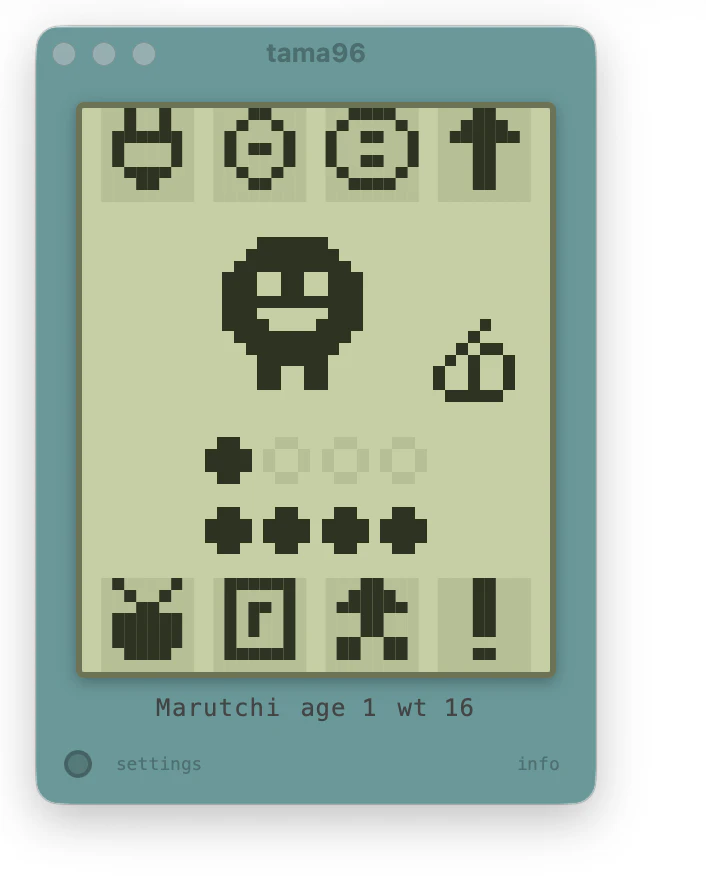
After being thrust headfirst into FPGA development thanks to the Analogue Pocket, my first from scratch creation was a gate level implementation of the original Tamagotchi toy. The core, running on both the Analogue Pocket and MiSTer platforms, lets users re-experience the very first Tamagotchi from 1996 with accurate emulation, but modern features. The core has savestates (which is much harder to do in hardware vs software emulation), high turbo speeds (1,800x was the max clock speed I've reached so far), and more. Learning more about hardware and FPGAs is something I've wanted to do for…
Oct 2025 · github.com
- 2IB
A while back I wrote a CHIP-8 emulator (which is considered the Hello, World! of emulators and is more accurately a virtual machine since historically CHIP-8 was an interpreted language running on top of the COSMAC VIP to make game programming easier). But a few months ago I got really interested in embedded software, so decided it would be neat to port my emulator to a STM32 MCU and design a console around it as a learning experience, since CHIP-8 never existed as a physical system. I didn't know much about embedded software when I began, and even less about electronics, but I managed to…
2022 · github.com
- 3LI
Not sure if I would post this for the last day of #marchintosh OR wait for tomorrow the 1st of April. Both apply equally. Anyway, here's a pet project of mine, I made it as a glued on for another pet project of mine, but it developed a life of it's own now and can soar skyward toward success, fame, and glory.
2024 · github.com
- 4
- 5OA
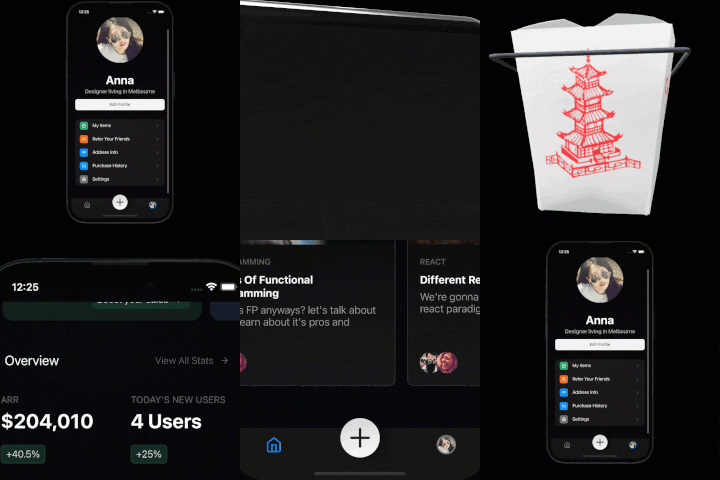
Hey HN, I'm Nate, the creator of Tamagui. One is a React framework that does two things differently in hopes of simplifying how we build websites and apps: 1. It unifies React Native and React web with typed file system routing by making Vite able to serve RN. This lets you share (or diverge) your code in a simpler way for cross-platform apps. 2. We've partnered with Zero (https://zerosync.dev) to make local-first work well. We've been building a solution in One that makes Zero supporting server rendering, without waterfalls, and with seamless server/client handoff. ---…
2024 · onestack.dev
- 6

- 7

- 8IM
I am proud to present my solo hobby project NAND. This year-long undertaking follows the completed Nand to Tetris course, but ported to the web with its own runtime, user interface, and IDE. Using the "Load example program" selector, you can try out some programs I wrote on NAND's emulated hardware such as 2048, a genetic algorithm, and a manual stack overflow to corrupt the screen. Check out NAND at https://nand.arhan.sh Additionally, I've authored an extensive writeup about the project. Read about it on the GitHub repository's readme.
2024 · github.com
- 9

- 10IS
Hello everyone! I'm a solo developer who's been doing UI/UX work since 2007. Over the years, I watched design tools evolve from lightweight products into bloated feature-heavy platforms. I kept finding myself using a small amount of the features while the rest just mostly got in the way. So a few years ago I set out to build a design tool just like I wanted. So I built Vecti with what I actually need: pixel-perfect grid snapping, a performant canvas renderer, shared asset libraries, and export/presentation features. No collaborative whiteboarding. No plugin ecosystem. No enterprise…
Feb 2026 · vecti.com
- 11
- 12IS
First Release is Here! I'm excited to announce the first release of i486SX_soft_FPU — a software FPU emulator for the classic Intel 486SX CPU, running on NetBSD 10! This project brings floating-point support back to life for 486SX machines, even though modern NetBSD versions no longer natively support processors without a hardware FPU. If you're into retrocomputing, operating system hacking, or just love old-school hardware, check it out! Project page: https://github.com/mezantrop/i486SX_soft_FPU Contributions, feedback, and testing are all very welcome! Let's keep these…
2025 · github.com
- 13WB
Hi! me and my friends together built an 8 bit CPU implemented in Logisim purely from scratch. The control unit of this system does not implement the generic microcode ROM or any kind of RAM. This was made purely from discrete logic gates and coded the system to run different programs. key features: Custom 16-instruction Harvard ISA, 8-bit fixed format, 4 general purpose registers Hardwired control unit built entirely from AND/OR gate logic matrix Dual-phase clocking to eliminate race conditions Bootstrap Control Unit that cold-boots via ROM-to-RAM transfer Early-exit conditional…
Jun 2026 · github.com
- 14
- 15TR
2021 · tamagui.dev
- 16
- 17AR
My background project for the last two years has been re-implementing my 2004 C++ shoot'em up game in TypeScript + WebGL, and it's finally done (just in time for the 20th anniversary!) Play the game online: https://nicollet.net/blog/darklaga/darklaga.html Technical article about the remake: https://nicollet.net/blog/darklaga/remake.html I have tested Firefox, Chrome and Edge on desktop and mobile (no access to a device capable of running Safari). It's amazing how much difference 20 years makes: the hardware is so much more powerful, the web…
2024 · nicollet.net
- 18

- 198C
Hi everybody! Due to Covid 19 pandemic I was forced in my home, so I revamped my book https://8bit.gioorgi.com It is a huge collection of information about the 8bit comnputer era (1980-1985) up to the NES console. I collected information from various source including “The 8bit Guy” videos and specific site (like C64 wiki, nesdev etc). I am using docusaurus to give a pleasnt look to the whole site. Please give me you feedback (and happy new year btw)!
2021
- 20C8
2025 · github.com
- 21CA
Made an ARM Thumb CPU from scratch in a digital circuit simulator for fun and decided to push the joke a little further and run real stuff on it, like a Web server, a Scheme interpreter, a MIDI player, and a VT100 emulator. This is basically a how-did-we-get-here blogpost, it's my second one of this kind, I'd love any feedback you might have.
2022 · zdimension.fr
- 22TV
2022 · tamagui.dev
- 23TL
I've developed a Tamagotchi-like virtual characters drawn in JavaScript. These characters can be manually controlled or interact dynamically with AI assistants, adding a visual identity and fun to AI. Imagine having an AI character that responds to user requests with different states, making interactions playful and engaging. Demo: https://barqawiz.github.io/Tamagotchi/ Code: https://github.com/Barqawiz/Tamagotchi
2024 · github.com
- 24WN
* OPEN TO CONTRIBUTIONS * NandToTetris is a course which has you build a full computer from: Logic gates -> Chips -> RAM -> CPU -> Computer -> Assembler -> Compiler -> OS -> Tetris All this is done via software defined hardware emulation. I'm building an emulator for this entire stack in C. How is my approach different to other projects that build emulators? - No external dependencies (so far) - Start with a single software defined NAND gate in C - EVERYTHING is built from this base chip - Don't use certain programming utilities: boolean logic operators, bitwise logic operators etc Instead…
2024 · github.com
Ranked by how close each launch is in meaning, then by votes. Refine with a description →