Cosmic Odometer
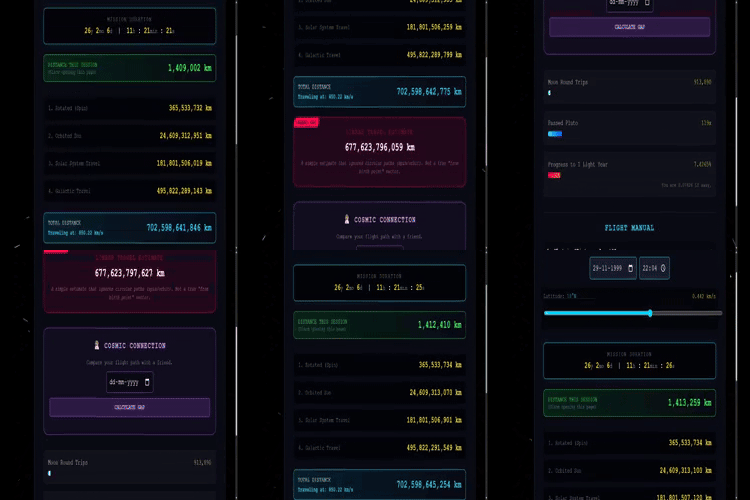
A little while ago I built a tool to calculate how far you've traveled through space since the exact second you were born. The math was relatively simple (Earth's spin + Solar orbit + Galactic drift), but the feedback I got here inspired me to rewrite the visual engine and turn it into a proper deep-space dashboard. Here is what’s new under the hood: 1. Vanilla JS 3D Engine: I built a custom Three.js simulation that renders your exact orbital alignment on your birth date and tracks it to the present. 2. Live Telemetry: It now actively tracks the real-time Keplerian orbital positions of…
Cosmic Odometer launched on February 5, 2026 with 7 votes, #1,385 of 16,627 launches that month and more than 90% of that year's launches.
What it does
We feel like we are sitting still, but physics says otherwise. Cosmic Odometer is a visualization tool that calculates exactly how far you have physically traveled through the void since the moment you were born. four velocity : Earth's Rotation Solar Orbit Solar System Velocity Galactic Drift New in Version 2.0: The Cosmic Receipt: Generate a retro sci-fi "Flight Log" image with your stats to share on social. Vanilla JS: Built with zero dependencies, runs entirely in your browser.
Calculate the distance you’ve traveled through space since birth.
A breakdown of every astrophysical calculation driving the Cosmic Odometer. Earth is not just a sphere, it is an oblate spheroid that completes a full rotation every 23 hours, 56 minutes, and 4 seconds. The speed at which you travel due to this rotation depends entirely on your latitude. At the equator (0°), you are moving at roughly 1,674 km/h (0.465 km/s). As you move closer to the poles, this speed drops to nearly zero. The app calculates your exact continuous angular velocity based on the latitude slider. Earth does not sit still; it is constantly in freefall around the Sun. To complete its massive elliptical orbit (one year), Earth must travel at an average velocity of roughly 107,000…from cosmicodometer.space
In the maker’s words, at launch
A little while ago I built a tool to calculate how far you've traveled through space since the exact second you were born. The math was relatively simple (Earth's spin + Solar orbit + Galactic drift), but the feedback I got here inspired me to rewrite the visual engine and turn it into a proper deep-space dashboard.…
Does a similar job
all alternatives →- IBI built a space travel calculator using Vanilla JavaScriptJan 2026 · cosmic-odometer.vercel.app · ▲54
I built this because measuring my age in years felt boring—I wanted to see the kilometers. The first version only used Earth's orbital speed (~30km/s), but the number moved too slowly. To get the "existential dread" feeling, I switched to using the Milky Way's velocity relative to the CMB (~600km/s). The math takes some liberties (using scalar sum instead of vector) to make the speed feel "fast," but it gets the point across. Under the hood, it's a single HTML file with zero dependencies. No React, no build step. The main challenge was the canvas starfield—I had to pre-allocate the…
 Atlas of Space2025 · atlasof.space · ▲770
Hello HN! Sharing a recent side project of mine, the Atlas of Space, that I built out to explore the Solar System. As a long-time space nerd, I realized recently that I didn't have a good intuition on the scale, speed, and relative orientation of the celestial bodies around us. So over the break I built out a kind of spatial Wikipedia to click around and learn about planets, moons, asteroids, and other bodies orbiting the Sun. The physics is all simulated in the browser using simple Newtonian mechanics. There's a lot left to do from here, including modeling objects in non-Keplerian orbits…
- GIGravity – Interactive solar-system simulator, from Newton to EinsteinJun 2026 · qunabu.github.io · ▲217
Just for fun and self education, I've built this over a weekend to teach myself why orbits exist, not just show planets going around. Something that was never clearly explain to me in school. It opens with a guided tour that builds the idea up step by step: two bodies and the equal/opposite force, inertia (the Sun is removed and Earth just drifts straight), then "an orbit is falling and continuously missing," cosmic velocities with a little rocket, Voyager 1 & 2's real gravity assists (the clock runs the actual 1977–1989 dates so the planets orbit into their grand-tour alignment and the…
 Galactic Compass – an app that points to the galactic center2024 · interconnected.org · ▲175
I made a single-serving iPhone app with a floating green arrow that always points to the center of the Milky Way, 26,000 lights years away. It’s weirdly grounding. I’ve never made an app before, so here’s how it worked with ChatGPT.
 AstraPixelsAug 2026 · astrapixels.com · ▲267
A pixel-art solar system at its real current positions.
More dev tools this month
the category →
Contribute to oosexgang/hackios-xnu-kernel development by creating an account on GitHub.
Dev tools · 1d ago · github.com


open-source IDE for thoughtful software design. Contribute to devdotfast/whiteboard development by creating an account on GitHub.
Dev tools · 29d ago · github.com

Contribute to reladraw/reladraw development by creating an account on GitHub.
Dev tools · 27d ago · github.com
 OpenBot▲362
Grok Bot alternative: free, local, open-source, multiplayer
Dev tools · 24d ago · openbot.run
 Talanoa▲346
Hi HN, I’m a fullstack developer, and honestly, I’ve lost count of how many side projects I’ve worked on over the years. But one idea kept coming back to me: a different kind of email client. It first came to me in 2014: “What if we could handle emails more like conversations?” Every year, I’d revisit this concept in my “Build Notes.” Ten years later, no one had built exactly what I had in mind — so I finally decided to do it myself. That’s how Talanoa was born. I wanted something focused on people, not timelines. I was tired of marking messages as unread just to remember to reply later, or…
Dev tools · 22d ago · talanoa.email
Source: Product Hunt launch ↗ · launch text quoted in part
Launched alongside, February 2026
the whole month →


 Lovon AI Therapy▲801
Feel closer and have more fun with your partner every day!
AI · Feb 2026 · lovon.app

Hello my name is Ben Ward for the past 3 years I have been remastering the financial game Wall Street Raider created by Michael Jenkins originally on DOS in 1986. It has been a rough journey but I finally see the light at the end of the tunnel. I just recently redid the website and thought maybe the full story of how this project came to be would interest you all. Thank you for reading.
Work · Feb 2026 · wallstreetraider.com