I built a space travel calculator using Vanilla JavaScript
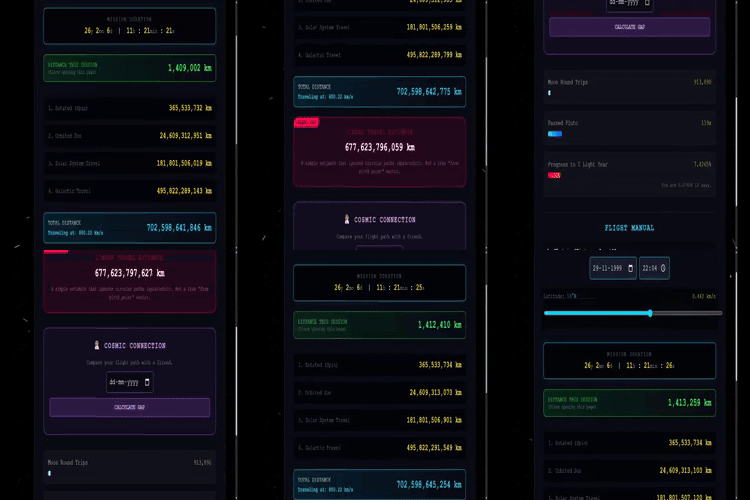
I built this because measuring my age in years felt boring—I wanted to see the kilometers. The first version only used Earth's orbital speed (~30km/s), but the number moved too slowly. To get the "existential dread" feeling, I switched to using the Milky Way's velocity relative to the CMB (~600km/s). The math takes some liberties (using scalar sum instead of vector) to make the speed feel "fast," but it gets the point across. Under the hood, it's a single HTML file with zero dependencies. No React, no build step. The main challenge was the canvas starfield—I had to pre-allocate the…
I built a space travel calculator using Vanilla JavaScript launched on January 24, 2026 with 54 votes, #532 of 14,584 launches that month and more than 95% of that year's launches.
In plain words
This space travel calculator measures age in kilometers rather than years by calculating distance traveled through the Milky Way. It uses the galaxy's velocity relative to the cosmic microwave background (~600km/s) to create a sense of cosmic motion, deliberately simplifying the physics for dramatic effect. Built as a single HTML file with vanilla JavaScript and no dependencies, it features a canvas-based starfield optimized to run smoothly on mobile devices without performance stuttering.
written from the facts on this page · September 2026
From the sources
Calculate the distance you’ve traveled through space since birth.
A breakdown of every astrophysical calculation driving the Cosmic Odometer. Earth is not just a sphere, it is an oblate spheroid that completes a full rotation every 23 hours, 56 minutes, and 4 seconds. The speed at which you travel due to this rotation depends entirely on your latitude. At the equator (0°), you are moving at roughly 1,674 km/h (0.465 km/s). As you move closer to the poles, this speed drops to nearly zero. The app calculates your exact continuous angular velocity based on the latitude slider. Earth does not sit still; it is constantly in freefall around the Sun. To complete its massive elliptical orbit (one year), Earth must travel at an average velocity of roughly 107,000…from cosmic-odometer.vercel.app
In the maker’s words, at launch
I built this because measuring my age in years felt boring—I wanted to see the kilometers. The first version only used Earth's orbital speed (~30km/s), but the number moved too slowly. To get the "existential dread" feeling, I switched to using the Milky Way's velocity relative to the CMB (~600km/s). The…
Does a similar job
all alternatives →- WIWhat if the speed of light was 5 km/h?Sep 2026 · rivendell.dmitrybrant.com · ▲629
Special relativity simulator in which light crawls along at a human speed, so Lorentz contraction, aberration and Doppler shift happen at walking pace.
 Cosmic OdometerFeb 2026 · cosmicodometer.space · ▲7
A little while ago I built a tool to calculate how far you've traveled through space since the exact second you were born. The math was relatively simple (Earth's spin + Solar orbit + Galactic drift), but the feedback I got here inspired me to rewrite the visual engine and turn it into a proper deep-space dashboard. Here is what’s new under the hood: 1. Vanilla JS 3D Engine: I built a custom Three.js simulation that renders your exact orbital alignment on your birth date and tracks it to the present. 2. Live Telemetry: It now actively tracks the real-time Keplerian orbital positions of…
 Atlas of Space2025 · atlasof.space · ▲770
Hello HN! Sharing a recent side project of mine, the Atlas of Space, that I built out to explore the Solar System. As a long-time space nerd, I realized recently that I didn't have a good intuition on the scale, speed, and relative orientation of the celestial bodies around us. So over the break I built out a kind of spatial Wikipedia to click around and learn about planets, moons, asteroids, and other bodies orbiting the Sun. The physics is all simulated in the browser using simple Newtonian mechanics. There's a lot left to do from here, including modeling objects in non-Keplerian orbits…
- IMI made a site where you can travel in space in your browser2022 · spaceinbrowser.com · ▲179
I made this site using R3F (https://github.com/pmndrs/react-three-fiber), a React renderer for 3JS (https://threejs.org/). The celestial bodies are Three.JS meshes. I used loaders (namely 'useLoader' from R3F and 'GLTFLoader' from 3JS) to import 3D models, such as International Space Station. More on loading models in R3F: https://docs.pmnd.rs/react-three-fiber/tutorials/loading-mod... I've future plans for this side project. It would be great to hear from the HN community before diving into them. Enjoy! P.S: Getting an empty…
- GIGravity – Interactive solar-system simulator, from Newton to EinsteinJun 2026 · qunabu.github.io · ▲217
Just for fun and self education, I've built this over a weekend to teach myself why orbits exist, not just show planets going around. Something that was never clearly explain to me in school. It opens with a guided tour that builds the idea up step by step: two bodies and the equal/opposite force, inertia (the Sun is removed and Earth just drifts straight), then "an orbit is falling and continuously missing," cosmic velocities with a little rocket, Voyager 1 & 2's real gravity assists (the clock runs the actual 1977–1989 dates so the planets orbit into their grand-tour alignment and the…
 Browser-based interactive 3D Three-Body problem simulatorNov 2025 · trisolarchaos.com · ▲249
Features include: - Several preset periodic orbits: the classic Figure-8, plus newly discovered 3D solutions from Li and Liao's recent database of 10,000+ orbits (https://arxiv.org/html/2508.08568v1) - Full 3D camera controls (rotate/pan/zoom) with body-following mode - Force and velocity vector visualization - Timeline scrubbing to explore the full orbital period The 3D presets are particularly interesting. Try "O₂(1.2)" or "Piano O₆(0.6)" from the Load Presets menu to see configurations where bodies weave in and out of the orbital plane. Most browser…
More life & fun this month
the category →
A free city-building game in your browser. You are the mayor. You know what the city needs. Now get it past the zoning board, the neighbors, the appeals court and the next election.
Life & fun · 2d ago · permit.petercai.com
- IV
Life & fun · 14d ago · tanzaniaeducationproject.org

Turn a phone, tablet or TV into a sign. Type a message and it fills the screen: welcome signs, timers, Wi-Fi passwords and more. No app, no account, free.
Life & fun · 15d ago · bigwords.page

Play a free virtual guitar online with your keyboard or by touch. Slow songs down and see every chord, string and strum. Acoustic, classic, electric and bass.
Life & fun · 9d ago · guitoro.com

Carrier settings from iPhone, Pixel and Galaxy firmware, decoded and compared: APNs, VoLTE, 5G and Wi-Fi Calling per carrier, and what each build changed.
Life & fun · 13d ago · carrierexplode.com

Life & fun · 23d ago · space.bl2.net
Source: Show HN post ↗ · launch text quoted in part
Launched alongside, January 2026
the whole month →- IN
Hey HN! I wanted to share something I built over the last few weeks: isometric.nyc is a massive isometric pixel art map of NYC, built with nano banana and coding agents. I didn't write a single line of code. Of course no-code doesn't mean no-engineering. This project took a lot more manual labor than I'd hoped! I wrote a deep dive on the workflow and some thoughts about the future of AI coding and creativity: http://cannoneyed.com/projects/isometric-nyc
AI · Jan 2026 · cannoneyed.com


Automatic AI-powered code reviews the moment you open a PR
Dev tools · Jan 2026 · kilo.ai
