Dev tools · alternatives · 2026
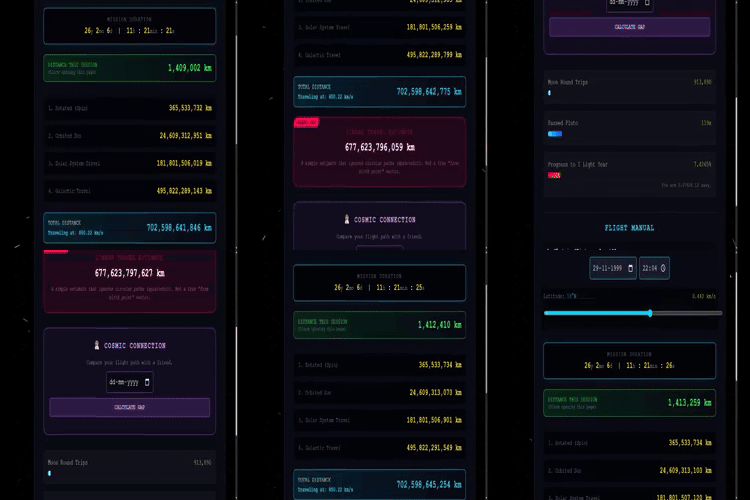
24 alternatives to Cosmic Odometer
A little while ago I built a tool to calculate how far you've traveled through space since the exact second you were born. The math was relatively simple (Earth's spin + Solar orbit + Galactic drift), but the feedback I got here inspired me to rewrite the visual engine and turn it into a proper deep-space dashboard. Here is what’s new under the hood: 1. Vanilla JS 3D Engine: I built a custom Three.js simulation that renders your exact orbital alignment on your birth date and tracks it to the present. 2. Live Telemetry: It now actively tracks the real-time Keplerian orbital positions of…
Below are 24 products that do a similar job, ranked by how close each is in meaning and then by launch-day votes. Prices are shown for the 3 we have checked on their own sites, 3 of them free or with a free tier.
- 1IB
I built this because measuring my age in years felt boring—I wanted to see the kilometers. The first version only used Earth's orbital speed (~30km/s), but the number moved too slowly. To get the "existential dread" feeling, I switched to using the Milky Way's velocity relative to the CMB (~600km/s). The math takes some liberties (using scalar sum instead of vector) to make the speed feel "fast," but it gets the point across. Under the hood, it's a single HTML file with zero dependencies. No React, no build step. The main challenge was the canvas starfield—I had to pre-allocate the…
Jan 2026 · cosmic-odometer.vercel.app · its alternatives →
- 2
 Atlas of Spacefree▲770
Hello HN! Sharing a recent side project of mine, the Atlas of Space, that I built out to explore the Solar System. As a long-time space nerd, I realized recently that I didn't have a good intuition on the scale, speed, and relative orientation of the celestial bodies around us. So over the break I built out a kind of spatial Wikipedia to click around and learn about planets, moons, asteroids, and other bodies orbiting the Sun. The physics is all simulated in the browser using simple Newtonian mechanics. There's a lot left to do from here, including modeling objects in non-Keplerian orbits…
2025 · atlasof.space · its alternatives →
- 3
- 4GI
Just for fun and self education, I've built this over a weekend to teach myself why orbits exist, not just show planets going around. Something that was never clearly explain to me in school. It opens with a guided tour that builds the idea up step by step: two bodies and the equal/opposite force, inertia (the Sun is removed and Earth just drifts straight), then "an orbit is falling and continuously missing," cosmic velocities with a little rocket, Voyager 1 & 2's real gravity assists (the clock runs the actual 1977–1989 dates so the planets orbit into their grand-tour alignment and the…
Jun 2026 · qunabu.github.io · its alternatives →
- 5

24d ago · space.bl2.net · its alternatives →
- 6

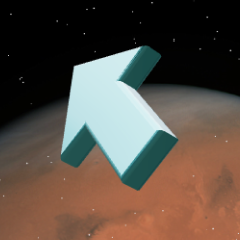
I made a single-serving iPhone app with a floating green arrow that always points to the center of the Milky Way, 26,000 lights years away. It’s weirdly grounding. I’ve never made an app before, so here’s how it worked with ChatGPT.
2024 · interconnected.org · its alternatives →
- 7
 AstraPixelsfree tier, from $5/mo▲267
A pixel-art solar system at its real current positions.
Aug 2026 · astrapixels.com · its alternatives →
- 8

This is a little hobby project that I hope you enjoy. You can see where the International Space Station is now, with live HD video from NASA, on a realistic 3D globe. The positions of the sun and moon are also accurate, though distances aren't to scale. The clouds are also near-realtime; I span that out into a separate project at https://clouds.matteason.co.uk, where the cloud images I create from EUMETSAT data are freely available. I've got more features almost ready to go, like the ability to turn off all UI, toggleable clouds and turning off the day/night cycle I'd love for…
2024 · iss.matteason.co.uk · its alternatives →
- 9

Sup HN, So I got tired of bouncing between Flightradar, MarineTraffic, and Twitter every time something kicked off globally, so I wrote a dashboard to aggregate it all locally. It’s called Shadowbroker. I’ll admit I leaned way too hard into the "movie hacker" aesthetic for the UI, but the actual pipeline underneath is real. It pulls commercial/military ADS-B, the AIS WebSocket stream (about 25,000+ ships), N2YO satellite telemetry, and GDELT conflict data into a single MapLibre instance. Getting this to run without melting my browser was the hardest part. I'm running this on a laptop…
Mar 2026 · github.com · its alternatives →
- 10
- 11WI
Special relativity simulator in which light crawls along at a human speed, so Lorentz contraction, aberration and Doppler shift happen at walking pace.
Sep 2026 · rivendell.dmitrybrant.com · its alternatives →
- 12

Hey HN! I made Orbit, an iOS app that allows you to see the satellites, planets, and constellations above you in AR, on a 2D map, and on a 3D globe. The app includes more than 15,000 objects tracked by CelesTrack, together with their pass predictions, descriptions, and detailed orbital data. A searchable catalog of all objects is also available, as well as a built-in chatbot designed to answer any space-related questions you might have. This is my first published iOS app, so any feedback is greatly appreciated! App Store: https://apps.apple.com/app/id6772174570
Jul 2026 · nagylukas.github.io · its alternatives →
- 13PA
We have a black hole at home — with actual relativistic physics, live in your browser. I'm Sasha (Alexander) Plavin, an astrophysicist at Harvard's Black Hole Initiative studying quasars and black hole environments. I work with raytracing/radiative transfer simulations professionally, and wanted to make one anyone can play with — so I built this app. Put the black hole onto your screen (any browser), or directly into your room with AR or VR (requires WebXR, for example Chrome on Android, or any VR headset). When looking around, pay attention to unintuitive relativistic effects: rays…
Jul 2026 · blackhole.plav.in · its alternatives →
- 14MA
Made a little Artemis II tracker for anyone else who is unnecessarily invested in this mission: https://artemis-ii-tracker.com/ For those of us who apparently need a dedicated place to monitor this mission instead of behaving like well-adjusted people.
Apr 2026 · artemis-ii-tracker.com · its alternatives →
- 15
 Spatium▲182
Hi there, humans! I'm excited to announce Spatium! I'm a big fan of any topic related to our universe. I'm also a developer, so I've put these things together and I built this new tab Chrome Extension for space lovers, astronomy fans, and science geeks like me. If you enjoyed it, please spread some love <3 FEATURES • Space images • Every day, get a fascinating image of our universe. Enjoy pictures of stars, planets, moons, galaxies, nebulae, comets and more right on your browser tab. • Sun Widget • Find out when the sunrise, sunset, first and last light times will be precisely at your…
2021 · spatium.earth · its alternatives →
- 16

- 17
 AstroGrid▲113
Explore the entire universe in your browser, in real 3D
Apr 2026 · velonspace.com · its alternatives →
- 18

Features include: - Several preset periodic orbits: the classic Figure-8, plus newly discovered 3D solutions from Li and Liao's recent database of 10,000+ orbits (https://arxiv.org/html/2508.08568v1) - Full 3D camera controls (rotate/pan/zoom) with body-following mode - Force and velocity vector visualization - Timeline scrubbing to explore the full orbital period The 3D presets are particularly interesting. Try "O₂(1.2)" or "Piano O₆(0.6)" from the Load Presets menu to see configurations where bodies weave in and out of the orbital plane. Most browser…
Nov 2025 · trisolarchaos.com · its alternatives →
- 19

Hello, I am the creator and maintainer of Stellarium Mobile. I have been working in my free time for about a year on this new project Galaxium, that is more about traveling in the universe rather than looking at the sky from Earth. It is still experimental, and at the moment I am not sure what it will become. Feedback is welcome.
Aug 2026 · galaxium.app · its alternatives →
- 20IM
I made this site using R3F (https://github.com/pmndrs/react-three-fiber), a React renderer for 3JS (https://threejs.org/). The celestial bodies are Three.JS meshes. I used loaders (namely 'useLoader' from R3F and 'GLTFLoader' from 3JS) to import 3D models, such as International Space Station. More on loading models in R3F: https://docs.pmnd.rs/react-three-fiber/tutorials/loading-mod... I've future plans for this side project. It would be great to hear from the HN community before diving into them. Enjoy! P.S: Getting an empty…
2022 · spaceinbrowser.com · its alternatives →
- 21
 AstroAlert▲113
Know exactly when satellites pass above you.
Nov 2025 · astroalert.app · its alternatives →
- 22

- 23

A 3D universe explorer & astronomy app, in your browser
Jun 2026 · space.pointdynamics.com · its alternatives →
- 24
 Cosmic-Watch▲73
The World’s first 3D astronomical clock & stunning skyguide
2020 · cosmic-watch.com · its alternatives →
Also compare
- I built a space travel calculator using Vanilla JavaScript alternatives
- Atlas of Space alternatives
- There alternatives
- Gravity – Interactive solar-system simulator, from Newton to Einstein alternatives
- The whole Solar System and every tracked satellite, live in the browser alternatives
- Galactic Compass – an app that points to the galactic center alternatives
Ranked by how close each launch is in meaning, then by votes. Prices were read from each product’s own site when checked and can change. Refine with your own description →