
The impact that made the Moon, 262k particles in a browser tab
A giant impact simulation in WebGL: two planets of real mass collide under their own gravity — the Theia impact that made the Moon, the splash, the debris disk, and the moon that gathers out of it. In the browser, nothing to install.
In plain words
The impact that made the Moon simulates the Theia collision between two planets using real physics in a web browser. It visualizes how gravity pulled proto-Earth and an impactor together, creating the splash, debris disk, and moon that formed afterward. Users can watch the simulation with 16,000 to 262,000 particles and adjust variables like mass and collision angle to explore five different scenarios of how the Moon might have been created. No installation required.
written from the facts on this page · September 2026
From the sources
Two planets of real mass fall together under their own gravity and collide: a proto-Earth and an impactor from a fiftieth of an Earth to a whole one, iron core to mantle to crust, 16k to 262k particles. The splash, the tidal arm, the debris disk, and the moon that gathers out of it — computed live in WebGL 2, in the browser, nothing to install. Five what-ifs. Theia , the canonical Moon-forming impact; head-on , flat and dead-on; hit & run , grazing too fast to be caught; twins , an impactor grown to Earth's own mass; shatter , fast enough to take both bodies apart. Mass, angle, inclination, speed, bounce, core and density are knobs under advanced , so the next what-if is a restart away. The…from gaploid.github.io
Does the same job
all alternatives → AstraPixels29d ago · astrapixels.com · ▲267
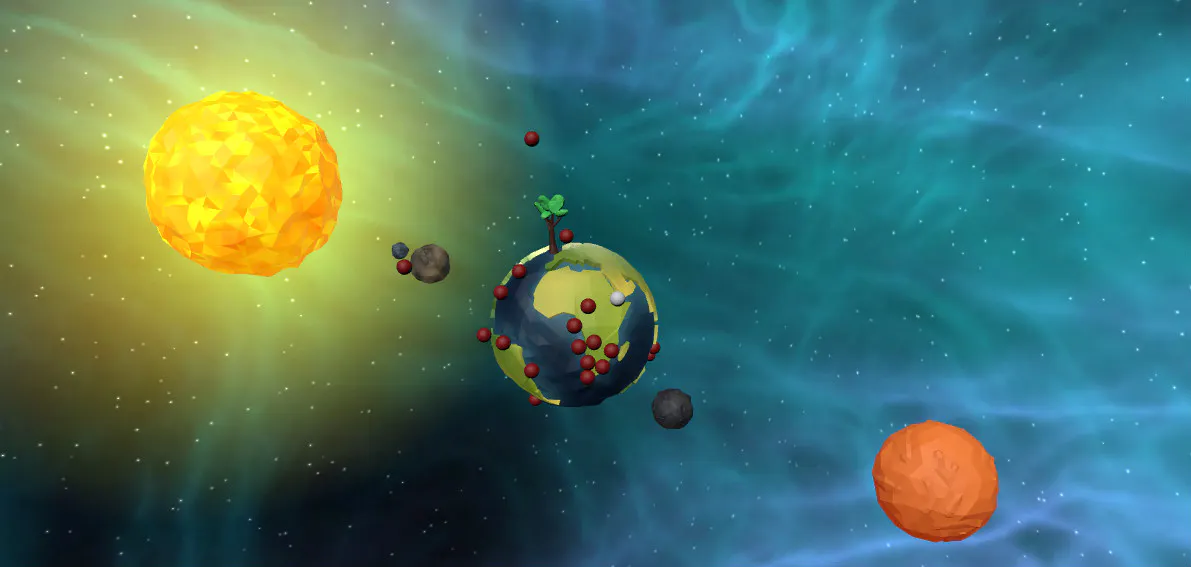
A pixel-art solar system at its real current positions.


More life & fun this month
the category →- TL
Life & fun · 10d ago · louisabraham.github.io

Photosynthesis fires two of your iPhone
Life & fun · 28d ago · photosynthesis.camera
 SoloUno▲310
Take control of hair pulling, nail biting & skin picking
Life & fun · 28d ago · solouno.io

Scroll through all 43,252,003,274,489,856,000 reachable Rubik's Cube permutations.
Life & fun · 26d ago · everycube.alen.is


Hi HN, I built Eigendrum, a web tool that solves the 2D wave equation for arbitrary shapes so you can hear what they sound like as drums. How it works: * Solves -∇²u = λu using finite element analysis (Kφ = λMφ) on a triangle mesh. * Validated to <0.1% error against closed-form solutions for circles (Bessel zeros) and rectangles. * Sound model factors in strike location, Rayleigh damping, and mallet width. * Includes Kac drums I & II to demonstrate identical sound spectra from different geometries. * No frameworks, build steps, or dependencies. Repo and tests:…
Life & fun · 27d ago · baselashraf81.github.io
Launched alongside, August 2026
the whole month →- TL
Life & fun · 10d ago · louisabraham.github.io


- SA
Hello HN! I found that picking out plausible but diverse skin tones for my digital art and game development projects was kind of difficult, and I got curious about if there was a way to define a color space that made it easy. I've built a color picker and procedural generation algorithm based on the space as well as a bunch of other fun js features and demos throughout the page that use the equations. If you find it interesting, I have lots of explanations of how I built it and what properties the space has. The methodology might be a bit shaky, but hopefully the result is as helpful for…
Life & fun · Aug 2026 · toneyalexander.github.io


I trained a 125M-parameter transformer to autocomplete piano performances in real time (~108 notes/sec on an iPhone 15). The idea is basically GitHub Copilot or Tabnine, except instead of prompting it with code, you prompt it by playing a few notes on a MIDI piano. The model then continues what you played, entirely on-device. The app is free if anyone wants to try it. Happy to answer questions about the model, training, Core ML, or the many things that didn't work.
AI · 17d ago · simedw.com