AI · alternatives · 2026

24 alternatives to Aegisora
The narrow control plane for AI agent tool and API calls.
Below are 24 products that do a similar job, ranked by how close each is in meaning and then by launch-day votes. Prices are shown for the 1 we have checked on their own sites, 1 of them free or with a free tier.
- 1

Zero-trust proxy & escalation boundary for AI agents.
Aug 2026 · github.com · its alternatives →
- 2
 Tracciafree tier, from $99/mo▲197
AI applications are becoming agents, which has started to take autonomous decisions. There are plenty of tools and platform available to trace, and observe what an agent or llms calls does. They are good in what they do, but tracing and observability isnt enough for AI agents era. We need a solution that can help you observe, evaluate, create run time policies to govern and finally audit the actions of the agent. We built Traccia to solve this problem. The good part, all of these can be achieved by just writing few lines of code. Traccia has an open-sourced sdk that can work with your…
Aug 2026 · traccia.ai · its alternatives →
- 3

Autonomous AI agents for ethical hacking and cyber defense.
2025 · its alternatives →
- 4
 CtrlAI▲104
Transparent proxy that secures AI agents with guardrails
Mar 2026 · github.com · its alternatives →
- 5
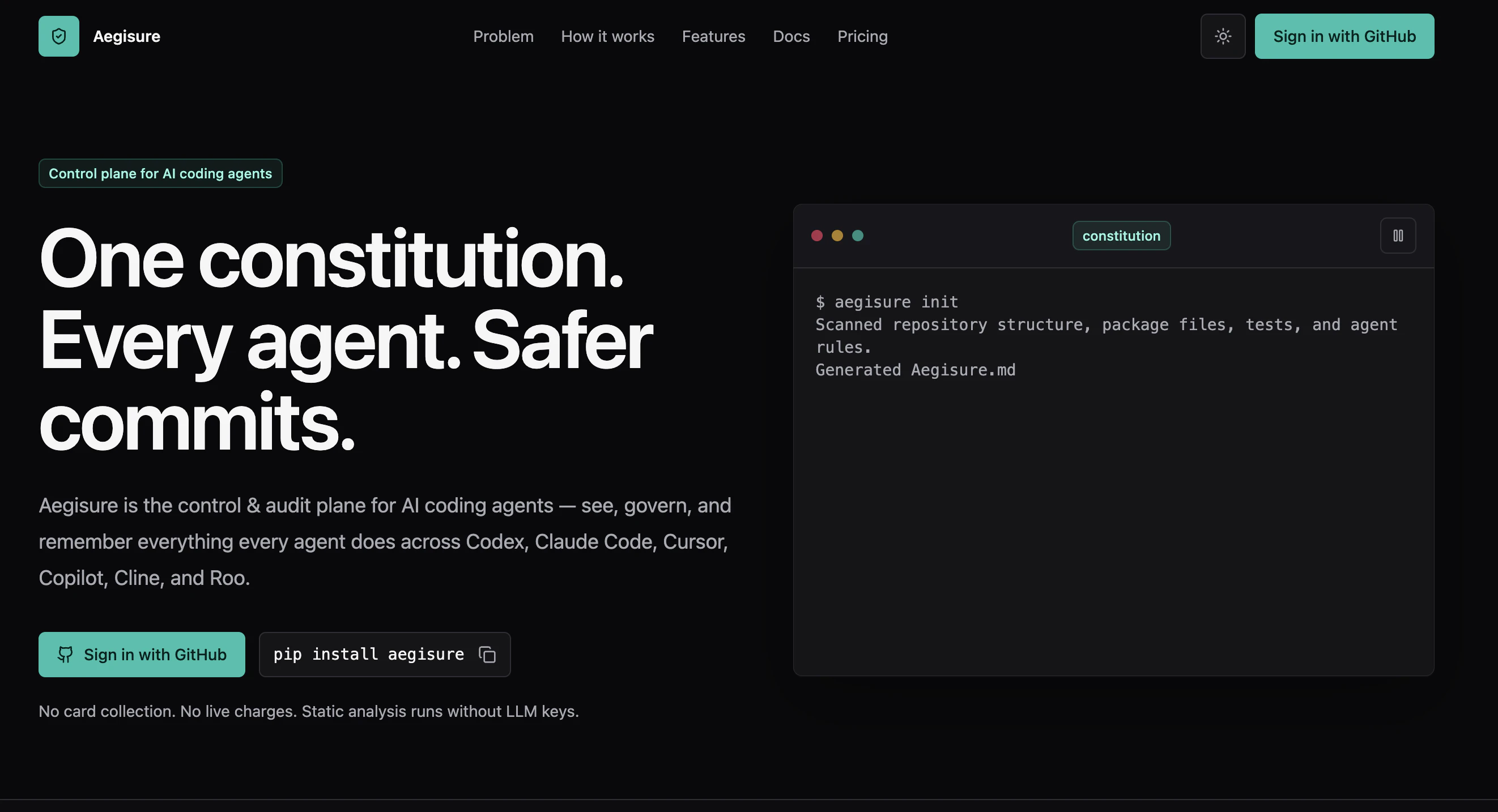 Aegisure▲5
Control & audit layer for your AI coding agents
Jun 2026 · aegisure.dev · its alternatives →
- 6

Hey HN! This is Adil, Salman and Jose and and we’re behind archgw [1]. An intelligent proxy server designed as an edge and AI gateway for agents - one that natively know how to handle prompts, not just network traffic. We’ve made several sweeping changes so sharing the project again. A bit of background on why we’ve built this project. Building AI agent demos is easy, but to create something production-ready there is a lot of repeat low-level plumbing work that everyone is doing. You’re applying guardrails to make sure unsafe or off-topic requests don’t get through. You’re clarifying vague…
2025 · github.com · its alternatives →
- 7
 Cyris▲98
"Cyris is the orchestration layer your AI agents are missing. Whether you're a two-person startup or a 10,000-employee health system — connect agents from OpenClaw, Claude, GPT-4o, Ollama, EPIC, or any platform and have them coordinate, hand off, and escalate across your entire organization. Self-hosted. Auditable. Human-governed" Just a side project I've been working on, and was curious whether people would actually find something like this useful! I'd recommend checking out the sandbox as well.
Apr 2026 · cyrisai.dev · its alternatives →
- 8
 VELA▲74
Securely execute AI-generated & untrusted code
Jun 2026 · vela-secure.vercel.app · its alternatives →
- 9

Hey HN! Wanted to show our open source agent harness called Gambit. If you’re not familiar, agent harnesses are sort of like an operating system for an agent... they handle tool calling, planning, context window management, and don’t require as much developer orchestration. Normally you might see an agent orchestration framework pipeline like: compute -> compute -> compute -> LLM -> compute -> compute -> LLM we invert this so with an agent harness, it’s more like: LLM -> LLM -> LLM -> compute -> LLM -> LLM -> compute -> LLM Essentially you describe each agent in either a self contained…
Jan 2026 · github.com · its alternatives →
- 10

- 11

- 12

Agent Aegis is an autonomous multi-agent system that audits.
Nov 2025 · agent-aegis-497122537055.us-west1.run.app · its alternatives →
- 13

- 14

Hey HN – I built a framework called Aegis to govern AI-assisted software development. The core idea is that AI-generated code should follow the same rules as human code: versioned, validated, observable. Aegis enforces this through blueprint-based development, drift detection, and runtime compliance systems. It’s designed for teams using tools like Copilot, Kilo, or Lovable to build production systems with confidence. This isn’t a library — it’s a way to architect AI-native engineering workflows. Would love feedback, questions, and critiques. Especially curious if others are facing similar…
2025 · github.com · its alternatives →
- 15

- 16

- 17
 AEGIS▲2
Open-source LLM defense that publishes its real bypass rate
Aug 2026 · defenseaegis.org · its alternatives →
- 18

An information-flow policy engine for LLM agents.
23d ago · openappa.com · its alternatives →
- 19
 Aether▲26
Since coding agents like Claude Code and Codex came out, I've been pretty obsessed with them. It's hard not to when you're getting a 20x discount on inference. I've also been frustrated by them a lot. I hated walking around with my laptop lid open while connected to a hotspot on my phone, having to tediously accept commands so I don't lose my root directory, and running out of RAM when running multiple agents that were spinning up dev servers in different worktrees at once. A lot of people would say existing cloud agents are the solution to this, as none of the above problems apply to any…
Jul 2026 · runaether.dev · its alternatives →
- 20
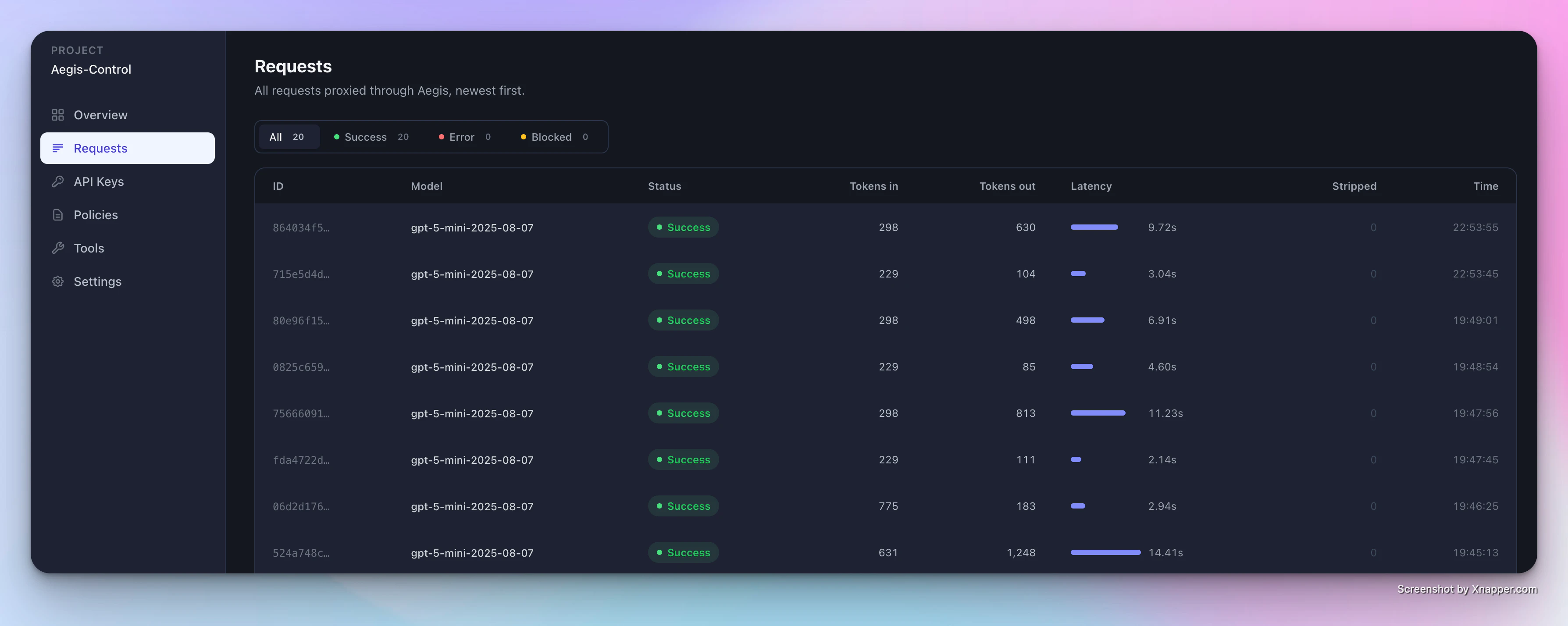
Policy enforcement for LLM tool calls.
Apr 2026 · aegis-control-io.github.io · its alternatives →
- 21

- 22
 AEGIS▲4
Self-hosted AI agents that interrupt you less
Jul 2026 · hikmahtechnologies.com · its alternatives →
- 23

Introducing Braintrust's latest feature: an AI proxy that lets you use open source models like LLaMa 2 and Mistral, as well as all of OpenAI's and Anthropic's models, behind a single interface with caching, security, and API key management built in.
2023 · braintrustdata.com · its alternatives →
- 24
 Aegis▲3
A Human-in-the-Loop, AI-driven bouncer for Linux servers
Feb 2026 · yogeshfire31.gumroad.com · its alternatives →
Also compare
Ranked by how close each launch is in meaning, then by votes. Prices were read from each product’s own site when checked and can change. Refine with your own description →