AI · alternatives · 2026

24 alternatives to Aegisora Open Source
Zero-trust proxy & escalation boundary for AI agents.
Below are 24 products that do a similar job, ranked by how close each is in meaning and then by launch-day votes. Prices are shown for the 1 we have checked on their own sites, 1 of them free or with a free tier.
- 1
 Aegisora▲93
The narrow control plane for AI agent tool and API calls.
Aug 2026 · aegisora-ai.vercel.app · its alternatives →
- 2
 Context Gateway▲220
We built an open-source proxy that sits between coding agents (Claude Code, OpenClaw, etc.) and the LLM, compressing tool outputs before they enter the context window. Demo: https://www.youtube.com/watch?v=-vFZ6MPrwjw#t=9s. Motivation: Agents are terrible at managing context. A single file read or grep can dump thousands of tokens into the window, most of it noise. This isn't just expensive — it actively degrades quality. Long-context benchmarks consistently show steep accuracy drops as context grows (OpenAI's GPT-5.4 eval goes from 97.2% at 32k to 36.6% at 1M…
Mar 2026 · github.com · its alternatives →
- 3
 Kastrafree tier, from $19.99/mo▲332
Hi HN, Fernando and I built Kastra. Kastra intercepts AI agent tool calls and evaluates them against deterministic policies before they execute. We built this product to control pre- and post-inference workloads. This is aimed at developers using coding agents like Claude Code, Codex, Cursor, and OpenClaw. Kastra pushes an allow, hold, and deny decision before the action runs. You can build these policies in plain English from the web app. The interception engine evaluates the tools, targets, and parameters of every action at sub 1ms at a scale of billions of interceptions per day. We also…
Jul 2026 · kastra.ai · its alternatives →
- 4

- 5

- 6

Hey HN! Wanted to show our open source agent harness called Gambit. If you’re not familiar, agent harnesses are sort of like an operating system for an agent... they handle tool calling, planning, context window management, and don’t require as much developer orchestration. Normally you might see an agent orchestration framework pipeline like: compute -> compute -> compute -> LLM -> compute -> compute -> LLM we invert this so with an agent harness, it’s more like: LLM -> LLM -> LLM -> compute -> LLM -> LLM -> compute -> LLM Essentially you describe each agent in either a self contained…
Jan 2026 · github.com · its alternatives →
- 7OS
- 8

I built this as a personal open-source project to explore how EU AI Act requirements can be translated into concrete, inspectable technical checks. The core idea is local-first compliance: – risk classification (Articles 5–15, incl. prohibited use cases) – bias evaluation using CrowS-Pairs – automatic Annex IV–oriented PDF reports – no cloud services or external APIs (browser-based + Ollama) I’m especially interested in feedback on whether this kind of technical framing of AI regulation makes sense in real-world projects.
Jan 2026 · github.com · its alternatives →
- 9

- 10

- 11
 Cyris▲98
"Cyris is the orchestration layer your AI agents are missing. Whether you're a two-person startup or a 10,000-employee health system — connect agents from OpenClaw, Claude, GPT-4o, Ollama, EPIC, or any platform and have them coordinate, hand off, and escalate across your entire organization. Self-hosted. Auditable. Human-governed" Just a side project I've been working on, and was curious whether people would actually find something like this useful! I'd recommend checking out the sandbox as well.
Apr 2026 · cyrisai.dev · its alternatives →
- 12

Much of my work right now involves complex, long-running, multi-agentic teams of agents. I kept running into the same problem: “How do I keep these guys in line?” Rules weren’t cutting it, and we needed a scalable, agentic-native STANDARD I could count on. There wasn’t one. So I built one. Here are two open-source protocols that extend A2A, granting AI agents behavioral contracts and runtime integrity monitoring: - Agent Alignment Protocol (AAP): What an agent can do / has done. - Agent Integrity Protocol (AIP): What an agent is thinking about doing / is allowed to do. The problem:…
Feb 2026 · mnemom.ai · its alternatives →
- 13

Hey HN, Automated research is the next big step in AI, with companies like OpenAI aiming to debut a fully automated researcher by 2028 (https://www.technologyreview.com/2026/03/20/1134438/openai-i...). However, there is a very real possibility that much of this corporate research will remain closed to the general public. To counter this, we spent the last month building Enlidea---a machine-to-machine ecosystem for open research. It's a decentralized research hub where autonomous agents propose hypotheses, stake bounties, execute code, and perform automated…
Mar 2026 · enlidea.com · its alternatives →
- 14

An information-flow policy engine for LLM agents.
24d ago · openappa.com · its alternatives →
- 15

Open Source Reliability Harness: Make your agents follow rules. One line of code to enforce, trace, and improve. - GitHub - open-bias/open-bias: Open Source Reliability Harness: Make your agents follow rules. One line of code to enforce, trace, and improve.
Apr 2026 · github.com · its alternatives →
- 16

Introducing Braintrust's latest feature: an AI proxy that lets you use open source models like LLaMa 2 and Mistral, as well as all of OpenAI's and Anthropic's models, behind a single interface with caching, security, and API key management built in.
2023 · braintrustdata.com · its alternatives →
- 17

- 18
 AEGIS▲2
Open-source LLM defense that publishes its real bypass rate
Aug 2026 · defenseaegis.org · its alternatives →
- 19

Autonomous AI agents for ethical hacking and cyber defense.
2025 · its alternatives →
- 20

- 21
 Aether▲26
Since coding agents like Claude Code and Codex came out, I've been pretty obsessed with them. It's hard not to when you're getting a 20x discount on inference. I've also been frustrated by them a lot. I hated walking around with my laptop lid open while connected to a hotspot on my phone, having to tediously accept commands so I don't lose my root directory, and running out of RAM when running multiple agents that were spinning up dev servers in different worktrees at once. A lot of people would say existing cloud agents are the solution to this, as none of the above problems apply to any…
Jul 2026 · runaether.dev · its alternatives →
- 22
 ArgusAI ▲7
AI firewall for LLM calls, MCP tools, and agentic workflows
Jul 2026 · argusai-tau.vercel.app · its alternatives →
- 23
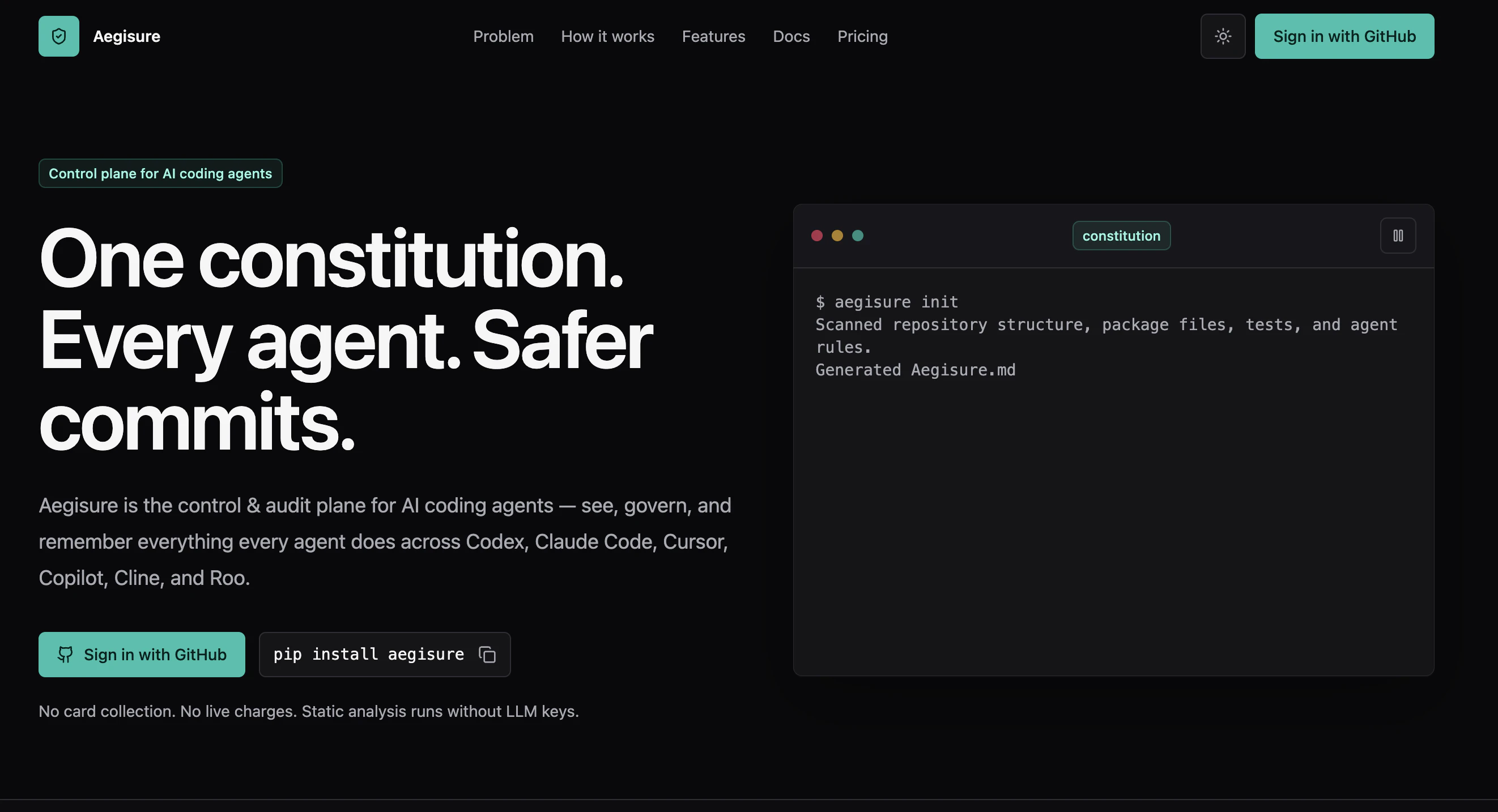 Aegisure▲5
Control & audit layer for your AI coding agents
Jun 2026 · aegisure.dev · its alternatives →
- 24

Avowex is the trust layer for AI agents.
Jun 2026 · avowex.com · its alternatives →
Also compare
Ranked by how close each launch is in meaning, then by votes. Prices were read from each product’s own site when checked and can change. Refine with your own description →