Alternatives
Products that do what ASTRO.PHYSICS // CHRONOS SYSTEM does
if time have age l think it will forever
- 1
- 2

- 3
- 4AOAtlas of Space▲770
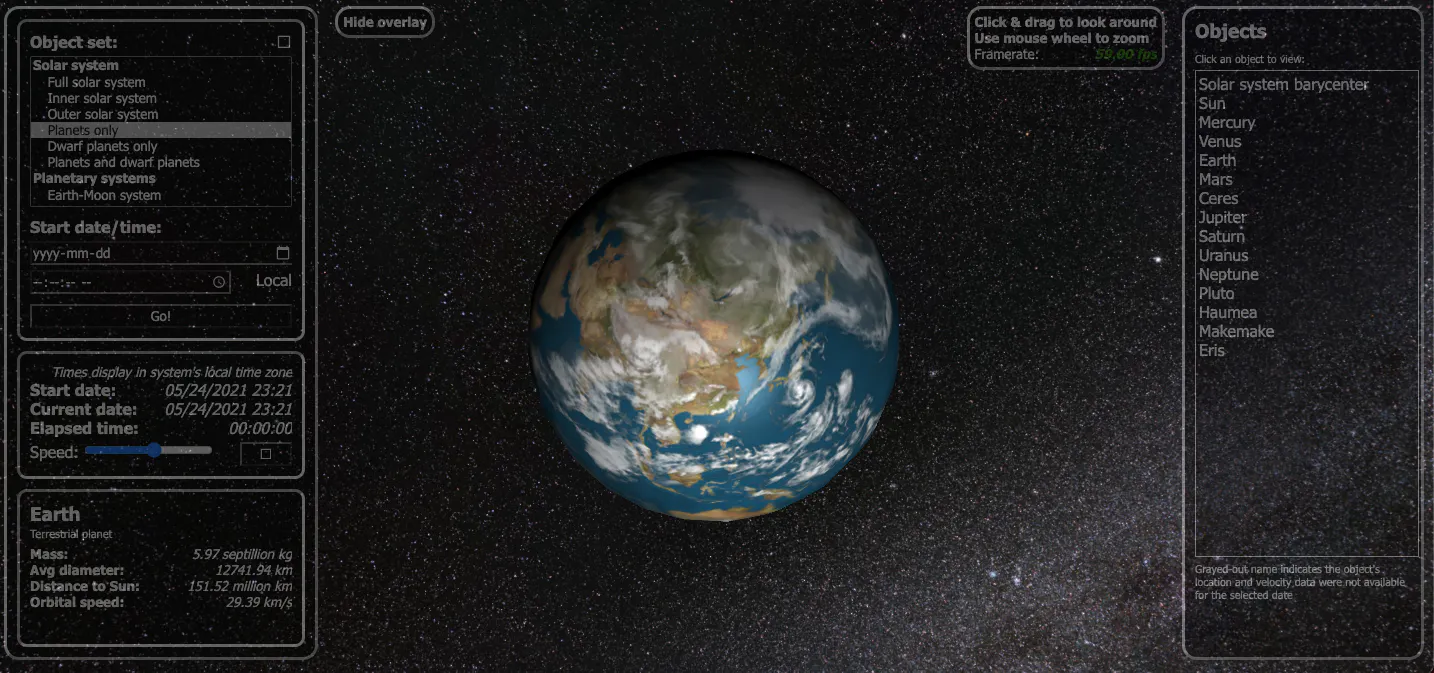
Hello HN! Sharing a recent side project of mine, the Atlas of Space, that I built out to explore the Solar System. As a long-time space nerd, I realized recently that I didn't have a good intuition on the scale, speed, and relative orientation of the celestial bodies around us. So over the break I built out a kind of spatial Wikipedia to click around and learn about planets, moons, asteroids, and other bodies orbiting the Sun. The physics is all simulated in the browser using simple Newtonian mechanics. There's a lot left to do from here, including modeling objects in non-Keplerian orbits…
2025 · atlasof.space
- 5P3
2020 · leeoniya.github.io
- 6PM
2018 · dinosaurpictures.org
- 7IB
I built Chronoscope, a project to explore the world through time. I've been wanting to do this for a while, after being inspired by Ollie Bye's "History of the World" video several years ago. I'm not the first person to have done this - resources like OpenHistoricalMaps are amazing. But, I noticed there were a few disparate datasets / academic databases online, so I combined them together as best as I could (I've linked all sources in the app). To make it more interesting, I also included: - Notable events from the time period (geolocated where possible), sourced from wikidata - Ancient…
Mar 2026 · shiphappens.xyz
- 8

- 9
- 10GA
A fork of Solar System Live that generates animated videos showing planetary orbits over any date range. Tracks orbital statistics (how many times Earth was lapped by Mercury/Venus, or lapped outer planets) and overlays dates/ages on each frame. Example: Einstein's lifetime (1879-1955) showing 76 years of solar system evolution. Built with Python + Pillow + ffmpeg, runs locally with Lighttpd. https://github.com/simondorfman/solar_system_live
Jan 2026 · github.com
- 11
Create beautiful historical timelines. BCE dates just work.
Feb 2026 · chronostimeline.com
- 12IB
I built this because measuring my age in years felt boring—I wanted to see the kilometers. The first version only used Earth's orbital speed (~30km/s), but the number moved too slowly. To get the "existential dread" feeling, I switched to using the Milky Way's velocity relative to the CMB (~600km/s). The math takes some liberties (using scalar sum instead of vector) to make the speed feel "fast," but it gets the point across. Under the hood, it's a single HTML file with zero dependencies. No React, no build step. The main challenge was the canvas starfield—I had to pre-allocate the…
Jan 2026 · cosmic-odometer.vercel.app
- 13

- 14

- 15

- 16
- 17
- 18GI
Just for fun and self education, I've built this over a weekend to teach myself why orbits exist, not just show planets going around. Something that was never clearly explain to me in school. It opens with a guided tour that builds the idea up step by step: two bodies and the equal/opposite force, inertia (the Sun is removed and Earth just drifts straight), then "an orbit is falling and continuously missing," cosmic velocities with a little rocket, Voyager 1 & 2's real gravity assists (the clock runs the actual 1977–1989 dates so the planets orbit into their grand-tour alignment and the…
Jun 2026 · qunabu.github.io
- 19CC
2020 · chronoflotimeline.com
- 20
- 21IT
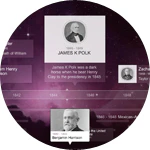
Make time make sense. Create and share beautiful interactive timelines from plain text. Also available as an Obsidian plugin. Developers can render Chronos timelines in their apps with chronos-timeline-md library on NPM
Oct 2025 · clairefro.github.io
- 22

- 23

- 24

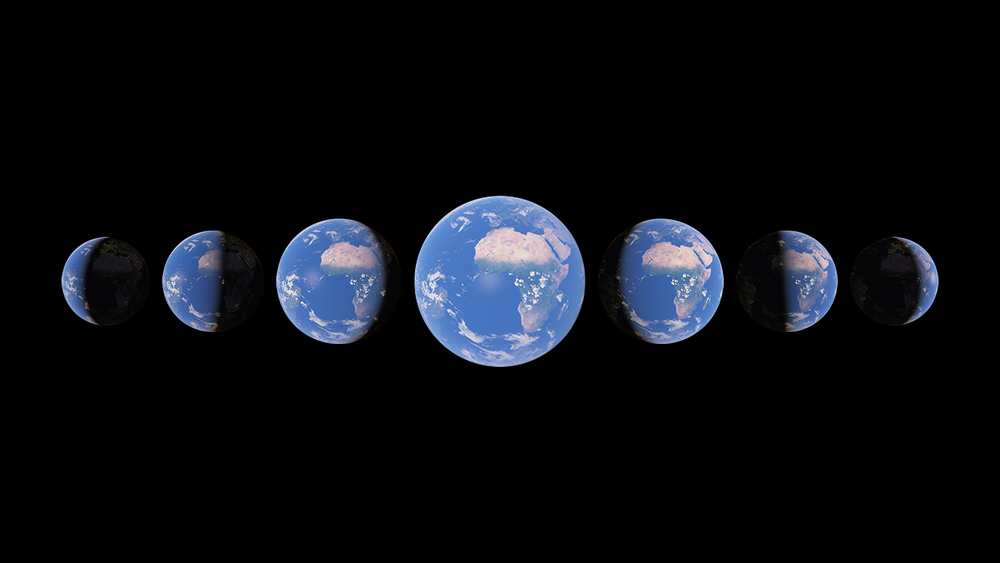
A rotatable Earth that drags today's countries and major cities through the Merdith 2021 plate reconstruction model, plus a simple future extrapolation. Continents keep their color families while the land follows plate motion from 1000 million years ago to 250 million years ahead.
29d ago · douwe.com
Ranked by how close each launch is in meaning, then by votes. Refine with a description →