
Today's cities on a globe of Earth's tectonic past and future
A rotatable Earth that drags today's countries and major cities through the Merdith 2021 plate reconstruction model, plus a simple future extrapolation. Continents keep their color families while the land follows plate motion from 1000 million years ago to 250 million years ahead.
Today's cities on a globe of Earth's tectonic past and future launched on August 9, 2026 with 37 votes, #644 of 23,274 launches that month and more than 95% of that year's launches.
In plain words
This interactive globe visualizes Earth's tectonic history and future by rotating today's countries and cities through 1 billion years of plate motion using the Merdith 2021 reconstruction model. Users can explore continental drift from the past through the present to a speculative 250 million years ahead, with land masses following realistic plate movements while maintaining their continental color groupings. The tool is designed for anyone curious about geology, Earth science, or how geography has transformed over deep time.
written from the facts on this page · September 2026
From the sources
Today's countries and cities are used as colored crust markers. Country polygons are split by the present-day static polygons from the Merdith 2021 plate model, then each country-on-plate fragment is reconstructed backward with pyGPlates finite rotations. The future side is a constant-motion extrapolation from young plate rotations with a few coarse collision handoffs, so treat it as an interactive sketch rather than a forecast. Red areas mark plate fragments that still overlap after reconstruction. Half Moon tonight. (At least it's better than no Moon atfrom douwe.com
Does a similar job
all alternatives → Plot modern addresses on Earth 240M years ago2018 · dinosaurpictures.org · ▲384
Earth looked very different long ago. Search for addresses across 750 million years of Earth
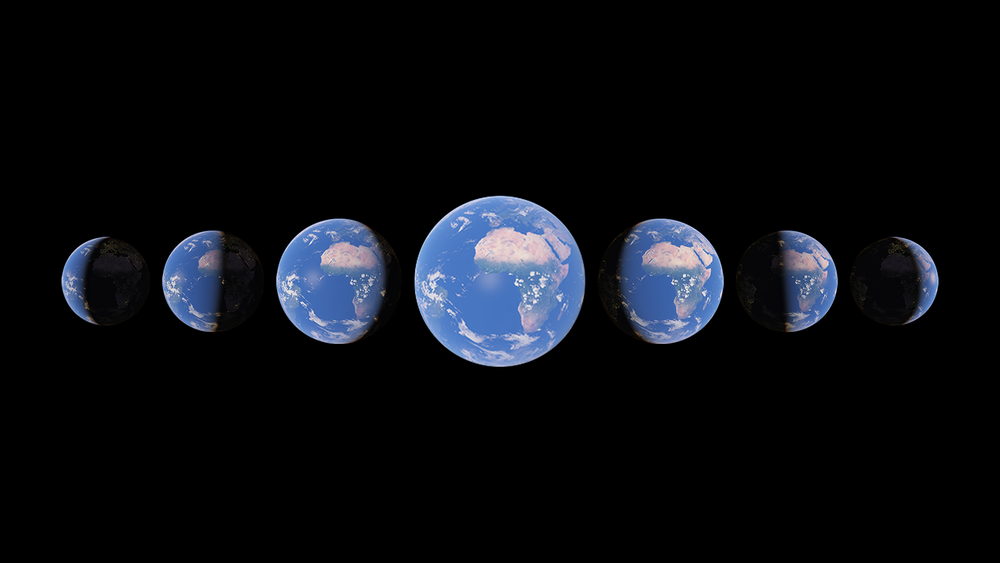 Timelapse in Google Earth2021 · earth.google.com · ▲325
Watch time unfold and witness 40 years of planetary change
 Globe of HistoryNov 2025 · globeofhistory.com · ▲189
I built Globe of History — an interactive 3D visualization of 6,000 years of human events, mapped onto the Earth’s surface. It includes 5,000+ data points covering wars, inventions, assassinations, natural disasters, and philosophers — spanning 4000 BCE → 2025 CE. The main goal was to build a visual entry point into history — not a database, but a way to instantly sense density and continuity over time. Stack / Process Python for scraping structured event data from Wikipedia/Wikidata Gemini 2.0 Flash for AI-based enrichment and multi-stage verification Mapbox GL JS + React (Vite)…
 Phersu Atlas2023 · phersu-atlas.com · ▲68
Interactive historical atlas - daily data and 4M statistics

- 4Y41 years sea surface temperature anomaliesApr 2026 · ssta.willhelps.org · ▲147
More life & fun this month
the category →
A free city-building game in your browser. You are the mayor. You know what the city needs. Now get it past the zoning board, the neighbors, the appeals court and the next election.
Life & fun · 3d ago · permit.petercai.com
- IV
Life & fun · 16d ago · tanzaniaeducationproject.org

Turn a phone, tablet or TV into a sign. Type a message and it fills the screen: welcome signs, timers, Wi-Fi passwords and more. No app, no account, free.
Life & fun · 16d ago · bigwords.page

Play a free virtual guitar online with your keyboard or by touch. Slow songs down and see every chord, string and strum. Acoustic, classic, electric and bass.
Life & fun · 10d ago · guitoro.com

Carrier settings from iPhone, Pixel and Galaxy firmware, decoded and compared: APNs, VoLTE, 5G and Wi-Fi Calling per carrier, and what each build changed.
Life & fun · 14d ago · carrierexplode.com

Life & fun · 24d ago · space.bl2.net
Source: Show HN post ↗
Launched alongside, August 2026
the whole month →- TL
Life & fun · Aug 2026 · louisabraham.github.io

 Clipto MCP▲655
Hey HN, We recently built Clipto. It’s a tool that lets you search over terabytes of video, audio, and images on your computer, without relying on the cloud. Motivation: we probably all had this similar experience, we know a moment exists in a video or audio, but finding it takes hours scrubbing the timeline. You can send all the media to process in the cloud, but it’s slow, expensive and raises privacy concerns. So we decided to build our own on-device media search engine. How it works (high level): 1. We ingest video, audio, image; normalize formats via ffmpeg; run content analysis to…
Work · Aug 2026 · clipto.com

Hello HN! I found that picking out plausible but diverse skin tones for my digital art and game development projects was kind of difficult, and I got curious about if there was a way to define a color space that made it easy. I've built a color picker and procedural generation algorithm based on the space as well as a bunch of other fun js features and demos throughout the page that use the equations. If you find it interesting, I have lots of explanations of how I built it and what properties the space has. The methodology might be a bit shaky, but hopefully the result is as helpful for…
Life & fun · Aug 2026 · toneyalexander.github.io

 Astute▲606
Automate your B2B brand going viral, with new media creators
AI · Aug 2026 · company-app.joinastute.com