Dev tools · alternatives · 2026

24 alternatives to Leet Robotics: Learn robotics and ROS2 with hands-on courses
Hi all, I've just launched Leet Robotics: a platform to learn robotics hands-on, with a full ROS2 workspace that runs in the browser (Jazzy, Gazebo Harmonic, Foxglove, VS Code) - no install required. The platform also has room for sharing projects and simulation assets as it grows. Our first course is live now: Intro to ROS2 (free to read). The course teaches skills ranging from building your first node to a capstone project of a robot touring a museum world, with every lesson runnable in the online workspace (free accounts get an hour of workspace time daily - enough to follow the course).…
Leet Robotics is a browser-based platform for learning robotics and ROS2 without installation. It provides a complete development environment including ROS2 Jazzy, Gazebo Harmonic, Foxglove, and VS Code accessible… Below are 24 products that do a similar job, ranked by how close each is in meaning and then by launch-day votes.
- 1

Hi HN! Proud to share our open-source robot platform, Dobb·E, a home robot system that needs just 5 minutes of human teaching to learn new tasks. We've already taken Dobb·E to 10 different homes in New York, taught it 100+ tasks, and we are just getting started! I would love to hear your thoughts about this. Here are some more details, below (or see a Twitter thread with attached media: https://twitter.com/i/status/1729515379892826211 or https://nitter.net/i/status/1729515379892826211): We engineered Dobb·E to maximize efficiency, safety, and…
2023 · dobb-e.com · its alternatives →
- 2OR
Hi all, excited to share our latest work, OK-Robot, which is an open and modular framework to perform navigation and manipulation with a robot assistant in practically any homes without having to teach the robot anything new! You can simply unbox the target robot, install OK-Robot, give it a "scan" (think a 60 second iPhone video), and start asking the robot to move arbitrary things from A to B. We already tested it out in 10 home environments in New York city, and one environment each in Pittsburgh and Fremont. We based everything off of the current best machine learning models, and so…
2024 · ok-robot.github.io · its alternatives →
- 3

Cloud logging + visualization tools for robotic development
2020 · its alternatives →
- 4

- 5
 OLO Robotics▲119
Control robots in your browser — no setup needed
Jun 2026 · olo-robotics.com · its alternatives →
- 6MP
Hey, we’re Axel and Vignesh, cofounders of Innate (https://www.innate.bot/). We just launched MARS, a general-purpose robot with an open onboard agentic OS built on top of ROS2. Overview: https://youtu.be/GEOMYDXv6pE Control demo: https://youtu.be/_Cw5fGa8i3s Videos of autonomous use-cases: https://docs.innate.bot/welcome/mars-example-use-cases Quickstart: https://docs.innate.bot/welcome/mars-quick-start. Our last thread: https://news.ycombinator.com/item?id=42451707 When we started we felt…
2025 · its alternatives →
- 7

LeetCode for PyTorch — 65 ML/AI interview problems from real interviews at Google, Meta, Anthropic. Jupyter notebooks, an auto-grader, and an MCP AI tutor. - Exorust/TorchLeet
2025 · github.com · its alternatives →
- 8PT
We just released a very excited touch sensor that finally simplifies touch sensing for robotics. Our most exciting result: Learned visuotactile policies for precise tasks like inserting USBs and credit card swiping, that work out-of-the-box when you replace skins! To the best of our knowledge, this has never been shown before with any existing tactile sensor. Why is this important? For the first time, you could now collect data and train models on one sensor and expect them to generalize to new copies of the sensor -- opening the door to the kind of large foundation models that have…
2024 · any-skin.github.io · its alternatives →
- 9
 V-JEPA 2▲198
Meta's world model for physical world understanding
2025 · ai.meta.com · its alternatives →
- 10
 YourGPT 2.0▲215
Today we are launching YourGPT 2.0, an update focused on making support, sales, and operational workflows work together more smoothly in one system. This release improves how workflows are built, how the platform connects to external tools, and how context is maintained across long, multi-channel interactions. AI Studio now makes it much easier to create and refine workflows. You can describe the process you want in natural language and the system generates the full workflow for you. It can also help debug issues by showing what happened at each step and explaining where things went off…
Nov 2025 · yourgpt.ai · its alternatives →
- 11
 Drift▲243
AI agent to run robot simulations faster and reliably
Mar 2026 · godrift.ai · its alternatives →
- 12

Sowbot is an open-hardware agricultural robot designed to close the "prototype gap" that kills most agri-robotics startups and research projects — the 18+ months spent on drivers, networking, safety watchdogs, and UI before you can even start on the thing you actually care about. The hardware is built around a stackable 10×10cm compute module with two ARM Cortex-A55 SBCs — one for ROS 2 navigation/EKF localisation, one dedicated to vision/YOLO inference — connected via a single ethernet cable. Centimetre-level positioning via dual RTK GNSS, CAN bus for field comms, and real-time…
Feb 2026 · sowbot.co.uk · its alternatives →
- 13

Hi HN, I’m Ben, founder of K-Scale Labs (YC W24). Last year, I wanted to buy a humanoid robot that I could hack on, but the few options for sale were either too expensive, proprietary, or had a limited SDK. We set out to build an affordable humanoid robot using off-the-shelf components that can be built and shipped today, capable of running modern machine learning models, and make it completely open-source for developers like me. Today, we’re releasing our reinforcement learning library and sim2real pipeline for people who want to train policies for humanoid robots. If you have a computer,…
2025 · github.com · its alternatives →
- 14

Our new, free ros-tool capability makes it trivial to interact with ROS from the web. It provides a React API for subscribing and publish to topics and for placing service calls. It works with both ROS 1 and 2, and unlike rosbridge, it caches all data in the cloud, which means your UIs will work even when your robot is offline (just showing the latest data). Since all data is synced via the cloud, it is also much easier and more efficient to aggregate data from multiple robots, e.g., for showing your fleet on a map. Demo: https://www.youtube.com/watch?v=OgNdGvwYSiI
2024 · transitiverobotics.com · its alternatives →
- 15
- 16

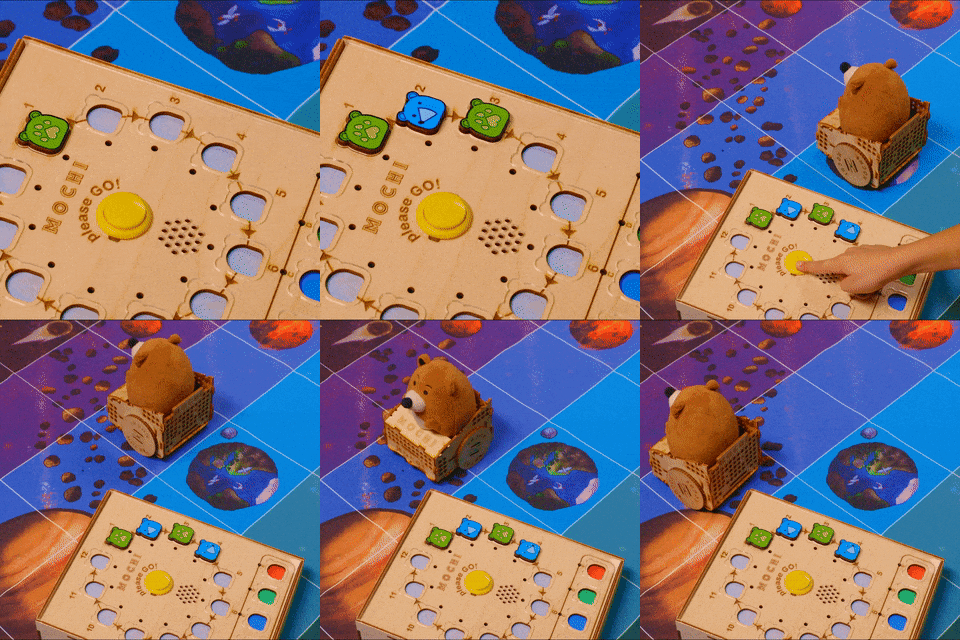
:robot: Introducing kids to coding with tiny virtual robots! - robotopia-x/robotopia
2017 · github.com · its alternatives →
- 17

We’ve open-sourced the Robot MCP Server, a tool that lets large language models (LLMs) talk directly to robots running ROS1 or ROS2. What it does - Connects any LLM to existing ROS robots via the Model Context Protocol (MCP) - Natural language → ROS topics, services, and actions (And the ability to read any of them back) - Works without changing robot source code Why it matters - Makes robots accessible from natural language interfaces - Opens the door to rapid prototyping of AI-robot applications - We are trying to create a common interface for safe AI ↔ robot communication This is too big…
2025 · github.com · its alternatives →
- 18
 GitGuessr▲98
I built this game as a playful way to train code reading skills. You're dropped into a random location in a real GitHub repo where some lines code are hidden. The goal is to pick up clues from the surrounding code and fill in the missing lines as quickly as possible. It currently has curated game content for Python, TypeScript, JavaScript (by most metrics the top 3 languages on GitHub). I had the idea when it dawned on me that reviewing and understanding code spat out by an LLM is a key skill for the AI era. (I sincerely hope you're critically reviewing what your favorite LLM is serving…
Feb 2026 · gitguessr.com · its alternatives →
- 19
- 20

- 21

Hey HN! Myself and my cofounder are excited to actually launch the product we've been working for the past six months. It's a robotics framework with a focus on testing and production. The current industry standard (ROS) is great for prototyping, but suffers from performance and testing problems as the robot gets more complex. I would have loved to work on this another six months or a year to polish it up and really, but I know it's better to launch a bit before you think you're ready. It's a C++ pub-sub framework (a lot like ROS, in that way), but rather than declaring C++…
2024 · github.com · its alternatives →
- 22

Henry, Matt and James here – we’re building an open source toolkit that makes it easy to integrate an LLM-powered copilot that talks to your API into software products. It works by calling API endpoints which you choose to expose to it. This lets the chatbot complete tasks within your software in response to natural language queries. It’s also open source, so you don’t have to send user data to another 3rd party. We support Llama 2, but we haven’t fine-tuned Llama 2 yet (coming soon) so highest accuracy is seen with GPT-4 or fine-tuned GPT-3.5 (much faster). We started working together 2…
2023 · github.com · its alternatives →
- 23
- 24

Agentic ROS 2 robotics dev in the browser
Feb 2026 · oorb.io · its alternatives →
Also compare
- Dobb·E – towards home robots with an open-source platform alternatives
- OK-Robot: open, modular home robot framework for pick-and-drop anywhere alternatives
- Link ROS - Cloud Logging+Viz for Robots alternatives
- JSRobot alternatives
- OLO Robotics alternatives
- MARS – Personal AI robot for builders (< $2k) alternatives
Ranked by how close each launch is in meaning, then by votes. Prices were read from each product’s own site when checked and can change. Refine with your own description →