Work · alternatives · 2026
24 alternatives to TheorIA – An Open Curated Physics Dataset (Equations,Explanations,JSON)
We’re building TheorIA— an open, high quality dataset of theoretical physics results: equations, derivations, definitions, and explanations — all in structured, machine- and human-readable JSON. Why? Physics is rich with beautiful, formal results — but most of them are trapped in PDFs, LaTeX, or lecture notes. That makes it hard to: - train symbolic/physics-aware ML models, - build derivation-checking tools, - or even just teach physics interactively. THEORIA fills that gap. Each entry includes: A result name (e.g., Lorentz transformations) Clean equations (AsciiMath) Straightforward…
Below are 24 products that do a similar job, ranked by how close each is in meaning and then by launch-day votes. Prices are shown for the 1 we have checked on their own sites, 1 of them free or with a free tier.
- 1

I was wondering how I can arrange objects along a spherical helix path, and read some articles on it. I ended up learning about parametric equations again, and make this visualization to document what I learned: https://visualrambling.space/moving-objects-in-3d/ feel free to visit and let me know what you think!
2025 · visualrambling.space · its alternatives →
- 2
 I built a synthesizer based on 3D physicsfree tier, from $99/mo▲512
I've been working on the Anukari 3D Physics Synthesizer for a little over two years now. It's one of the earliest virtual instruments to rely on the GPU for audio processing, which has been incredibly challenging and fun. In the end, predictably, the GUI for manipulating the 3D system actually ended up being a lot more work than the physics simulation. So far I am only selling it direct on my website, which seems to be working well. I hope to turn it into a sustainable business, and ideally I'd have enough revenue to hire folks to help with it. So far it's been 99% a solo project, with…
2025 · anukari.com · its alternatives →
- 3

Pure C# 3D real time physics simulation library, now with a higher version number. - bepu/bepuphysics2
2019 · github.com · its alternatives →
- 4

Interactive notes for algebra based physics with explorable explanations
2020 · landgreen.github.io · its alternatives →
- 5
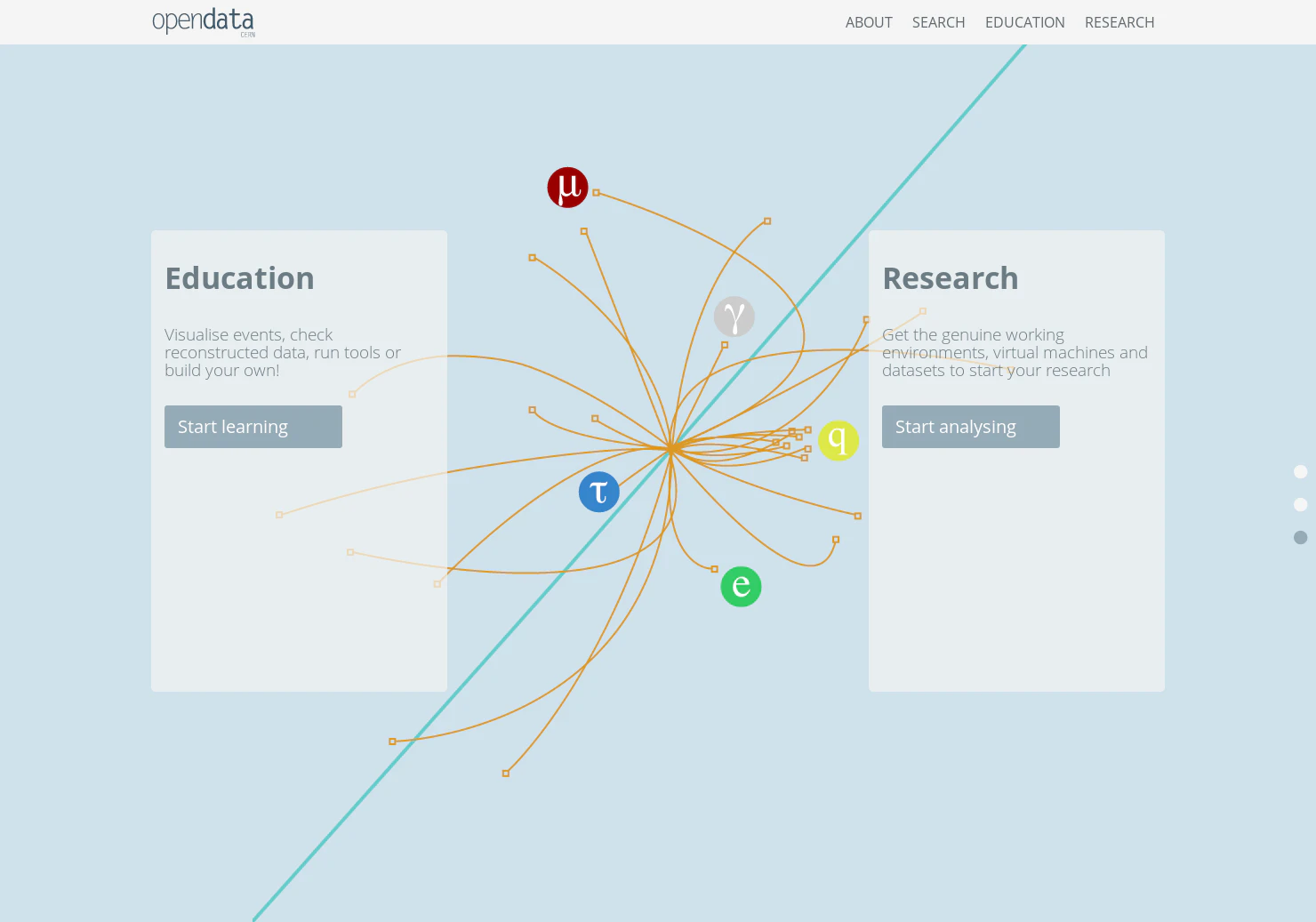
REAL data from the LHC + open source analysis tools
2014 · opendata.cern.ch · its alternatives →
- 6

This is a GPU "software" raytracer (i.e. using manual ray-scene intersections and not RTX) written using the WebGPU API that renders glTF scenes. It supports many materials, textures, material & normal mapping, and heavily relies on multiple importance sampling to speed up convergence.
2024 · github.com · its alternatives →
- 7IT
Experiments in expressing statistical thinking with interactive design
2015 · r2d3.us · its alternatives →
- 8

Visual explanations of Algorithms and Data structures
2020 · chrislaux.com · its alternatives →
- 9
 Odyssey 3▲159
A world model that simulates physics in real time
16d ago · odyssey.systems · its alternatives →
- 10

A container for dataclasses with multi-indexing and bulk operations. - joshlk/dataclassframe
2020 · github.com · its alternatives →
- 11

Ultra-fast and customizable Python charts. Contribute to reflex-dev/xy development by creating an account on GitHub.
Jul 2026 · github.com · its alternatives →
- 12OO
Hi! One of the creators here. Very proud to finally be able to show you what we've been working on for over a year now. Curious to hear your thoughts! Objectiv is open-source (APLv2) product analytics infrastructure. It's built around a generic but strict event taxonomy, open/common data- and infra tools (currently PG, snowplow, working on bigquery with more to come), and the analyses are done using our pandas-like, SQL speaking modeling library called Bach. As a result, we’re moving towards a vision wherein models can be shared openly, independent of product, platform[1] or data…
2022 · objectiv.io · its alternatives →
- 13

Lean and lucid descriptions of modern physics
2015 · amazon.com · its alternatives →
- 14

Hi everyone, I started working on nanoeuler after the ban of anthropic's fable because my ambition and dream is to work in the AI field in anthropic. The two interesting reasons that led me to create nanoeuler were (1) interfacing with llm does not mean understanding how they are composed and (2), working on llm with a very low-level layer to understand the correlation between parameters and data and growth of the model and how the GPU works and how some layers can be optimized. So I started working on it with a research aspect by making nanoeuler grow more and more but doing one step after…
Jun 2026 · github.com · its alternatives →
- 15IB
Mar 2026 · structuredlabs.github.io · its alternatives →
- 16

Originally built as my master's thesis in 2008, Visual Lambda is a graphical environment where lambda terms are manipulated as draggable 2D structures ("Bubble Notation"), and beta-reduction is smoothly animated. I recently revived and cleaned up the project and published it as an interactive web version: https://bntre.github.io/visual-lambda/ GitHub repo: https://github.com/bntre/visual-lambda It also includes a small "Lambda Puzzles" challenge, where you try to extract a hidden free variable (a golden coin) by constructing the right term:…
Feb 2026 · github.com · its alternatives →
- 17

OP here. This is a geometric decoding of Chopin's Prelude No. 4. I built a 3D music midi visualizer ( https://github.com/jimishol/cholidean-harmony-structure ) and realized that standard music theory couldn't explain the shapes I was seeing. So, I developed the Umbilic-Surface Grammar to map the topology of the harmony. This document demonstrates that the prelude's tension isn't random, but a rigorous conflict between 'Gravity' (Station Shifts) and 'Will' (Pivots). I am looking for feedback on the logic—specifically from anyone with a background in topology or music…
Feb 2026 · github.com · its alternatives →
- 18TW
Web-based quantum physics visualizer for wavefunctions and the Schrödinger Equation
2016 · ridiculousfish.com · its alternatives →
- 19

Physics, if you already knew physics. Open source Physics book Obsidian vault. - meltyness/kg-uniphy
2022 · github.com · its alternatives →
- 20IM
Just a fun toy I wanted to make. I've been studying and playing around with language models lately and have always been intrigued by how words are processed by these models. Since the vectors generated by embedding models is in very high dimensional space, I thought it would be cool to reduce them to 3D vectors and visualise them myself. This is what I have so far!
2023 · seesaurus.com · its alternatives →
- 21

A visual introduction to probability and statistics 📊
2017 · students.brown.edu · its alternatives →
- 22AI
2017 · trie.now.sh · its alternatives →
- 23AT
Hey HN! Erik here from banana.dev We’ve trained a small(ish) language model on structured extraction, and today we’re launching a playground for it at https://anythingtojson.com. Give it a try! This model continues our work on structured generation, following last week’s launch of Fructose[1], a python client for strongly-typed LLM responses. There seem to be two distinct halves of the problem intended to be solved by Fructose and structured generation: 1. the reasoning ability of the model, such as performing chain of thought, creative acts, and natural language tasks. In a way,…
2024 · anythingtojson.com · its alternatives →
- 24

Trim is building a foundation model for physics. We found almost all well-maintained transformer-based architectures are optimized for language models. We’re releasing our own open-source transformer package that is optimized for physics. It achieves a 90% reduction in memory usage and a 3.5x speedup in a standard Navier-Stokes dataset.
2025 · github.com · its alternatives →
Also compare
- I was curious about spherical helix, ended up making this visualization alternatives
- I built a synthesizer based on 3D physics alternatives
- BepuPhysics – 3D real-time physics simulation library in C# alternatives
- Simulation-based high school physics course notes alternatives
- OpenData by CERN alternatives
- I've made a Monte-Carlo raytracer for glTF scenes in WebGPU alternatives
Ranked by how close each launch is in meaning, then by votes. Prices were read from each product’s own site when checked and can change. Refine with your own description →