Life & fun · alternatives · 2026

24 alternatives to A tiny and platform-agnostic true random number generator for FPGA/ASIC
It is based on phase noise, consumes less than 60 LUT4s/FFs and achieves up to 7.99 bits of entropy per byte. Feel free to comment if you have any questions, ideas or thoughts :)
This is a true random number generator designed for FPGAs and ASICs that uses phase noise to produce random bits. It requires minimal hardware resources, consuming fewer than 60 LUT4s and flip-flops, while generating… Below are 24 products that do a similar job, ranked by how close each is in meaning and then by launch-day votes. A tiny and platform-agnostic true random number generator for FPGA/ASIC launched in 2023; newer entries below may have overtaken it.
- 1

🎲 A Tiny and Platform-Independent True Random Number Generator for any FPGA (and ASIC). - stnolting/neoTRNG
2021 · github.com · its alternatives →
- 2RA
2022 · joelkp.frama.io · its alternatives →
- 3AT
A 3.16M-parameter INT4 transformer running entirely in the on-chip memory of a Xilinx Kria KV260. Zero DRAM in the token loop, 59,965 tok/s on the fabric, bit-exact. Chat with it live.
Aug 2026 · mikeayles.com · its alternatives →
- 4

Pseudorandom generator written in Go using CPU context switch - maxamel/BitGenGo
2018 · github.com · its alternatives →
- 5VP
2016 · fpgasite.net · its alternatives →
- 6
 True Entropy▲11
Open-source true random number generator for iOS
2017 · apps.apple.com · its alternatives →
- 7SA
I built this machine so I could generate Bitcoin keys that I could trust. Air-gapped and simple to use and understand (mechanical). The Satoshi 9000 demo: https://youtu.be/bJiOia5PoGE The key value proposition of the machine is that it generates analog randomness in the physical world and converts it into digital (1’s and 0’s) randomness. Seamlessly. But it occurs to me that it may have other uses beyond crypto keys for your own use, such as: * Randomized clinical trials. Clinical trials need a high degree of transparency for ethical reasons; also, for legal reasons should it…
2024 · its alternatives →
- 8

filippo.io/mlkem768 is a pure-Go implementation of the post-quantum key exchange mechanism ML-KEM-768 optimized for correctness and readability.
2024 · words.filippo.io · its alternatives →
- 9

2017 · github.com · its alternatives →
- 10

LoopMix128 is a fast C PRNG I wrote for non-cryptographic tasks. GitHub (MIT): https://github.com/danielcota/LoopMix128 Highlights: * ~0.37 ns/value (GCC 11.4, -O3 -march=native), 98% faster than xoroshiro128++ and PCG64. * Passes TestU01 BigCrush & PractRand (32TB). * Guaranteed 2^128 period. * Proven injective (192-bit state) via Z3 SMT solver; allows parallel streams. * Core requires only stdint.h. Seeking feedback on design, use cases, or further testing.
2025 · github.com · its alternatives →
- 11

Morning HN. Random number generation feels is a somewhat underrepresented topic in the C++ realm. There is a lot of questionable info about it found online and even the standard library is quite behind the times in terms of it's algorithms. It suffers from trying to accommodate sometimes impractical standard requirements and has several ways of getting significantly bad statistical results. This leaves a lot easily achievable performance & quality on the table. So, being a mathematician who mostly works with stochastic models and wants these models to run fast and well, I embarked on a…
2025 · github.com · its alternatives →
- 12

:game_die: Generate "truly" random numbers (WARNING: NOT RANDOM!!! The "truly" is in sarcasquotes) - jaybosamiya/true-random
2016 · github.com · its alternatives →
- 13

Generate passwords from real-world chaos, not Math.random()
Jun 2026 · not-another-password-generator.vercel.app · its alternatives →
- 14

This is a little script I wrote a while ago to help generate sprites for a game I was working on. You can use it to build a seemingly-infinite aperiodic noise texture that is actually composed of a relatively small number of tiles. For example, imagine a large grassy field or body of water in a 2D pixel art game, but without the obvious repeated patterns that arise from simple tiling. The use case is pretty niche (for example, in many cases you could just evaluate the perlin noise function directly in a shader) but I thought it was a cool idea regardless.
2024 · github.com · its alternatives →
- 15

Simple and easy to use ad-free number generator
2021 · play.google.com · its alternatives →
- 16

The model uses a 1024-dimensional complex Hilbert space with 32 layers of programmable Mach–Zehnder meshes (Reck architecture) and derives token probabilities directly via the Born rule. Despite using only unitary operations and no attention mechanism, a 1024×32 model achieves coherent TinyStories generation after < 1.8 hours of training on a single consumer GPU. This is Part 1 - the next step is physical implementation with $50 of optics from AliExpress.
Nov 2025 · zenodo.org · its alternatives →
- 17

Bitwise operations and conversions to hexadecimals
2016 · flippybitandtheattackofthehexadecimalsfrombase16.com · its alternatives →
- 18DB
The only way to get a trust-less random value is to have it distributed and time-locked three ways, player, server and a future-entropy. In the demo above, the moment you commit (Roll-Dice) a commit with the hash of a player secret is sent to the server and the server accepts that and sends back the hash of its secret back and the "future" drand round number at which the randomness will resolve. The future used in the demo is 10 secs When the reveal happens (after drand's particular round) all the secrets are revealed and the random number is generated using…
Feb 2026 · blockrand.net · its alternatives →
- 19

A new programming language rooted in Pure Mathematics
2025 · leetarxiv.substack.com · its alternatives →
- 20

Haskell re-implementation of STOKE, the stochastic superoptimizer - blaze/notebooks/tutorial.ipynb at master · bollu/blaze
2019 · github.com · its alternatives →
- 21

An experimental pseudo-random number generator prediction concept. - yutarochan/PRNGPredict
2014 · github.com · its alternatives →
- 22
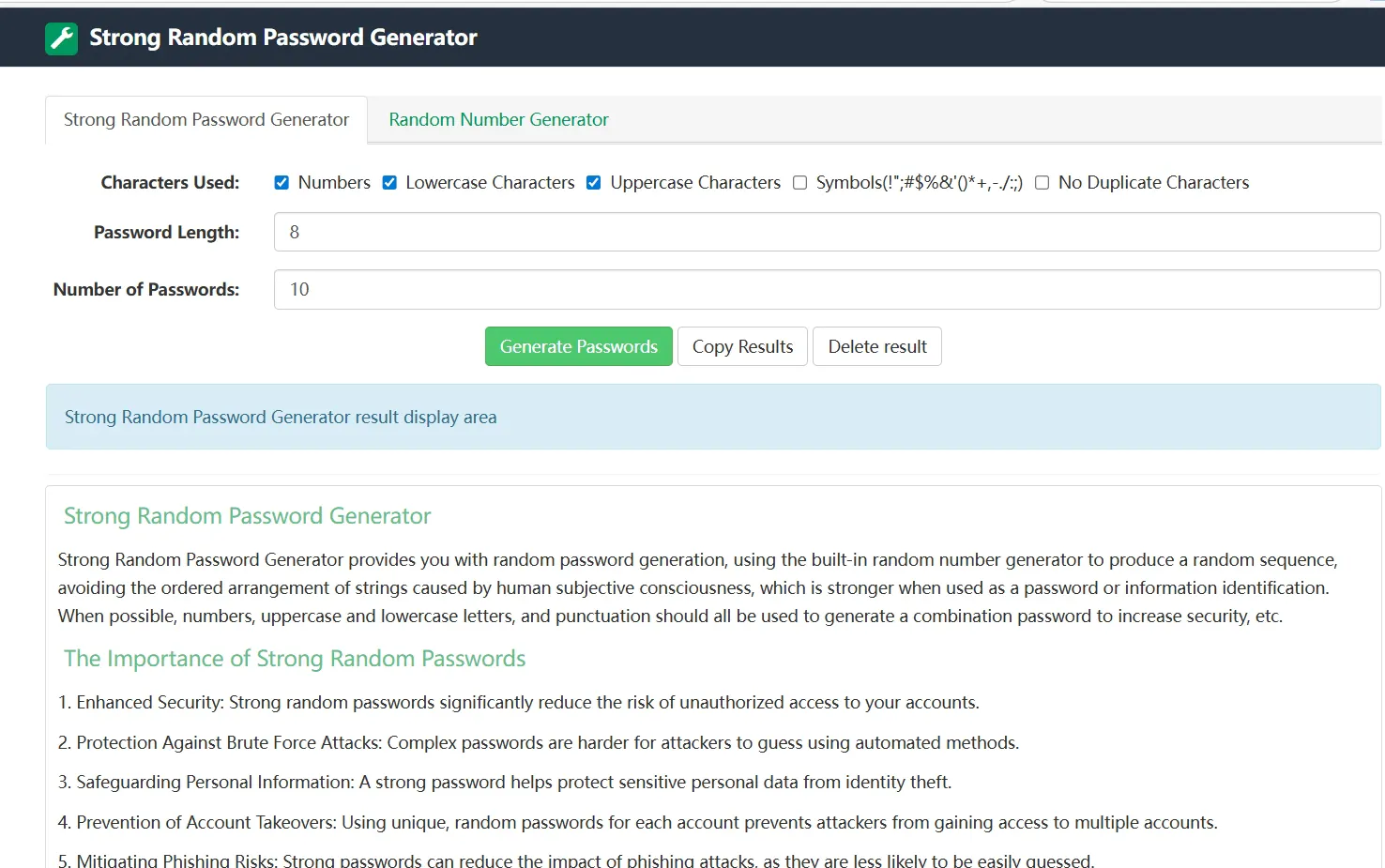
Combines numbers, letters
2025 · strongrandompassword.com · its alternatives →
- 23

Hey HN! I've created a quantum coin flip demo leveraging IBM's quantum computing tech to explore true randomness. It's a primer on into how quantum mechanics can solve classical computing's randomness limitations, crucial for cryptography and secure systems. Would love your thoughts on its application and quantum computing's future role in tech!
2024 · quantumcoinflip.com · its alternatives →
- 24

Using serverless functions to provide an API for checking potential passwords against an enormous corpus of passwords leaked from security breaches. - jthomas/serverless-pwned-passwords
2017 · github.com · its alternatives →
Also compare
- A Tiny and Platform-Agnostic True Random Number Generator for Any FPGA alternatives
- Random access noise – counter-based pseudo-random number generator alternatives
- A tiny LLM running at 21,000 tok/s on a $250 FPGA (Live Demo) alternatives
- Simple way to obtain pseudorandomness from CPU context switch in Go alternatives
- VHDL pseudo random generator tutorial (three parts) alternatives
- True Entropy alternatives
Ranked by how close each launch is in meaning, then by votes. Prices were read from each product’s own site when checked and can change. Refine with your own description →